Category: Notes from the Studio

Reading: Extreme You – Part 4: Break Yourself to Make Yourself

Image result

IN Part 1 I explored drive, In Part 2 I looked at standing out, in Part 3 I looked at specialization, and finally in Part 4 I am exploring starting over.

Or more accurately I am looking at Sarah Robb O’Hagan’s chapter Break Yourself to Make Yourself from her book Extreme You.

Essentially she talks about that point in time in your career where objectively speaking everything is going well, and will for the foreseeable future, but there is no growth. It is time to move on. It is time to try something different.

I think that this can be very relevant to an artist career. There is a lot of pressure, if you have managed against the odds to find something that works in the market place, to stick with it and continue putting out visually or conceptually similar work. The famous example of course is Philip Guston, who as a successful abstract painter during the height of modernist painting made a radical shift back to figuration. Below are examples of his later and earlier work. I highly recommend you see more of his work. Google it. Wikipedia it. Go forth. But for now, back to the post.
Image result for philip guston abstract paintingsImage result for philip guston abstract paintings

So, as I was this saying, this can be a challenge for an artist, because if you break out of what you are known for, well, people can’t seem knowledgable when they look at one of your paintings and can say without looking at the title, “oh thats a Bob Loblaw, I’d know his brushwork anywhere…” or whatever. And your gallerists are terrified that this new work won’t sell, because your established collectors “really like the emptiness of your lake scenes, they find the riotous colours and crowded compostions of the beach scenes to be claustrophobic’ blah blah blah.

Over time though, and from my own experience, every change circles back to a core centre of interest. The change was necessary to approach it from a different angle, a different understanding.

I have come under attack, well not attack, more just criticism, for having wildly disparate styles, sometimes abandoning  what others think I should be following.

I comfort myself with the knowledge that for each person who thinks I should go this way, someone else seems to think the other direction is more interesting!

So despite the pressure to develop my unique and recognizable style as an artist, and O’Hagans prior advice on playing your specialist game (part 3) she (and I) think it is important to maintain the right to explore different avenues, because each leads us to grow, rounds out our understanding of the world, and eventually converges with the other directions.

However, if anyone has a solution to problem of delivering the 30 second elevator pitch with so many irons in the fire,  I’d love to hear it.
Reading: Extreme You – Part 3: Play Your Specialist Game

Image result

In Part 1 I covered personal drive, and in Part 2 I covered my thoughts (and worries) about standing out. Today we will look at Sarah Robb O’Hagans perspective on playing your specialist game.

So, I do take a little issue with this. She talks quite a bit about knowing yourself and what you bring to the table better than anyone else, and sticking to that.

BUT

From my experience as a visual artist and a creative entrepreneur, sometimes you have to be flexible, open to new ideas, confident in your ability to learn and adapt quickly, and embrace being a generalist in order to find your path to making your living.

Amoung the many things I do or have done to retain my independence and keep my studio going: Art installations, picture framing, book keeping, art career consulting, show and event organizing, commissions, murals, web design, advertising and marketing, fundraising, art lessons to kids, seniors, adults and the disabled, workshops, arts writing (for news, journals and promotional materials), competitive and performance painting events, socially engaged art projects and public performance art, private painting parties, children’s art parties and art lessons in schools. Also, I have created and sold fine art greeting cards, participated in art fairs, commercial and artist run gallery systems, and explored different media from textile, painting and pottery to video! There is more, but after 20 years some experiences start to get a little foggy.

Where I agree with O’Hagan is in assessing these experiences after the fact and weeding out the ones that really don’t work for you, or fit with your specialist game. Even if that particular venture looks profitable, you have every right to assess whether it aligns with your strengths and temperament and let it go if you don’t see a future in it for you. Others may not understand or agree with your decision, but if you can make out a reasonable pro and con list for yourself, stick with your decision and shift your focus to the things that have greater potential for you.

Reading: Extreme You – Part 2: Get Out Of Line

Image result

In my last post I shared my take a way from Sarah Robb O’Hagan’s book on developing drive. You can read it here.

My next take away is on stepping out of line.

As part of my current 100 Rejections Project, I am sending out a lot of proposals, resumes and calls for submissions. If it were not for the aim of this project, to get over the paralyzing fear of rejection and do it as fast as possible by applying for everything I think I am capable of in the arts, I would not say that this is the best or most efficient method for me to find interesting new projects. Why? Because essentially what I am doing by responding to calls is standing in line, with everyone else who is also qualified and interested in this area. In that context, I am safe, ordinary, and definitely un-interesting.

My best opportunities have come when I stepped out of line. When I did not fill out an application, write a resume or get references. When I saw an opportunity, had an idea, and unsolicited, asked to talk to someone about it.

The problem with stepping out of line, is that it really is risky. In the arts  (a field known for individualism and boundary pushing), it can be a real challenge to step out of line without crossing the line. Consequences of crossing the line in such a social industry can mean no one will deal with you. Yet sometimes those lines can be murky, invisible, or even shift location.

If you must stand in line, there is a way to stand out. You know what the interviewer wants. I know you do. But if it isn’t you, don’t pretend it is! Stay true to yourself. Be honest with them. You may not get that part, but if you impress that person with the strength of your own gifts, they may have a better offer for you later. I have been to interviews where this was the case, and special positions or projects have been created just for me. If you do get the part, you know and they know what they will be getting.

However, knowing that my best opportunities come from stepping out of line, I can use that to quell my fears about the possibility of getting caught out of line. What could be the consequences? What is the likelihood of that? How can I recover if that happens? Is the benefit worth the risk?

A final bit of solace, in the words of Oscar Wilde:

The only thing worse than being talked about is not being talked about.


Reading: Part 1: Extreme You – Step Up. Stand Out. Kick Ass. Repeat.

Image result

Well 20 minutes of deleting spam and I can finally settle down to writing this blog post. Part 1 of a 4 part series inspired by Sarah Robb O’Hagan’s lively contribution to the swift kick in the butt genre of self-help literature.

Before I begin, I will let you know that this is not my main read of the summer, even if a four part series would suggest that. In my studies on the subject of money for my currency paintings I have read some great books including:

  • The Undercover Economist Strikes Back – Tim Harford
  • Money: The Unauthorized Biography – Felix Martin
  • Financial Fir$t Aid for Canadian Investors – Mike Graham
  • Money Rules – Gail Vaz-Oxlade
  • Smart Women Love Money – Alice Finn
  • Rich Dad series (4) –  Robert T. Kiyosaki

I haven’t formulated my thoughts on these ideas yet. I am just looking at the range of thinking at this point, but sooner or later I will revisit those of most interest. Art will emerge, and possibly some reviews as well.

So why, with all of this to choose from, am I doing a four part series on Sarah Robb O’Hagan’s book?

Well, because even though there is nothing particularly ground breaking in her book, some times we all need a good kick in the pants. We need a reminder of what our passions are, why we got into our particular game, and some encouragement to find new avenues to explore that game.

Each Post will cover my take aways from her book, or what I found spoke to me (you may find something else speaks to you), rather than being an official review:

  1. Ignite Your Magic Drive
  2. Get Out of Line
  3. Play Your Specialist Game
  4. Break Yourself To Make Yourself

So without further ado:

PART 1: Ignite Your Magic Drive


Of all the advice from this chapter, such as starting with a doable challenge and building your momentum up to reach the big goal, choosing your own challenges and doing what you love… for me the most inspiring piece of advice about developing drive had to do with the topic of support.

Support, of course, is the support you have from your family, friends, community and larger society in the accomplishment of your goals.

This is a topic that strikes home for me as a visual artist, because as an artist, who studied fine art at the post secondary level, and who continues to pursue a fine art career, I deal with a lot of “D” words from most of the people in my non-art world. Disbelief, Dubiousness, even Derision. Jokes about art majors serving french fries float freely about our culture, and the official statistics on incomes in the industry are not encouraging. At some family gatherings people avoid talking work with me, make snide comments about people who work vs. those who don’t (because they don’t understand the nature of my work it is easier for them to assume I don’t work I guess), or offer ‘helpful’ suggestions about employment (despite having no knowledge about my situation in the first place). Their assumptions and criticisms pain me and piss me off by turns.

Rather than becoming demoralized and giving in to a world view I believe is wrong (or wrong for me), O’Hagan advises using that pain and that anger as the flame to ‘ignite my magic drive’, pushing through obstacles to reach my goals.

So thank-you Sarah, I may even post the next ‘joke’ in my studio as a reminder of what is at stake as I continue to shake the trees for new and interesting opportunities and set new goals for myself.


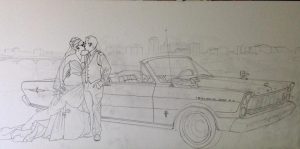
Process: Tom & Laura’s Wedding Portrait Painting

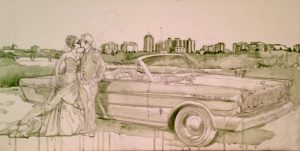
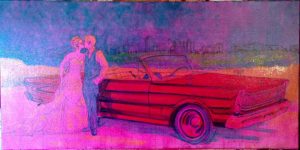
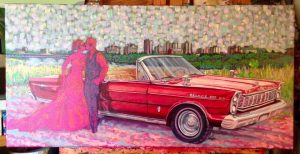
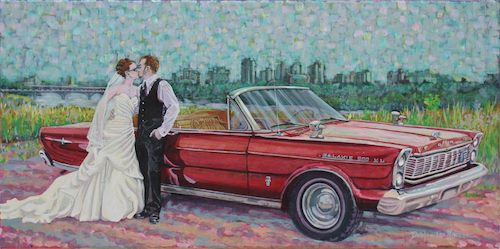
I thought it might be fun for you to see the stages of creating this modern fairytale portrait painting. I scheduled about a month, at two days per week, to work on this 16″ x 32″ acrylic painting on canvas. To learn more about commissioning a painting, click here. So without further ado:

Stage 1: Drawing using graphite and then Pitt artist pen.

Stage 2: Grisaille in Chromium Oxide Green.

Stage 3: Colour wash. Quinacridone Red, Pthalo Green and Green Gold.

Stage 4: Establish background buildings and sky.

Stage 5: Working on everything but negative space objects.

Stage 6 & 7: Work on the car.

Stage 8: Paint the figures and adjust the background to create proper recession and focus. DONE!

To see more of my portraits click here.

To learn more about commissioning a painting, click here.

Reading: PANTONE The 20th Century in Color

I picked up this book at my local library on the advice of a friend, and it is just a fantastic read, a must have reference for anyone interested in creating art evoking certain historical periods, or anyone interested in predicting future trends in colour preferences.

Essentially, Leatrice Eiseman and Keith Recker take the reader on a grand tour of 20th century western history exploring the influence of politics, social changes, science, art, design and fashion on colour preferences from decade to decade.

From the utilitarian and action oriented colours of war time decades, the soft neutrals of recessions and upbeat pastels of post war returns to stability and optimism, PANTONE seeks to not just show the what and how of colour preference, but also the why, in as much as they are able in the lushly illustrated overviews of the key movements within each decade.

Although I am not sure I would purchase the book outright, I will definitely keep it on my list for future reference. Usually if I check something out more than 3 times in a year I will consider buying it, because apparently I need to have it.

Here is a link to the PANTONE website: https://www.pantone.com/pantone-20th-century-color

Fear of Rejection – Lessons from Jia Jiang

I watched this (and highly recommend you do as well),

shortly after the new year, but it took me half a year to act on it. I realized that I was hanging too much of my dreams of future happiness on each application, proposal and submission I was sending out in to the world, and then disproportionally thrown off course by very rejection letter I got. So much so that I was finding every reason not to respond to this call or that, knowing how much time I would spend crafting each and how floored I would be if it was turned down.

Jiang’s talk convinced me I should be taking a more light hearted approach to the process, and I decided to make it my mission to collect 100 rejections per year. Rather than base my perception of success on how many of my submissions are approved, I will consider it a successful year if I have collected 100 rejections in that year.

What if one is approved, or more then one? Well, I suppose I will have to send out submissions until I have 100 rejections. Since I have had a slow start to this year, I now need to send out at least 4 per week for the rest of the year to reach my goal of 100 for a successful year.

What is your strategy for dealing with rejection?

Process: Paintings are grown, not executed.

I was posting some progress images of a wedding portrait I am currently working on to my Facebook page, One Life Fine Art (if you are on Facebook, make sure to like and follow me there), and it occurred to me suddenly that the person for whom I am making the painting could actually be terrified by what they were seeing!

The first phase was the line drawing, the second, a grisaille in chromium oxide green, and the third was the layer where I work out my major colour story (in this case a series of full strength washes of pthalo green, green gold and Quinacridone red/violet mix).

On top of that I will start to refine the forms and paint in details, balancing lights, darks and colour as I go along. To me this seems natural, but to someone who has never seen a painting grow from sketch to finish, they might have assumed the process was something like paint by numbers or colouring books, where each clearly delineated area has its individual colour mixed and applied from left to right, in one go.

I suppose some artists work like that, but my paintings are more like a living thing, layers upon layers built up from the back to the front of the painting (or canvas to picture plane), with each layer growing from the layer beneath.

The major difference is in how preplanned the painting is. Am I merely executing something which already exists fully realized in my head, or am I working with the idea to create something unique to itself?

Working left to right, filling in areas in a planned and orderly fashion is certainly efficient, but doesn’t allow me to take advantage of coincidence or discovery. Knowing that I can’t possibly anticipate every eventuality in the painting, I would rather give myself the opportunity to stop earlier than planned or change things to capitalize on coincidences as they appear. I couldn’t see these coincidences and happy accidents if I were focussing on the orderly filling of areas of colour instead of an organic approach to the image.

So, should you be out there watching my paintings take shape and feel you are on a bit of a rollercoaster ride in terms of progress, never fear, we will arrive safely. You will just have to have a little faith in the process and trust your pilot. In the mean time, sit back and enjoy the ride!

Reading: Art Visionaries by Mark Getlein & Annabel Howard

A good primer on some of the major artist’s of our times, and their ideas and innovations.

It is an easy read, with a democratic 3-4 pages dedicated to each artist, even ones with incredibly long and illustrious careers like Picasso. Each artist is covered with a portrait, a timeline, a page condensing key points about their biography, career and innovations, and 3 or 4 representative images of work.

I would recommend this book to beginners interested in getting a crash course in art since the beginning of the modernist period. However, even as an artist familiar with the western canon and art since the beginning of the modern period, I found fresh insights on the work of familiar artists.

One critique of this book would be that despite it’s recent publication (2016) the youngest artists profiled are Damien Hirst and Olafur Eliasson. Could it be that titles for Art Visionary have yet to be settled for the artists of Generation X and beyond?


SPAM!

Okay, I know I have been away since March 13th, and if you have posted a legit comment on a post since then, I am genuinely sorry that it will not be read or posted, however 2800 pieces of spam are a little much to expect someone to sift through in order to find the one nugget of authentic human contact in my inbox. I skimmed the posts as I marked them spam, but for the most part they were neither specific nor relevant to this blog.

So, if you would like to have your post actually read and responded to, PLEASE make sure that it is specific and relevant, and is very obviously so. There are so many generic spam posts that are clearly copy and pastes, saying how wonderful this site or post is,  or asking general questions related to the technical side of blogging… well you see what I am saying, praise is only meaningful if its authentic right?

Anyhow, I am still here, still checking in, and I do hope that one day I will be skimming my inbox and actually see a legit post from one of you out there. So lets talk!