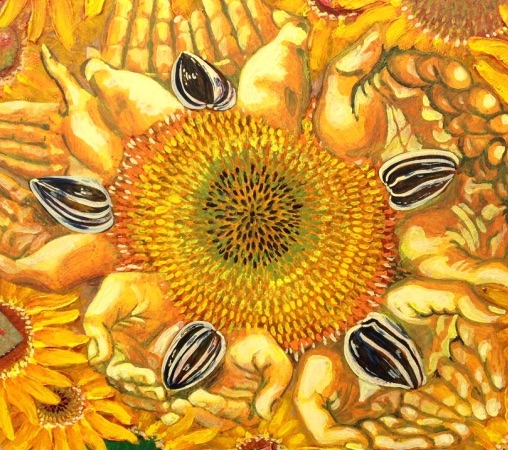
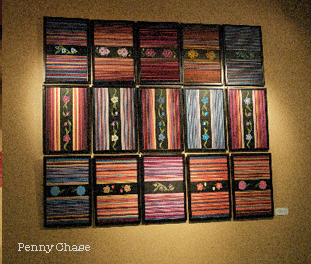
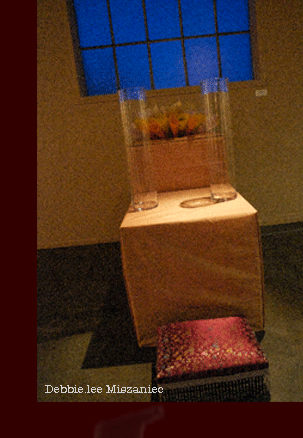
I am pleased to say that the Sunflower Project is growing yet again!
The wish 150 Alberta Mosaic Sunflower has been selected by the Multifaith Action Society for inclusion in their 2019 Multifaith Calendar. The 2019 theme is Coming Together: Exploring New Connections. As the aim of the sunflower project is to create bridges of good will and the growth of positive action, I felt that the Sunflower Project would be a great fit for the Multifaith Calendar. I am also honoured to be recognized and included as an artist of no faith (by choice), by the inclusion of my work in the calendar.
” Founded in 1972, the Multifaith Action Society (MAS) is a Canadian registered charity dedicated to the facilitation of interfaith education and dialogue. For over forty years, MAS has worked to build bridges between the myriad cultural and spiritual communities that characterize British Columbia, and has collaborated on a wide variety of public education campaigns and initiatives that have affected positive social change while raising awareness of multicultural issues.”
I believe that the effort to promote understanding between cultures and faiths is a good and worthy one. Therefore I am happy to have the Sunflower Project featured in a fundraising initiative which will be supported by individuals who also believe in affecting positive social change across cultures and faiths.
I will make sure to let you know when the calendars become available for purchase!
I am pleased to announce the selection of five of my pieces for inclusion in the 2018 Calgary Stampede Western Showcase Art Gallery. Find the art at the Western Oasis on the Calgary Stampede grounds where the paintings will be on view and available for sale. If you are scheduling your visit, stay tuned for announcements regarding my participation in Artist InSite, the Western Showcase Art Gallery program set up to allow visitors to meet the artists and see them in action. I will post details and relevant links as they become available.
Taking it Global, the group behind the Canada Wish 150 Mosaic Project, has asked me to share a funding opportunity for Canadians between ages 15 and 30 to initiate and implement community building projects, from gatherings to gardens and beyond. Funding levels for projects range from $250 – $1500. Visit Canada Service Corps to learn more!
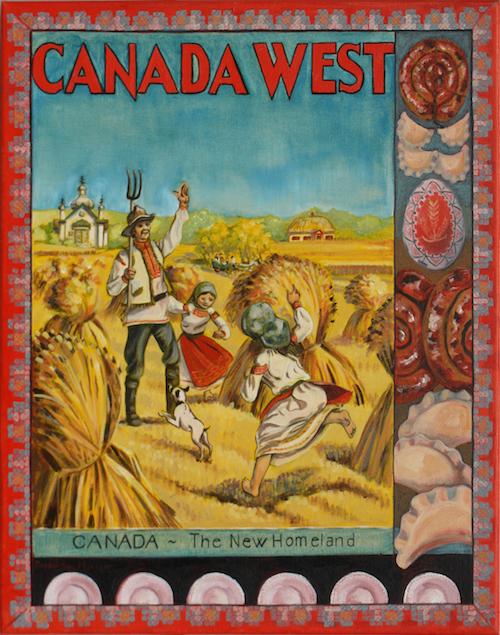
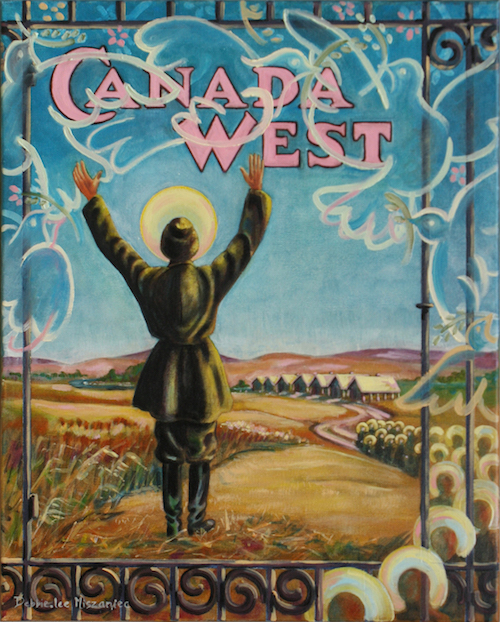
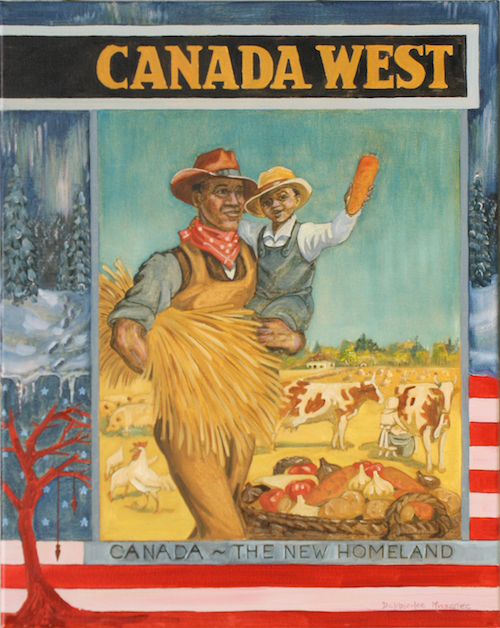
The Canada West series are a group of oil on canvas paintings created by artist Debbie.lee Miszaniec. The works revisit early 20th century Canadian advertising posters that were intended to encourage immigration to the Canadian West. Each painting interprets the source image through juxtaposition, modification, or both. Debbie.lee is a life-long painter, a student of art history, culture and society. Visit the Journey of a Lifetime exhibit and join the artist for a session of informal dialogue and gain insight into this colourful and insightful series of paintings.
This is a quick announcement to let you know that March 10th and 11th 2018 between 11 am and 2 pm I will be at Heritage Park’s Gasoline Alley giving mini artist talk/tours about my Canada West paintings and how they relate to their exhibition, Journey of a Lifetime. The talks are not posted to the website yet, but will be free with admission to the exhibition. Find out more about the exhibition here.
I am pleased to announce that the seven paintings in my Canada West series, which centre on themes relevant to immigration, will be on display in conjunction with the exhibit The Journey Of A Lifetime. The Exhibit is on display from January 23rd – April 22nd 2018 at Heritage Park Historical Village. It is built around the last surviving colonist railway car in Canada and is partially sponsored by BMO. I have included my Artist Statement relating to the Canada West series below:
ARTIST STATEMENT
To judge the past by it’s advertising literature, one would assume that immigrants to Canada were a fairly homogenous, and privileged, bunch. The Canada West series explore that assumption. The Canada West series are paintings revisiting early 20th century Canadian immigration posters that were intended to encourage immigration to the Canadian West. Each painting interprets the source image through juxtaposition, modification, or both. Through examining the cultural artefacts of Canada’s attitudes to, and experiences with, immigration from the early part of the last century, I encourage a long range view on the impact of contemporary immigration concerns on Canada’s future culture.
A Level Playing Field is based on an image circulated mainly in the United States of America, which I juxtaposed with a representation of a Monopoly board. It is an interesting coincidence that this image would have been in circulation at about the same time Monopoly was invented. Monopoly is essentially a real-estate game which was initially created to illustrate the danger of monopolies and the inevitable failure of capitalism to provide prosperity for all, in that although each player starts out at the same place with the same amount of money, through a combination of luck of the dice, attention, and shrewd development, one player triumphs above the rest, eventually owning all the property on the board and bankrupting all competitors. The homesteading program seems like a live play enactment of this game; Each homestead offered 160 acres of land at 0$ to a relatively wide base of potential homesteaders, on condition that they prove up the land within a specified time. It could be seen as a matter of luck, skill and hard work that one succeeded as a homesteader, as opposed to heredity, class and connections. Even the land, which in the original poster is depicted as flat gridded plots, looks like a board game. The idea that starting everyone out with 160 acres for 0$ could constitute a level playing field turns out to be an illusion, as not only were there restrictions on who could play the game (women and many ethnicities discouraged), often the deck was stacked against the homesteader in terms of practical experience, operating capital, access to resources and quality of land. However, the fact remains that, as in Monopoly, hundreds of thousands signed up to play the game under the Dominion Lands Act, and as in Monopoly, the majority of them lost the game.
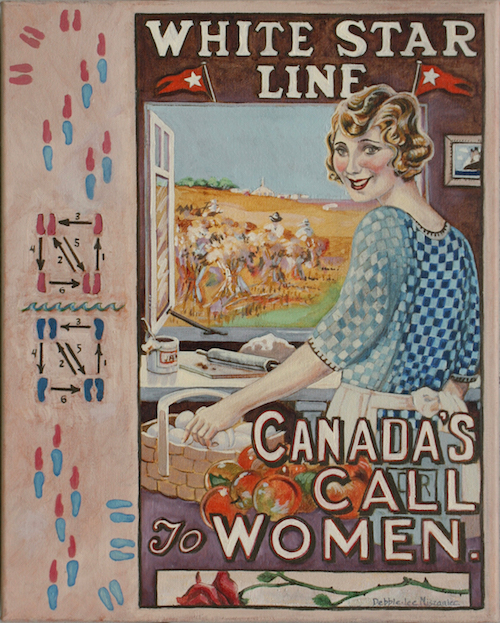
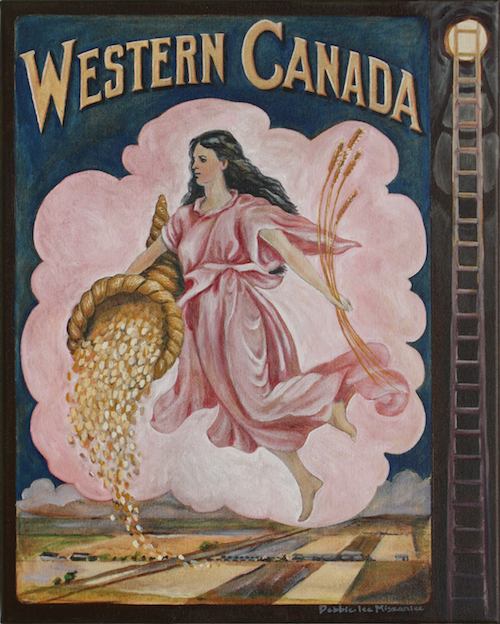
Salvation comments on the perception, versus the reality, of immigration to Canada by people escaping poverty, oppression and famine, who then faced the challenge of homesteading unbroken land. Although the PR machine for immigration to Canada overpromised the ease with which prosperity could be attained in the new homeland, the situation that the potential immigrant was in, in their native land, was often so bleak that the chance to homestead in Canada may have been like being trapped in a deep pit and suddenly being offered a ladder to a better life. However, being an immigrant homesteader often meant they found themselves in another deep pit of hardship they were unprepared for, requiring them to learn and adapt rapidly if they were going to realize the promise of the PR machine.Finding a Dance Partner is interested in the controversy of ‘Surplus Women” in Britain. A gender imbalance if favour of females led to concerns that women unable to marry would fall into poverty. At the same time, a majority of males immigrating to Canada had officials looking for women to immigrate as domestics, hopefully to start families, thus ‘civilizing’ the west. For the government, they appear to be staging a game of the bachelorette, inviting women to step up from overseas. For women, the message is to take a big chance in the name of love, by crossing an ocean to a metaphorical dance floor where it is more likely they will find a partner. I found this early open invitation to young single female immigrants amusing from the perspective of critics of immigration today who worry that women will find shortcuts to citizenship through marriage. One era saw it as desirable, and another sees it as cheating!
The New Homeland places the figure of the original poster in front of a floating field of the flags of some of the major immigrant groups of that time to western Canada, including (in no particular order) France, Romania, Belgium, China, Germany, the Netherlands, Poland, the Ukraine, Russia and Scandinavia. I am interested in the difference between the depicted characteristics of the original poster’s personification of a potential immigrant, and the actual range of ethnic backgrounds represented among immigrants of the time.
The Spirit Wrestlers engages the history of the Russian religious exiles, the Doukhobors, and their (at the time) radical beliefs of communal living, pacifism and vegetarianism, in Canada. There was a great deal of fear and opposition to their strange ways and refusal to give up their values in order to integrate and participate fully in Canadian society, particularly during some of the more extreme protests in the 1920’s which involved nude marches, and the burning of public and even their own properties in protest. I find it interesting that today we still struggle with concerns about how immigration from other religious and cultural groups will impact the culture of Canada as it currently stand. Yet if I look at the example of the Doukhobors in Canada, I can see how those values, though they stood apart then, have gradually woven themselves into our culture in a way which does not seem damaging, but rather enhancing our Canadian identity.
A Matter of Life and Death challenges the racial stereotype of the white settler through altering the ethnicity of the original image to speak about immigration by African Americans and Afro-Native Americans escaping discriminatory laws and race based violence in the United States of America. Although (or because) these settlers faced discouragement from immigration agents and extremely rigorous applications of the rules of admissions by immigrations officials due to the unofficial racism of the time, they proved generally to be some of the fittest, physically and economically, of the homesteaders who came to Canada. They tended to settle the more remote lands in a bid to ‘live in peace,’ as even among the maligned slavic ethnic groups, they were deemed suspect. It is a testament to the desperation of the situation they saw themselves in south of the border; that they were willing to face such resistance for the opportunity to raise their families in relative safety. This is still a relevant example to contemplate today as we think about individuals willing to risk frost-bite and hypothermia to make illegal border crossings from the US to Canada in order to apply for refugee status here.
Land of Fairytale Abundance challenges the cultural stereotype of the British colonial settler through altering the ethnicity of the original image to speak about immigration by Ukrainians to western Canada. It is also interested in the reasons for and cultural impact of Ukrainian immigration to Canada. Although the general perception of Slavic immigrants during Sifton era immigration policy was negative, their admission was favoured by government during Clifford Sifton’s tenure due to their skills as farmers and perceived ability to handle the harsh Canadian climate. Meanwhile, in their home countries they were often starved or starving due to political, ethnic and class suppression, as well as over-crowding. To take a big chance by leaving everything familiar behind just to have an opportunity to grow enough food to feed their families seemed like a Fairytale come true. This alone should have been enough to incur the sympathies and support of established Canadians, but the response to their impoverished and alien appearance was distaste and distrust. Often they became the unwarranted scapegoats for crime and violence. Although many were able to take advantage of bloc settlement allowances in Canada, they were encouraged to abandon their customs of food, dress, language and dance to integrate with British colonial culture. Yet today the impact on the culture of Canada can be seen across the country in dances, cuisine and architecture, and does not seem out of place or questionable at all to most contemporary Canadians, even to the point of being grouped with definitions of colonial culture in the west.
I am happy to announce that I will have three artworks in an upcoming group show, Mystical Magical Fantasy, at the Visual Arts Studio Association in St. Albert Alberta.
The show runs Tuesday October 3rd to Saturday October 28th 2017. Opening reception Thursday October 5th, 6-9pm. Visit the VASA website for address and other details as they become available.
Artist Statement:
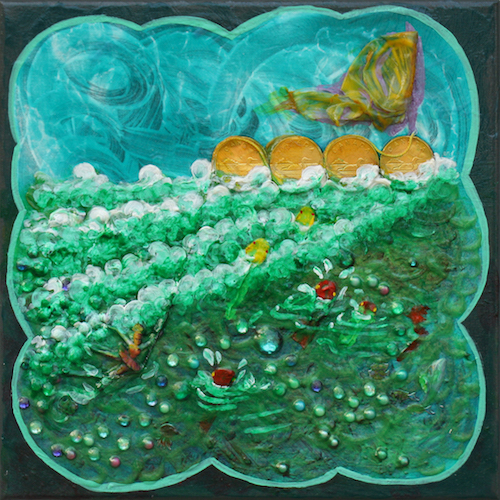
The Fun Money Series of paintings are part of an exploration of the cultural significance of money and the ways that we learn in childhood to think about money through fantasy, play, and story.
I incorporate coin shaped foil candy wrappers into the paintings to create fantasy worlds in which the main actors, represented by plastic figurines, interact with the coins in different ways.
Much like the foil wrappers themselves, the innocent, shiny prettiness of the paintings belie messages that are being delivered to the individuals consuming them. The wrappers are interesting devices that teach children about money, being attractive containers representing the potential for pleasurable experiences contained within.
Life Line 12 x 12 A/CCastle in the Sky 12 x 12 A/C
Fun Money: Castle in the Sky and Fun Money: Life Line represent the ways in which money can function, or be seen to function, in adult life, through enabling one to realize their fantasies, or to stay afloat while reaching for goals and building dreams.
Video Games, also, often use a coin based reward system to provide benefits to players which will help them complete their game successfully. The way coins are collected, as a reward for various actions, teach children that the getting of money is a matter of faith in the system as well as skill, persistence and effort. As they put their characters through obstacle courses that challenge their dexterity and problem solving skills in repeated attempts to capture all the coins, they learn that these are the ways they will be asked to function in a competitive adult world.
Leap of Faith 12 x 12 A/C
While Fun Money (Video Games): There’s Got To Be A Way (not pictured, not in the show, but click here to see more of the Fun Money series) explores the character’s faith in their ability to make seemingly impossible aerial acrobatics to collect all of the coins, Fun Money (Video Games): Leap of Faith looks at that moment where the character can see opportunity, but not the outcome of the leap to take advantage of the opportunity. Is the landing safe? We don’t know. The child playing the game learns faith in the system (that it can be done or it wouldn’t have been placed in such a way), but that faith may not necessarily be well placed in the real world.
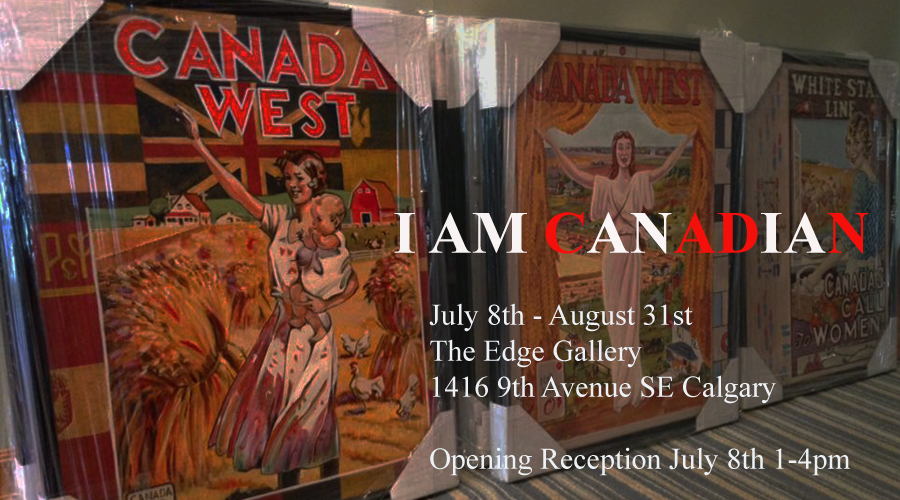
Hi All! It is the final week to see I am Canadian at the Edge Gallery in Calgary’s historic Inglewood neighbourhood. Make sure you check out all the fantastic work on display, and remember, it IS for sale! Gallery hours are 10 – 5:30 Tuesday through Friday and 10 – 5:00 on Saturdays.
Below I am posting my artist statement with images of the pieces in the show:
Finding a Dance Partner 16 x 20 O/CSalvation 16 x 20 O/CThe New Homeland 16 x 20 O/CA Level Playing Field 16 x 20 O/CSpirit Wrestlers 16 x 20 O/CLand of Fairytale Abundance 16 x 20 O/CA Matter of Life & Death 16 x 20 O/C
The Canada West series are paintings revisiting early 20th century Canadian immigration posters that were intended to encourage immigration to the Canadian West. Each painting interprets the source image through juxtaposition, modification, or both. Through examining the cultural artefacts of Canada’s attitudes to, and experiences with, immigration from the early part of the last century, I encourage a long range view on the impact of contemporary immigration concerns on Canada’s future culture.
The New Homeland places the figure of the original poster in front of a floating field of the flags of some of the major immigrant groups of that time to western Canada, including (in no particular order) France, Romania, Belgium, China, Germany, the Netherlands, Poland, the Ukraine, Russia and Scandinavia.
Salvation comments on the perception, versus the reality, of immigration to Canada by groups escaping poverty, oppression and famine, who then faced the challenge of homesteading unbroken land.
Finding a Dance Partner is interested in the controversy of ‘Surplus Women” in Britain. A gender imbalance if favour of females led to concerns that women unable to marry would fall into poverty. At the same time, a majority of males immigrating to Canada had officials looking for women to immigrate as domestics, hopefully to start families, thus ‘civilizing’ the west.
A Level Playing Field is based on a poster circulated in the United States of America, at about the time the board game Monopoly was invented.
The Spirit Wrestlers engages the history of the Russian religious exiles, the Doukhobors, and their (at the time) radical beliefs of communal living, pacifism and vegetarianism, in Canada.
A Matter of Life and Death challenges the racial stereotype of the white settler through altering the image to speak about immigration by Americans escaping discriminatory laws and race based violence in the United States of America.
Land of Fairytale Abundance is interested in the reasons for and cultural impact of Ukrainian immigration to Canada.
I have just added a new western art gallery to my website. Included in the gallery is the painting featured in my last post, and I will be talking about some of the others more in depth as we go along. The images are not super high quality yet, the captions are short, and the design does not line up with the other galleries either, but it is there. Adding it required changes to all of the other pages, and will also require further changes, but one could spend all week on updating and never get into the studio! The other side of my new years resolution is spending the afternoon in the studio, so what it is really about is achieving balance between office and studio so I am neither binging on one nor neglecting the other. So, even though it is super difficult to break focus and move to another task, that is it for website stuff today. This afternoon I will be working on a still life painting of fruitcake. In the mean time, take a quick peek at the new gallery, and check back in a week or so to see what has changed, I am sure you will enjoy!