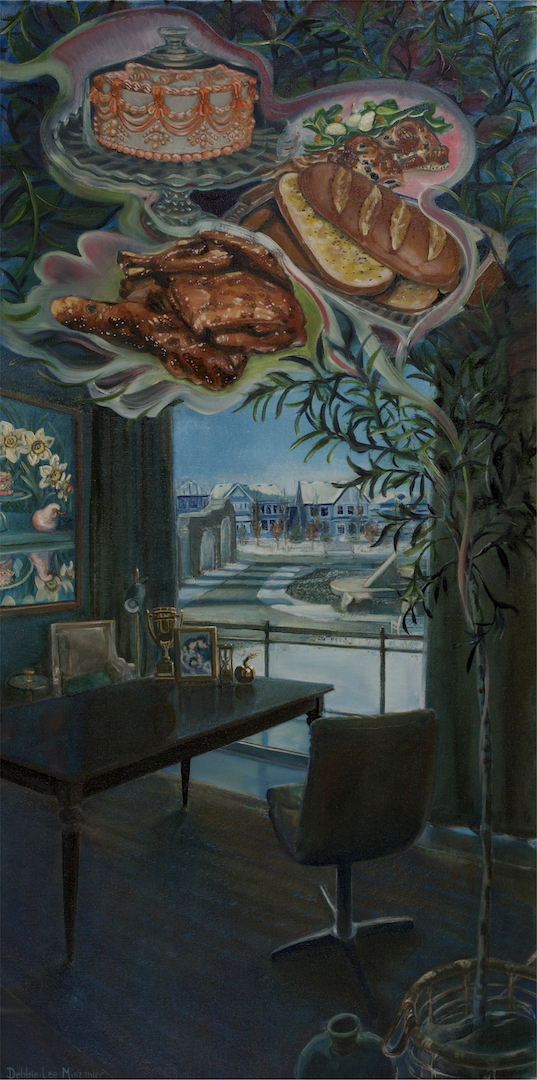
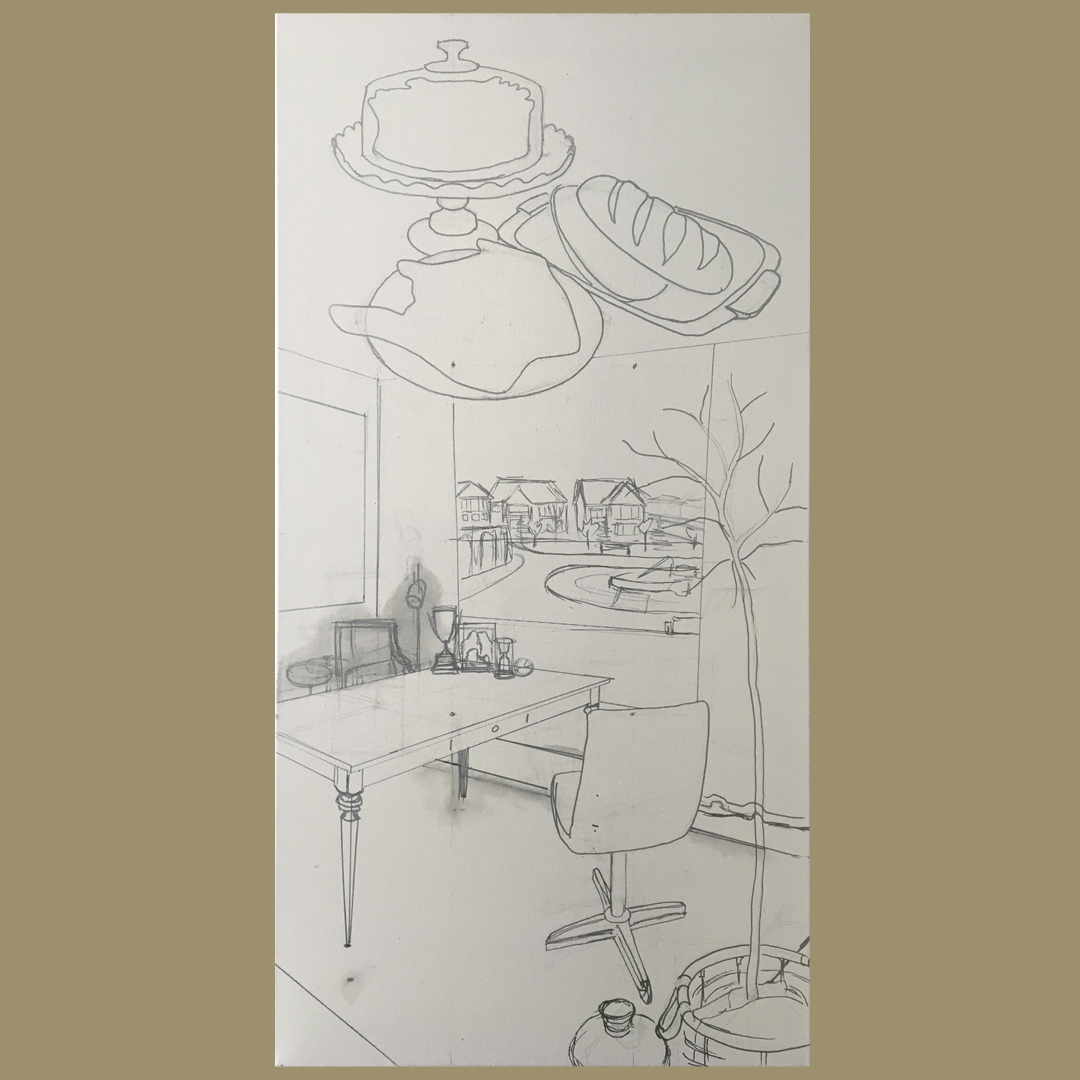
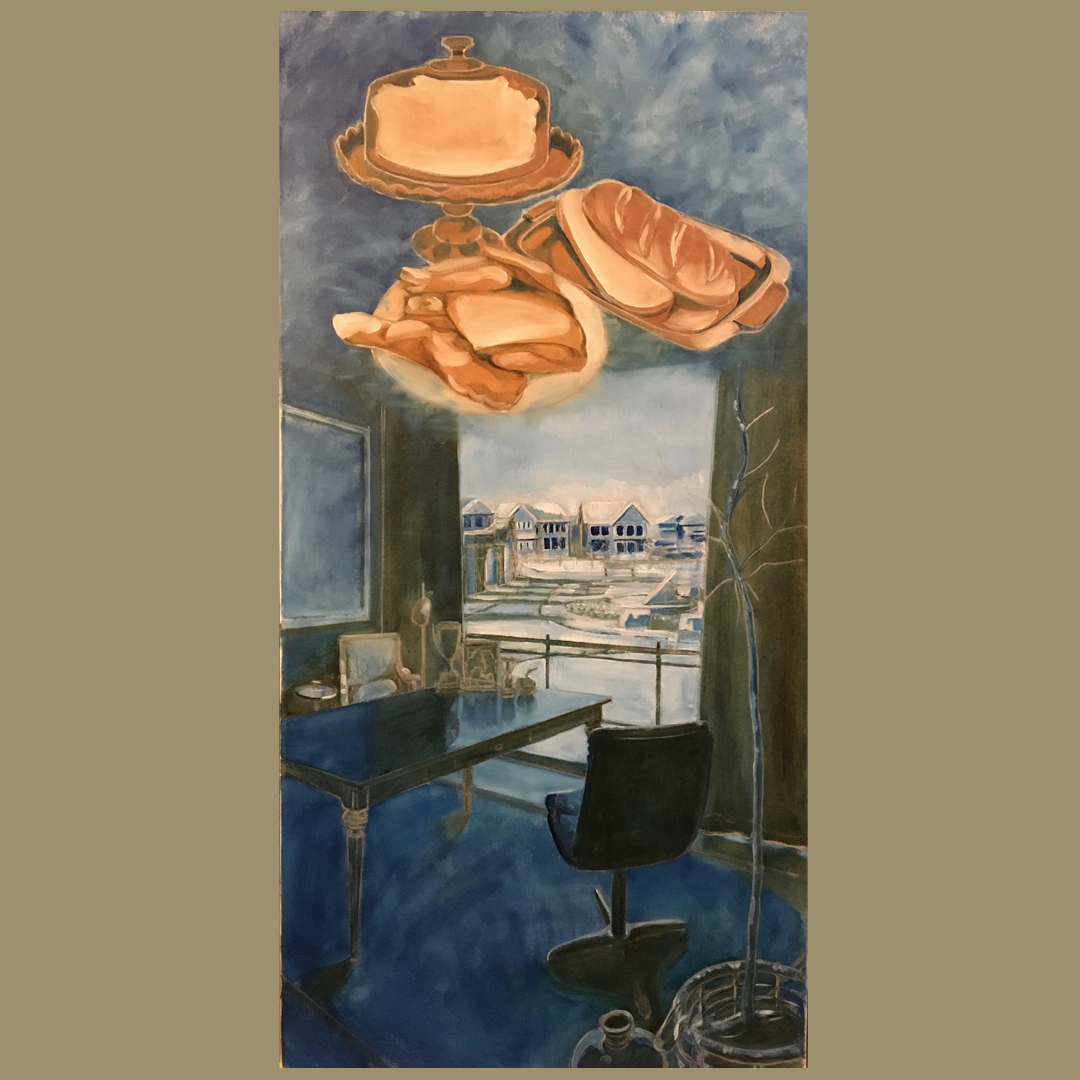
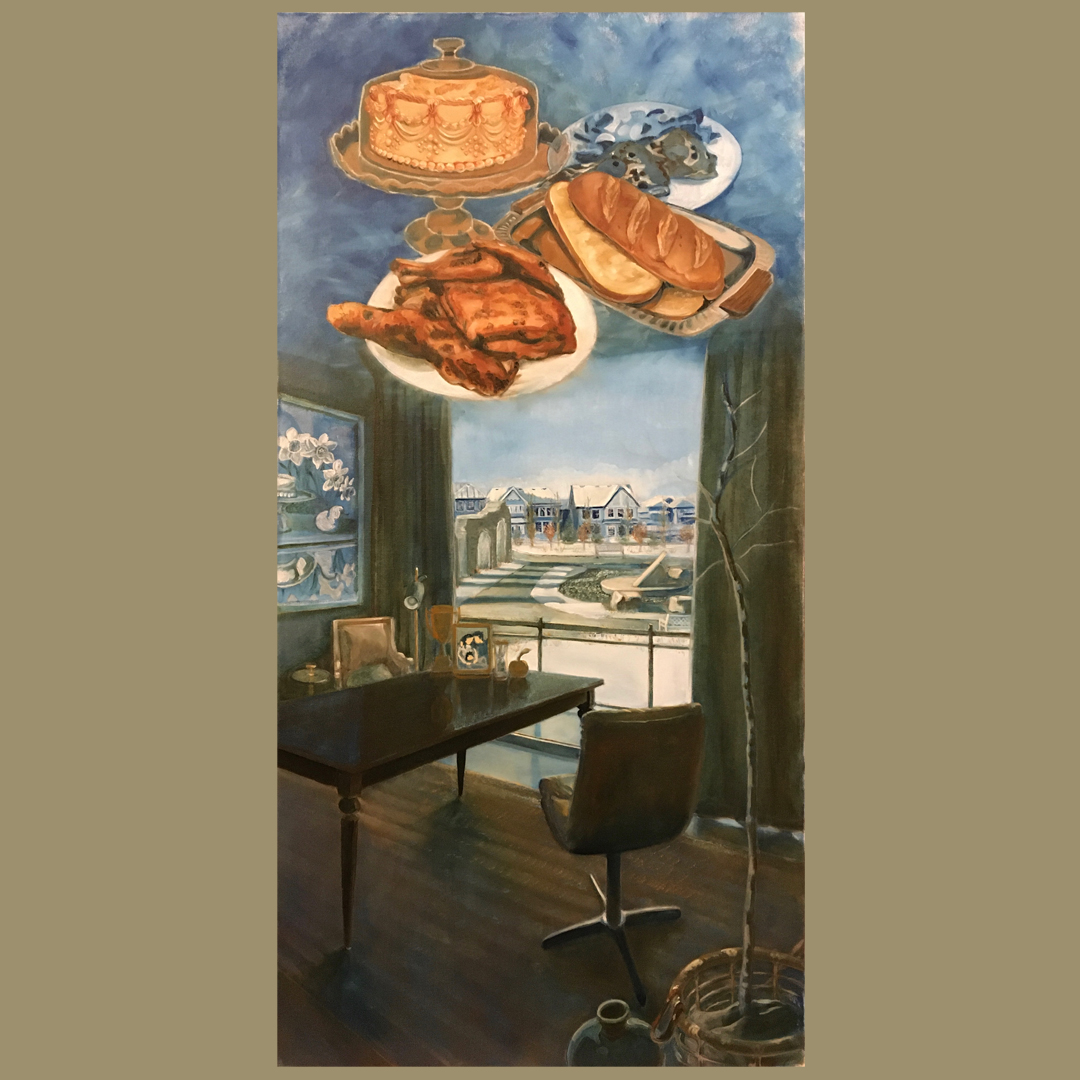
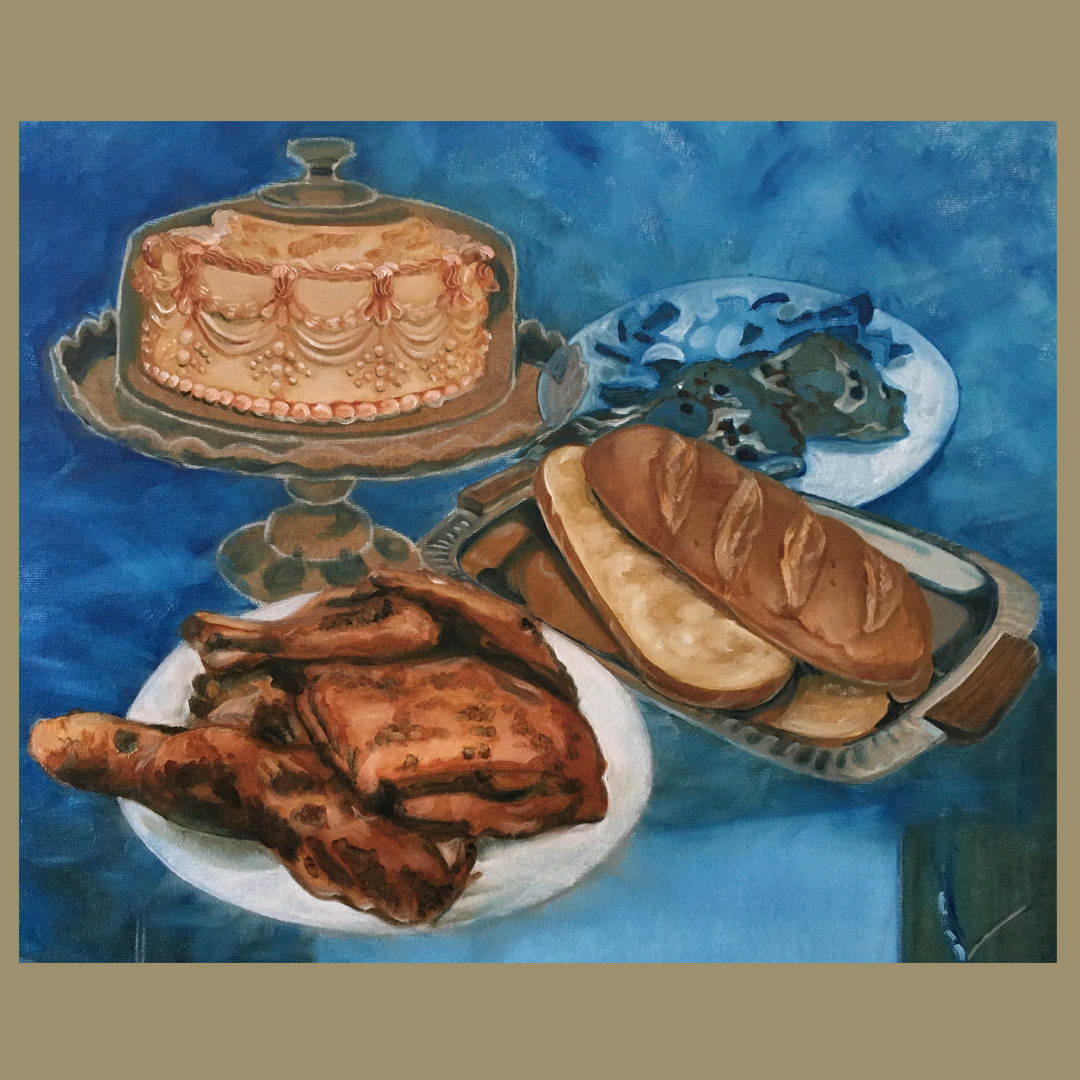
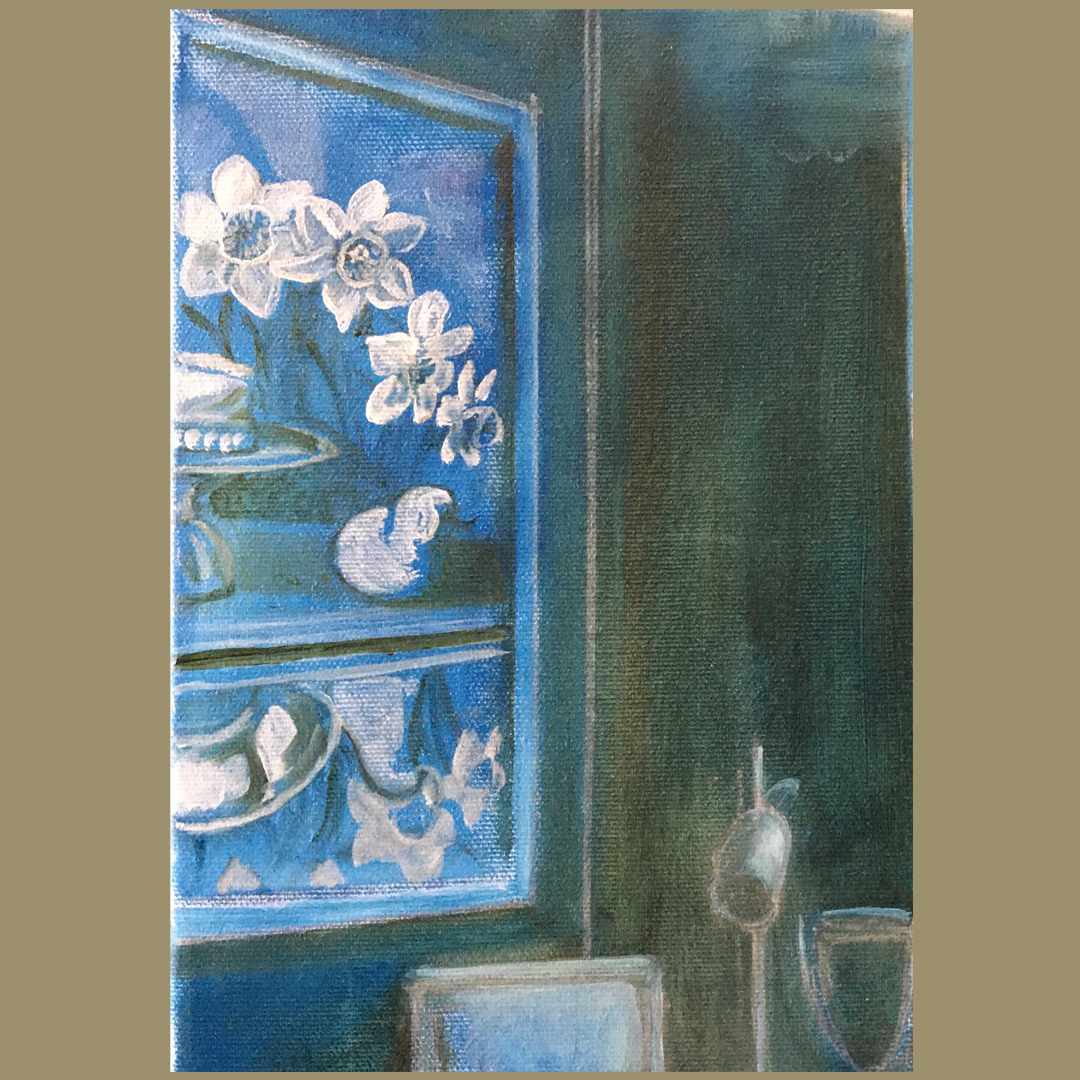
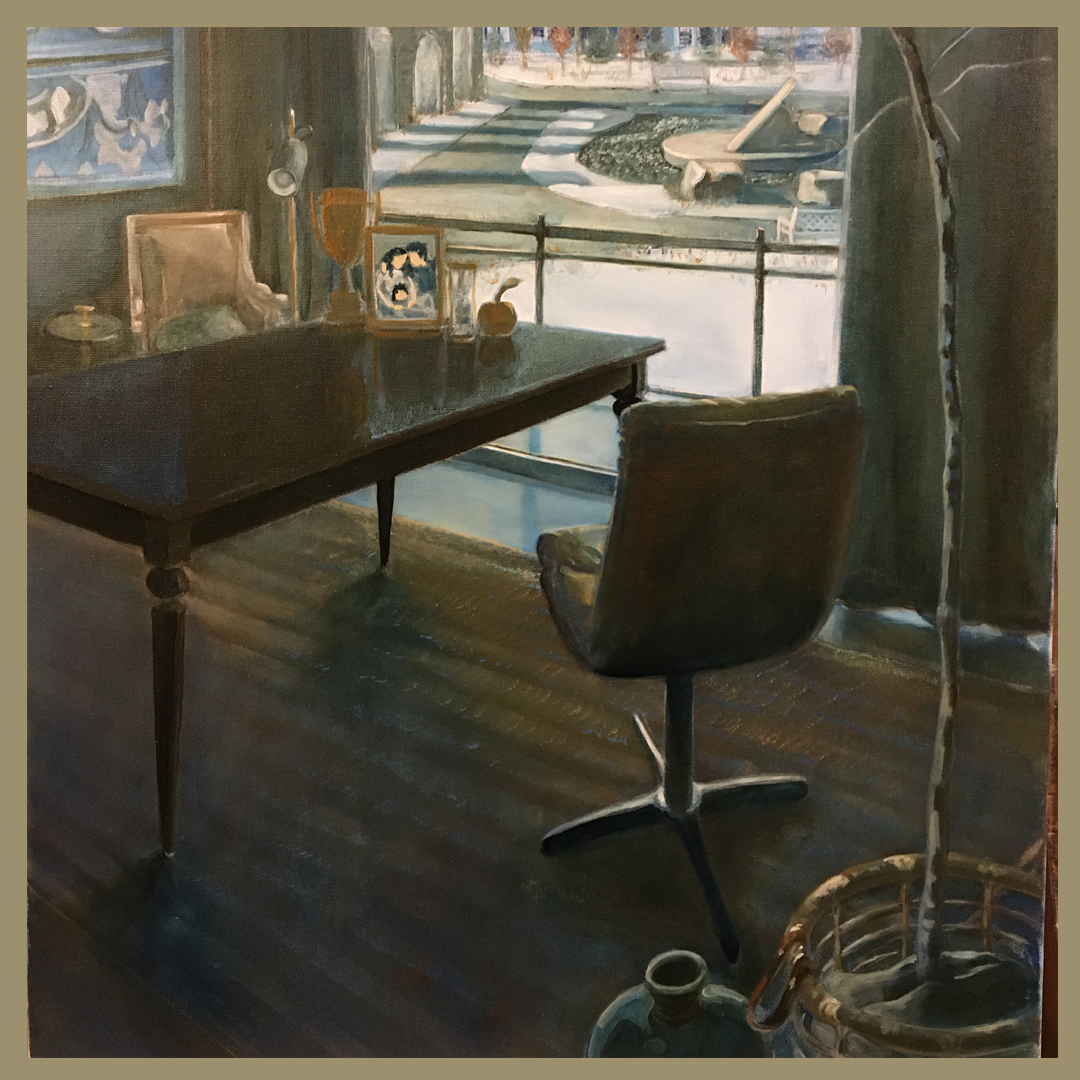
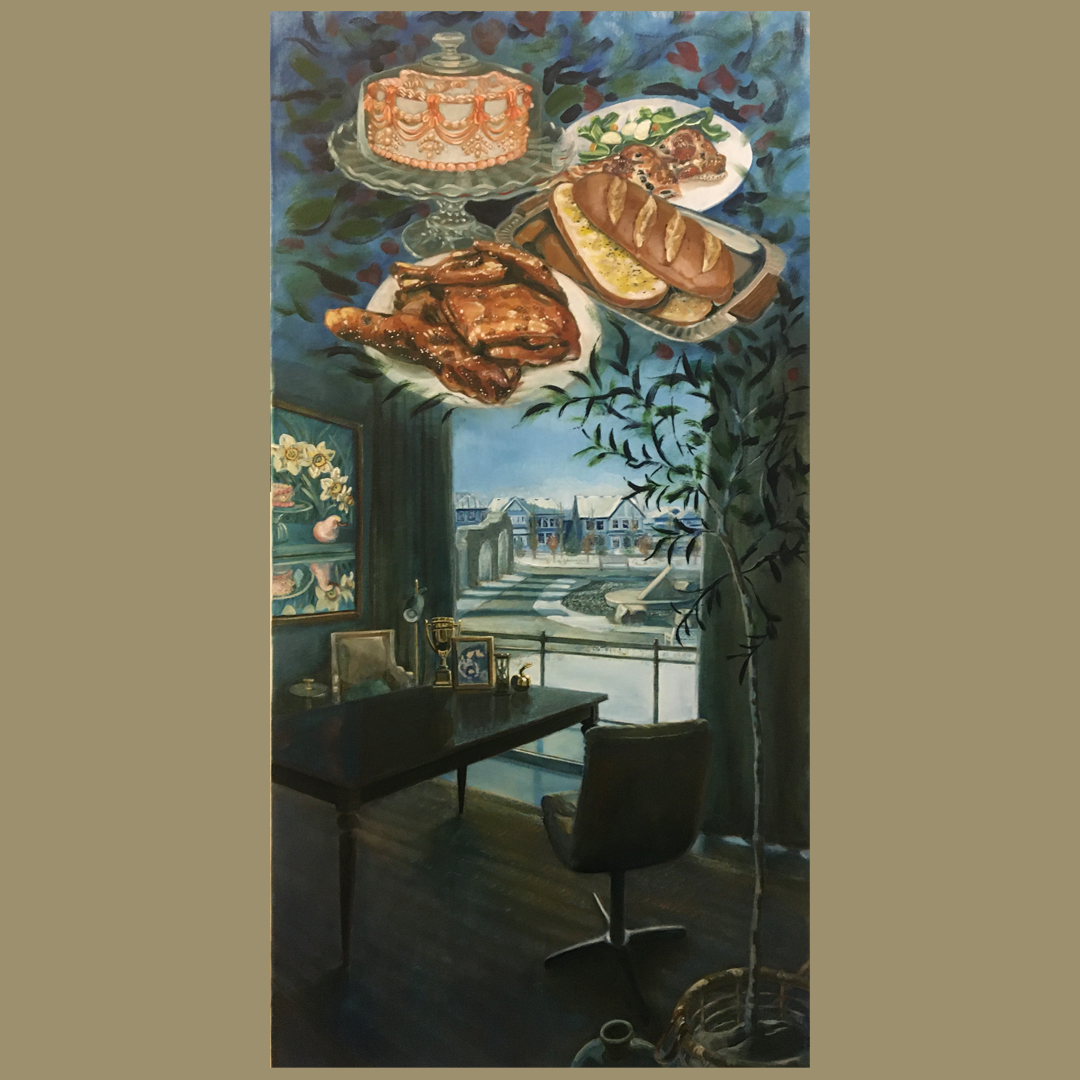
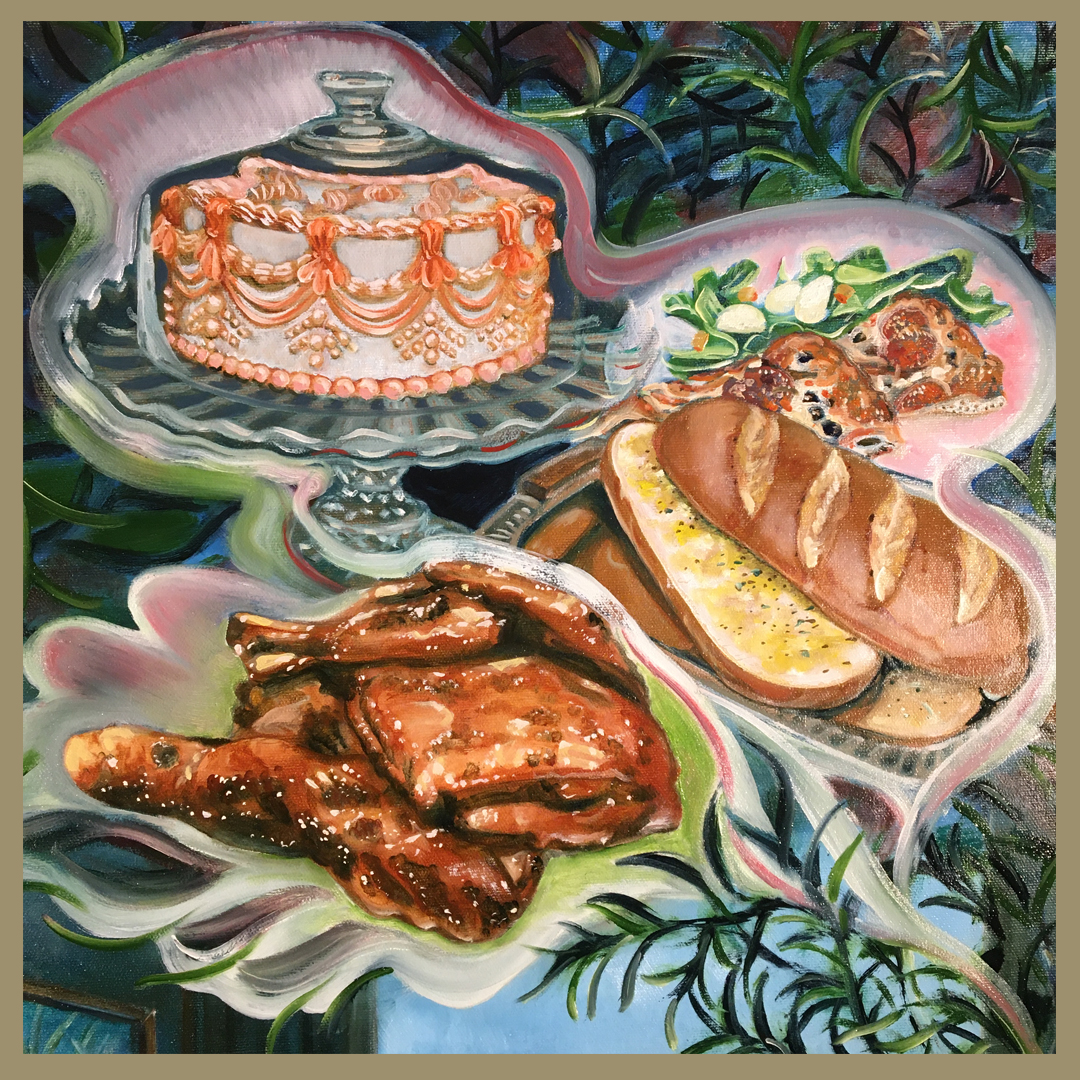
On the surface, Debbie.Lee Miszaniec’s Earthly Delights is the height of temptation – luscious donuts, seductive cupcakes and feasts for the eyes and mind. She spends hours painting the golden flakes on the pastry, or a glistening fatty sausage. Debbie.Lee’s expansive banquet scenes reference historic foods, feasts, figures and artworks.
Stewing within the work deeply questions our contemporary obsession with food, diet culture and body size. Health and wellness ideas are conflated with images of thin and fit bodies. We use virtuous language in refusal, graciously declining the temptations of food.
“There are still health concerns for individuals struggling to balance the health consequences of obesity against the health consequences of long-term weight loss efforts. As someone coping with that legacy, I am challenging myself to talk about it through my work,” Debbie says.
Image credits: Debbie.lee Miszaniec, Debbie.Lee Miszaniec, Power or Glory, 2024, oil and canvas with sculpture; Portrait of the artist, in the style of Titian by Courteney Miszaniec and Logan Miszaniec, 2024.
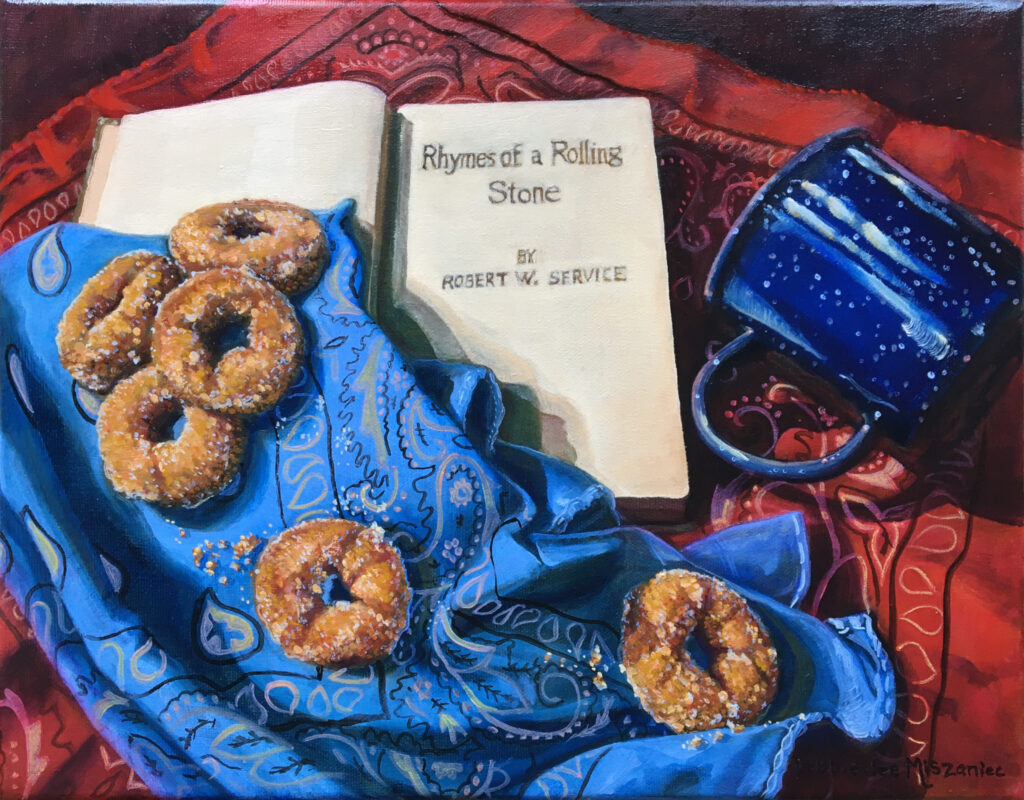
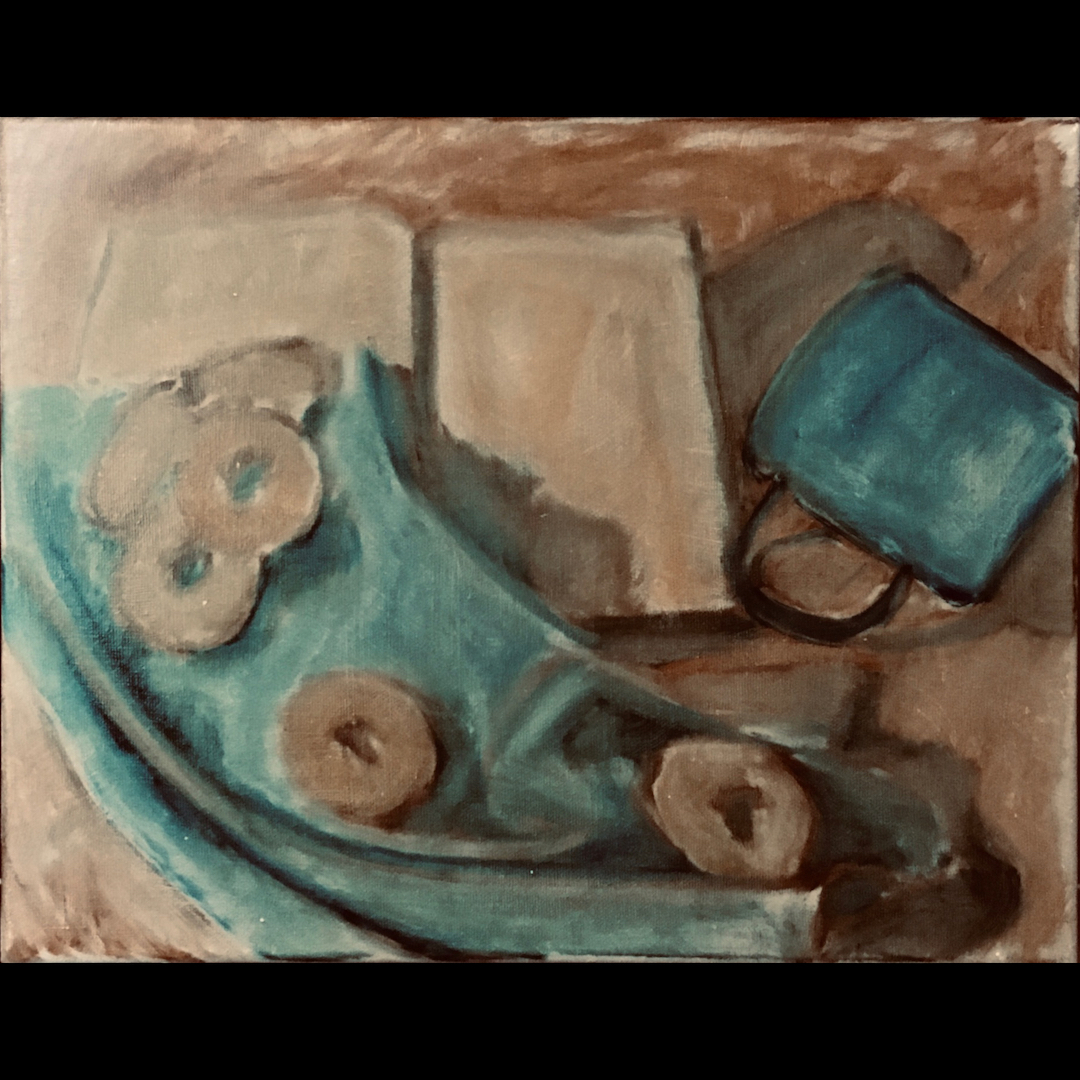
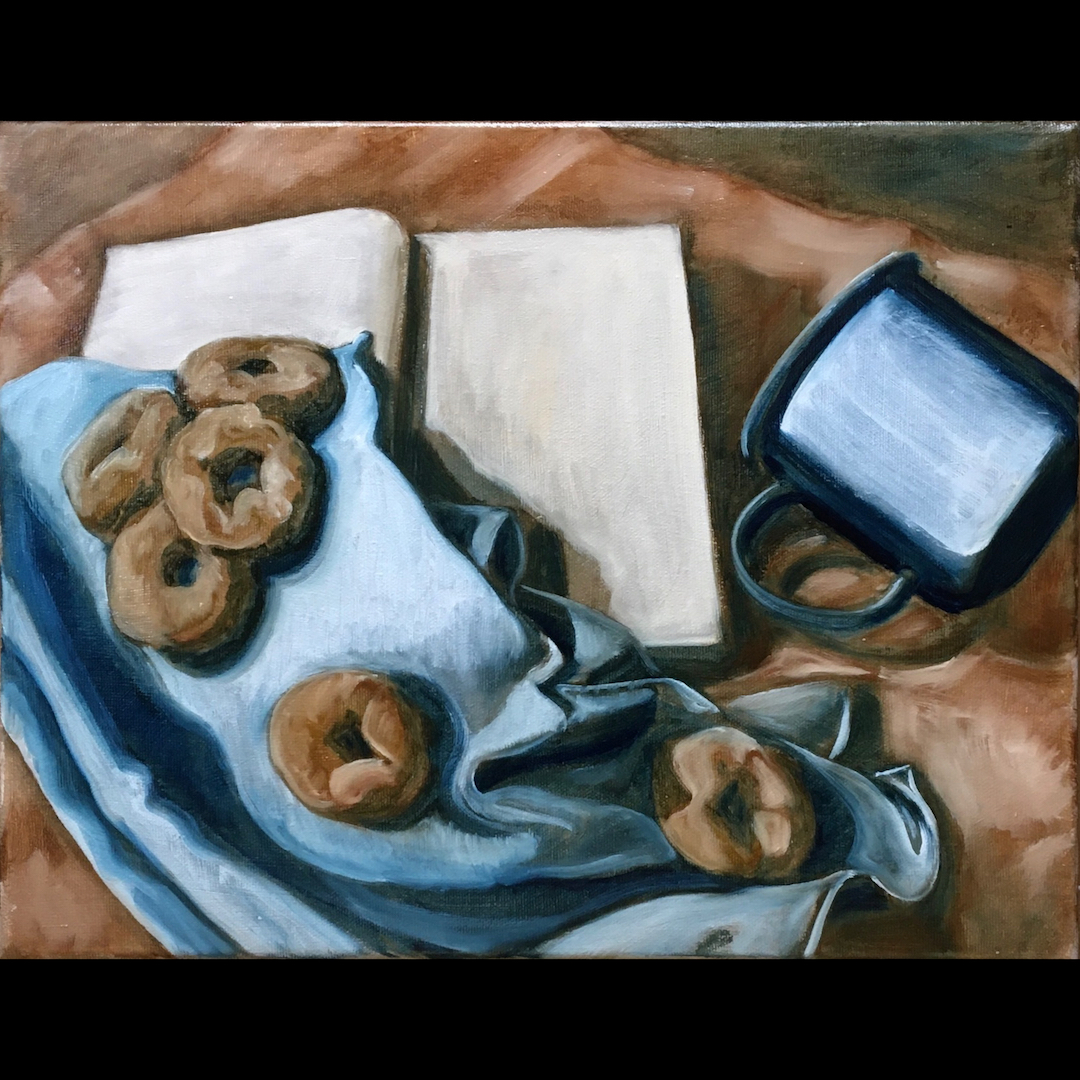
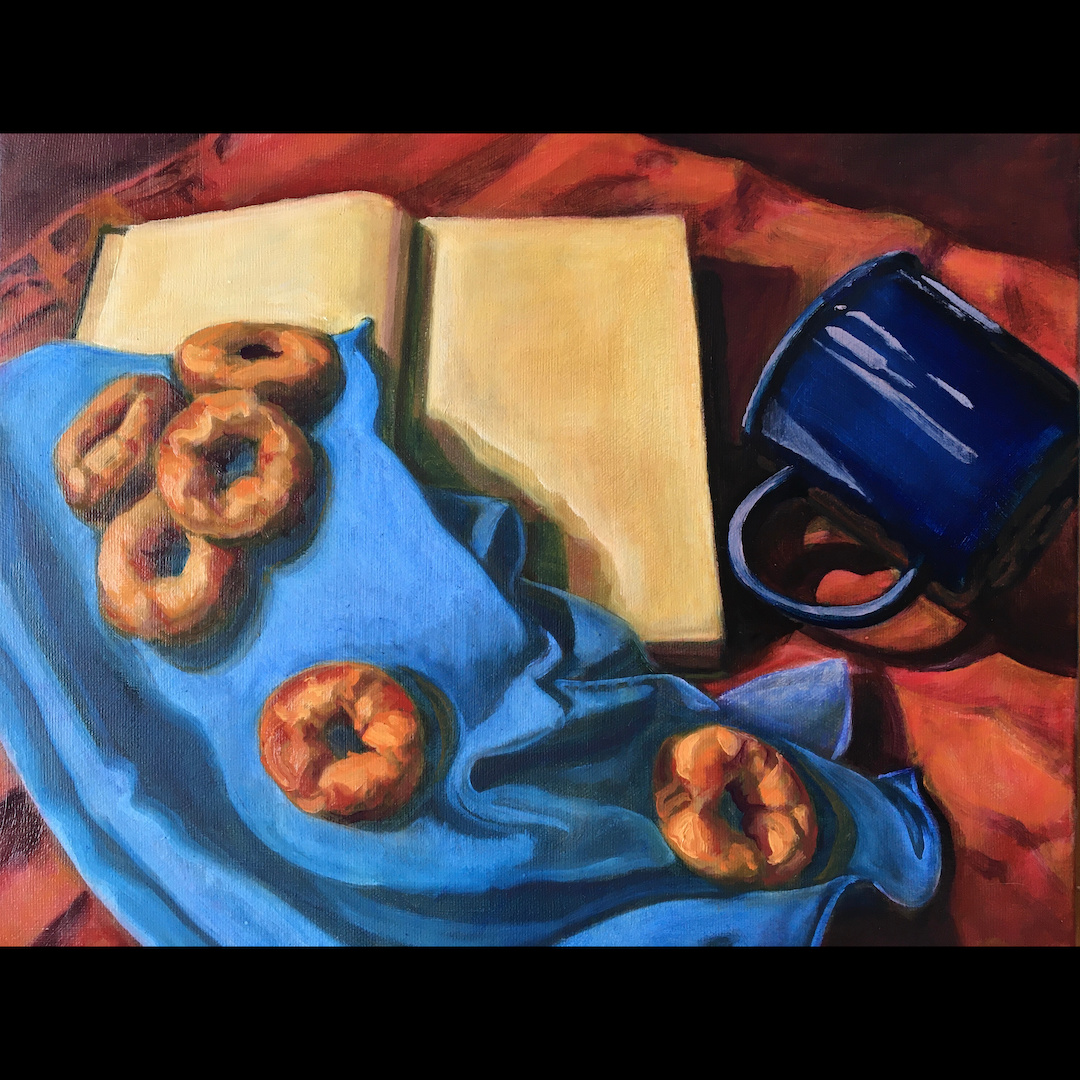
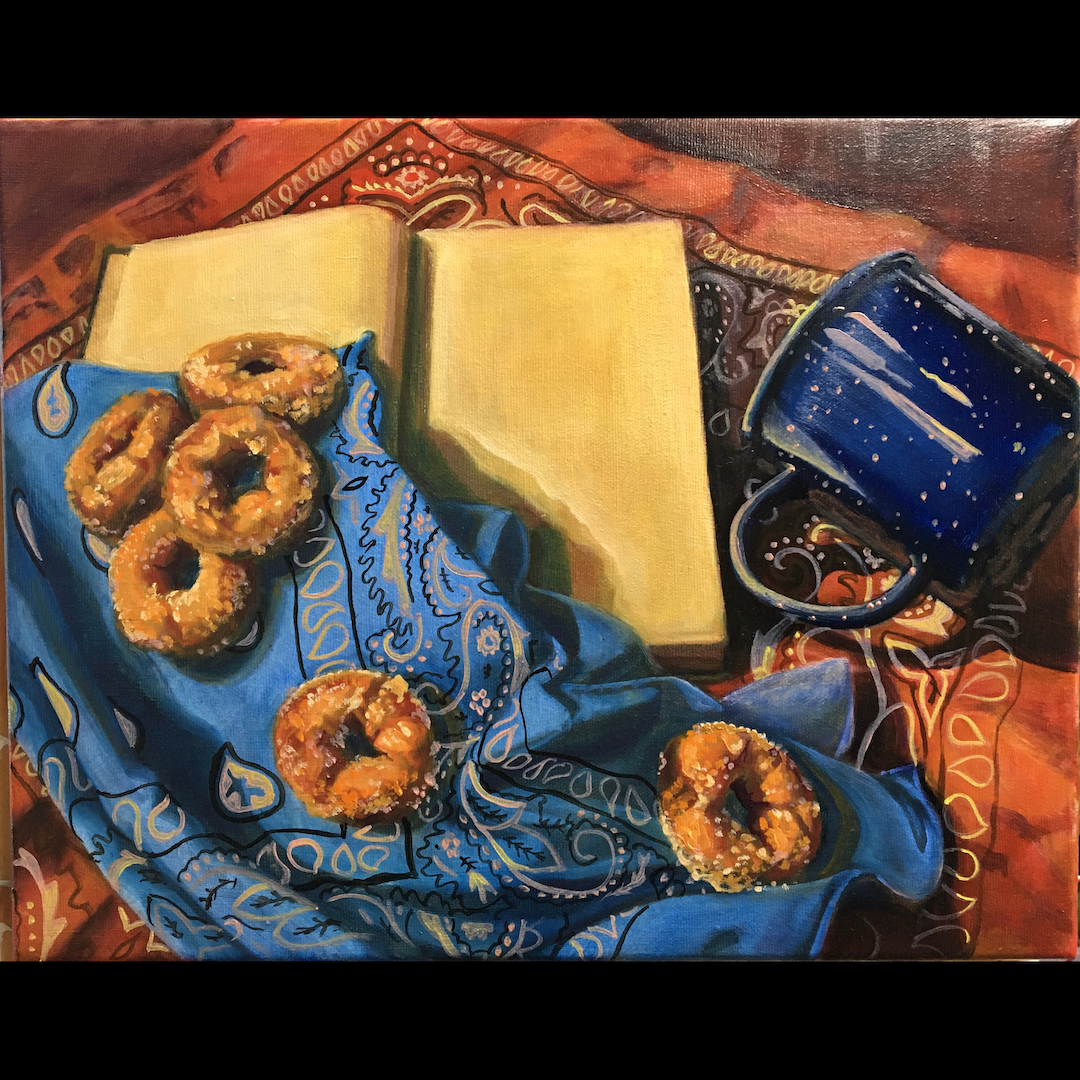
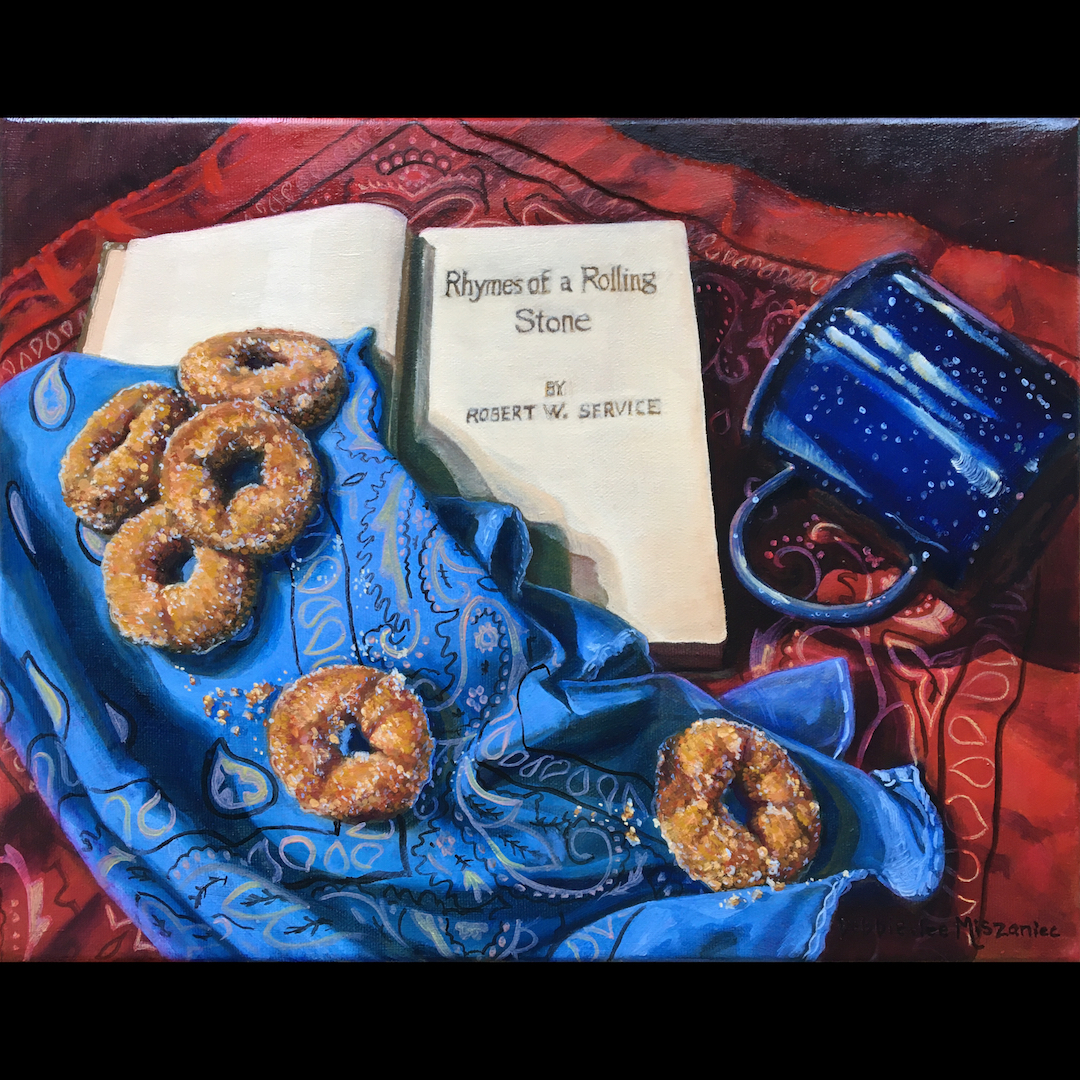
Wouldn’t we all like a mini donut service? I started this painting at the Calgary Stampede last summer during my engagement painting live and meeting the public in the Western Oasis. Of course, the way I work these days I knew there was no way I would be completing it in that 2 hour session, especially since I did more talking than painting. Which is as it should be, plenty of time to paint back in the studio. Or so I thought. Turns out that painting larger than life triptychs exploring the life cycle of diet culture can definitely take over your life and studio. So January of 2024 finally saw the completion of this lovely little painting of the famous stampede midway treat, the Mini Donut, together with a vintage book of Robert W Service’s western poetry. Enjoy this compilation of progress pics below. Want to buy this painting? Let me know!
One and Three Pears (after Kosuth). Digital Photograph, Debbie.lee Miszaniec
Besides being a little shout out to an OG conceptual artist, Joseph Kosuth, this photo represents the process I went through to create Restrained, a stuffed pear tied to its seat with measuring tapes, which you can see now at the Okotoks Art Gallery in What You Do To My Body (and Mind) until March 22nd 2024. Referencing Kosuth’s One and Three Chairs (1965) I’ve presented the real pear, the paper pattern made from the real pear, and the small scale model testing the pattern for the larger finished pear. Below you can see the pear in situ:
Photo by Amir Said for the Western Wheel.
Check out Restrained in What You Do To My Body (& Mind) before March 23rd 2024 at the Okotoks Art Gallery:
Energy Requires Mass, 30″x40″ o/c, Debbie.lee Miszaniec
Welcome to the tenth instalment of a series of blog posts going more in-depth into the thoughts and ideas behind each of the paintings in the Earthly Delights series. The series is based on my experience navigating health and diet culture as a long term participant. You can read the full background by following the link to that blog post below:
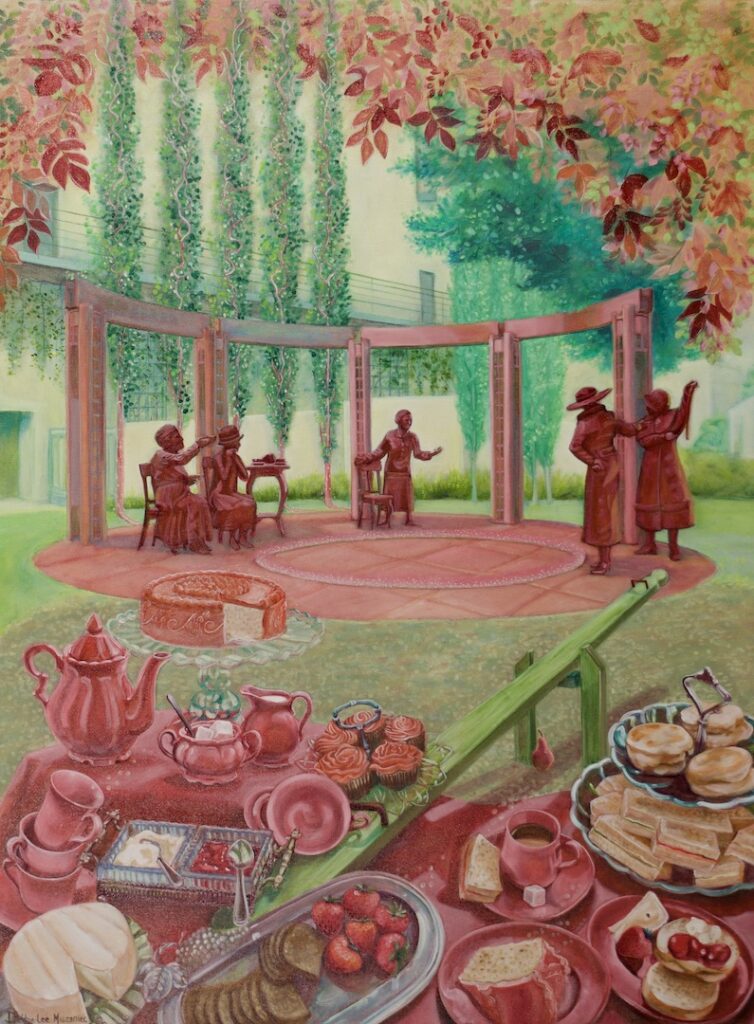
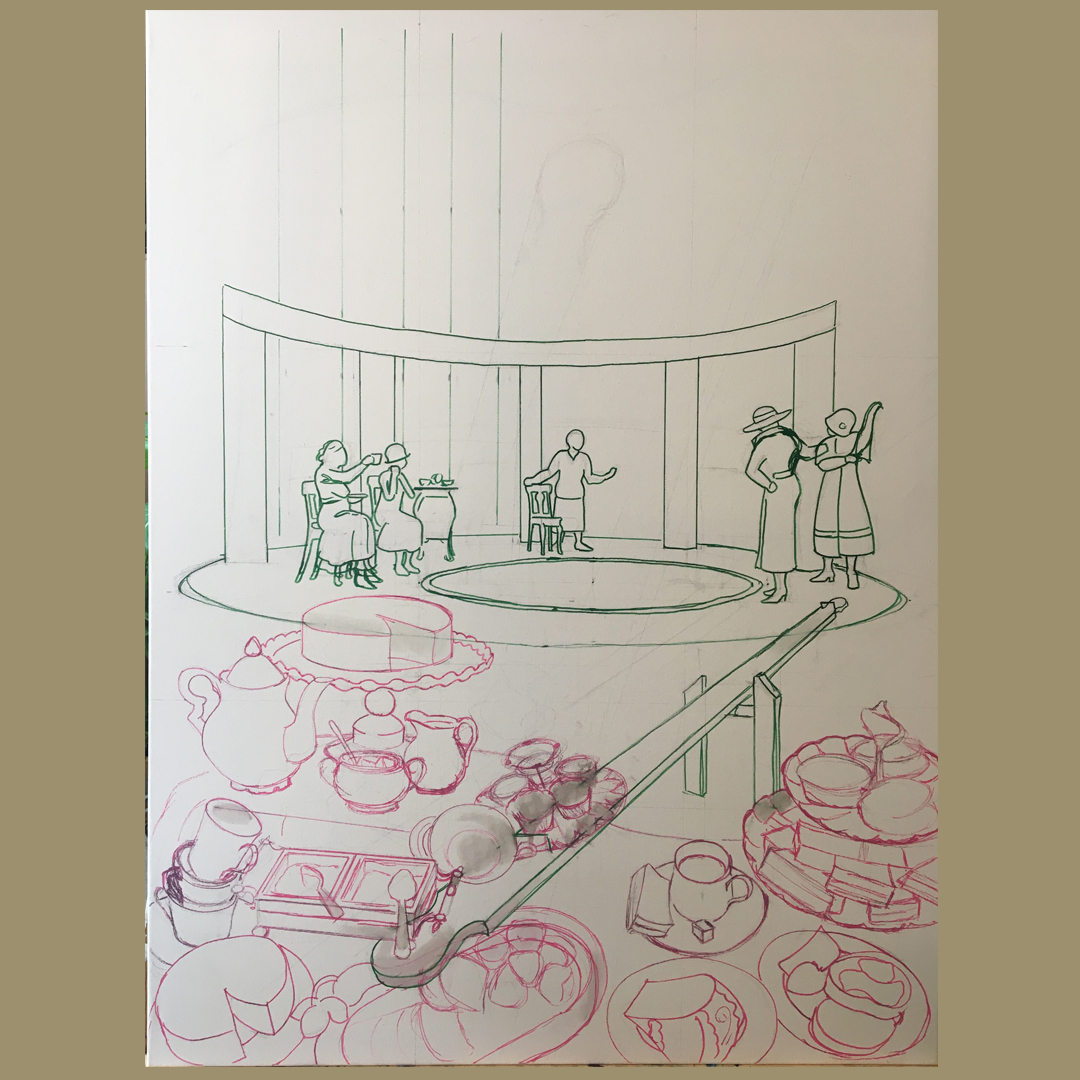
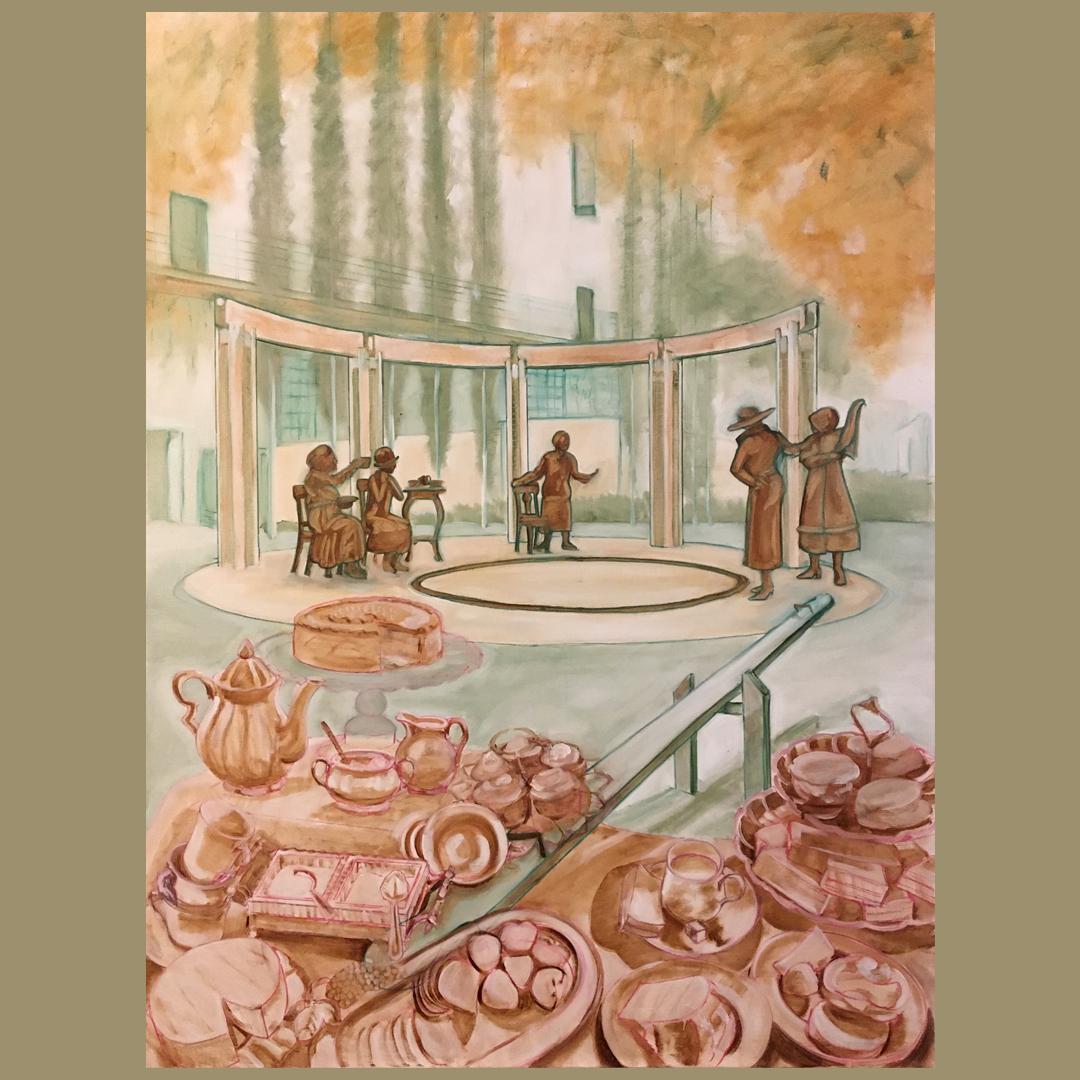
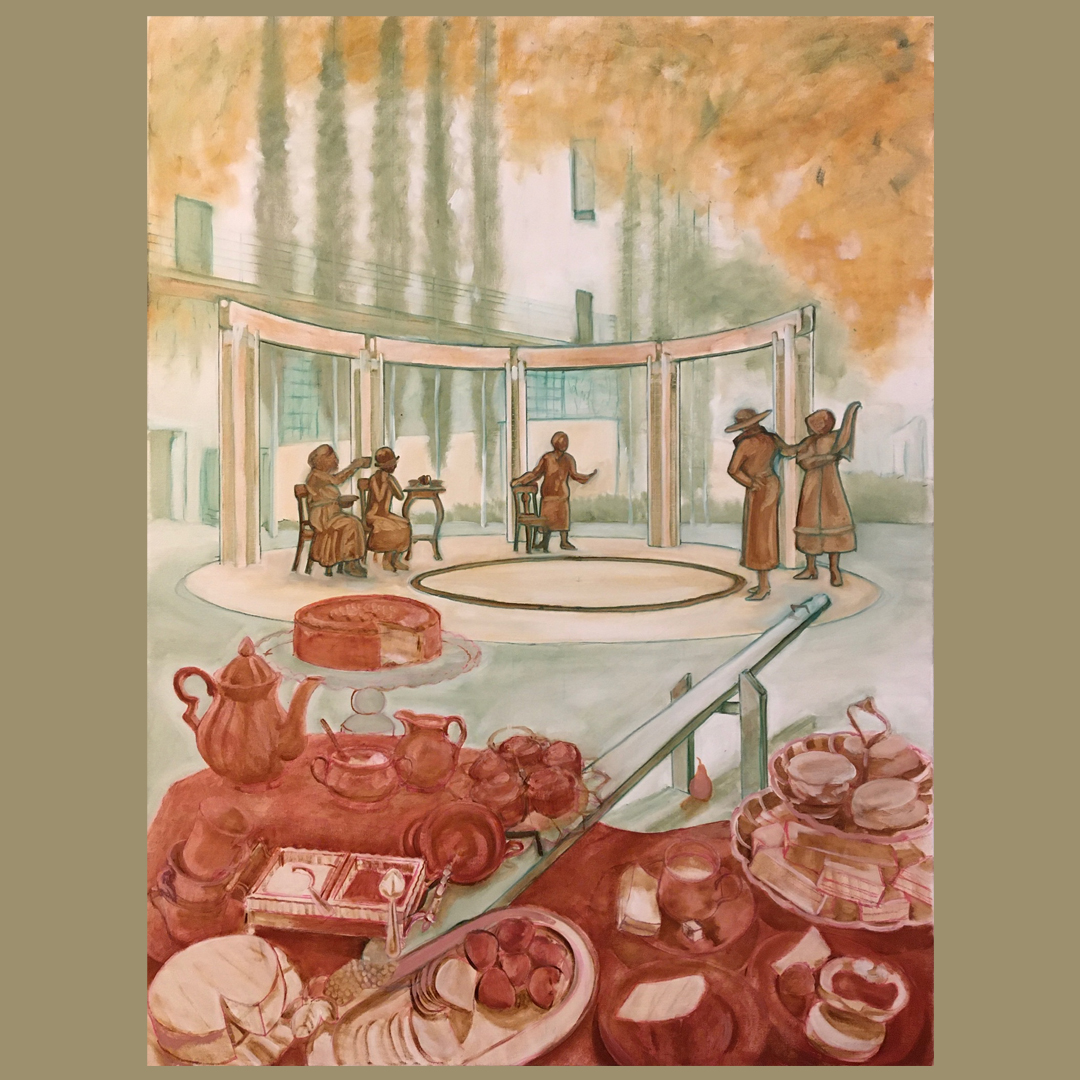
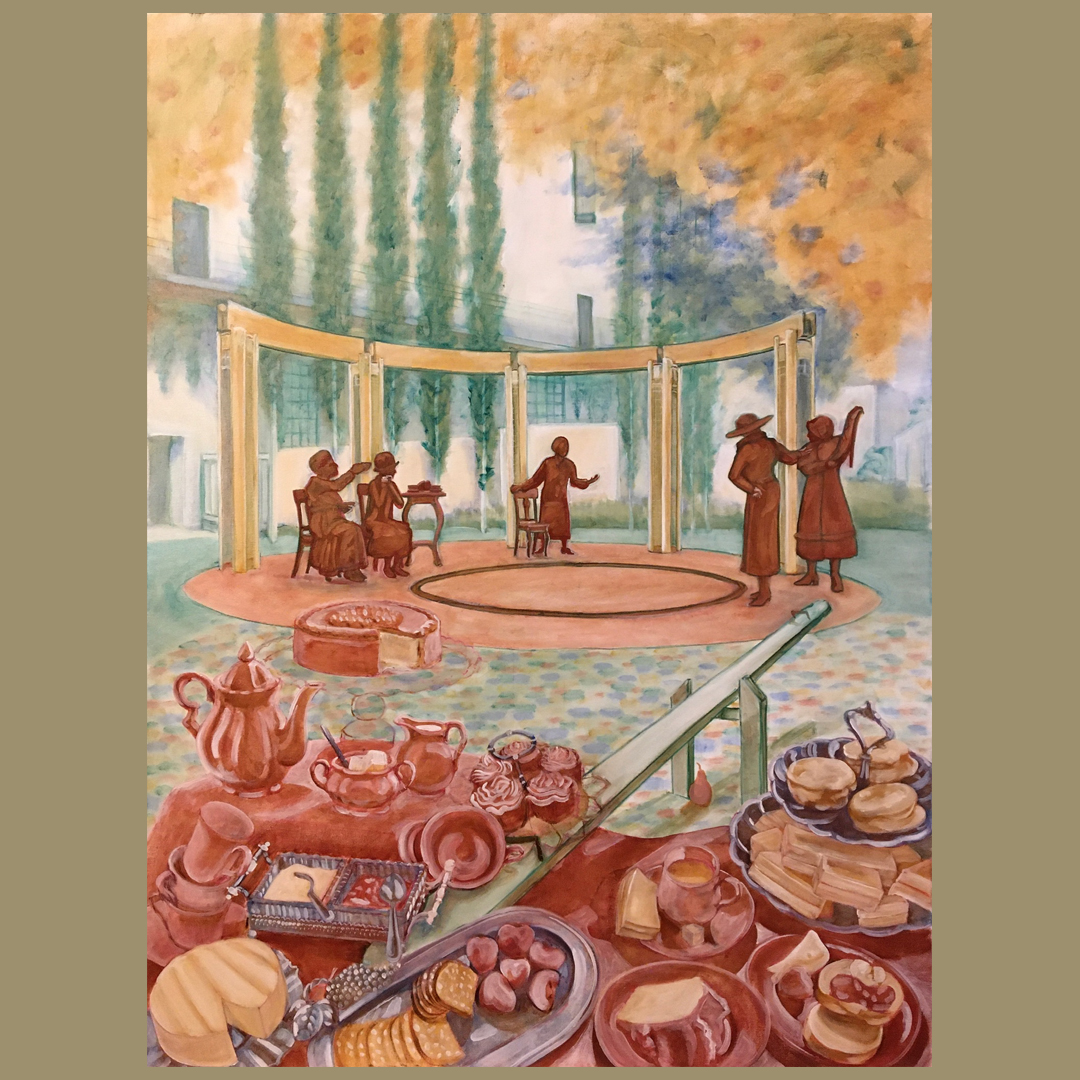
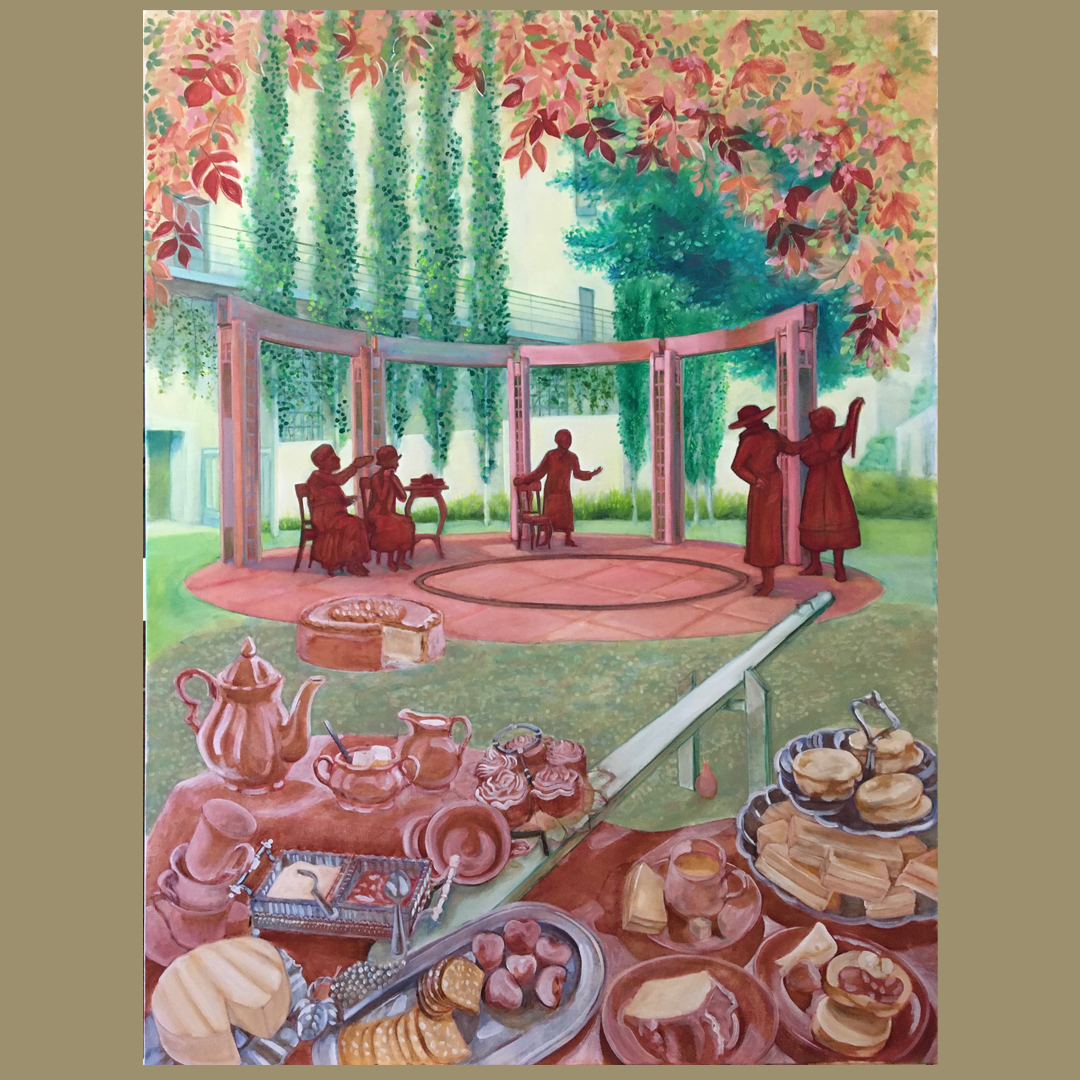
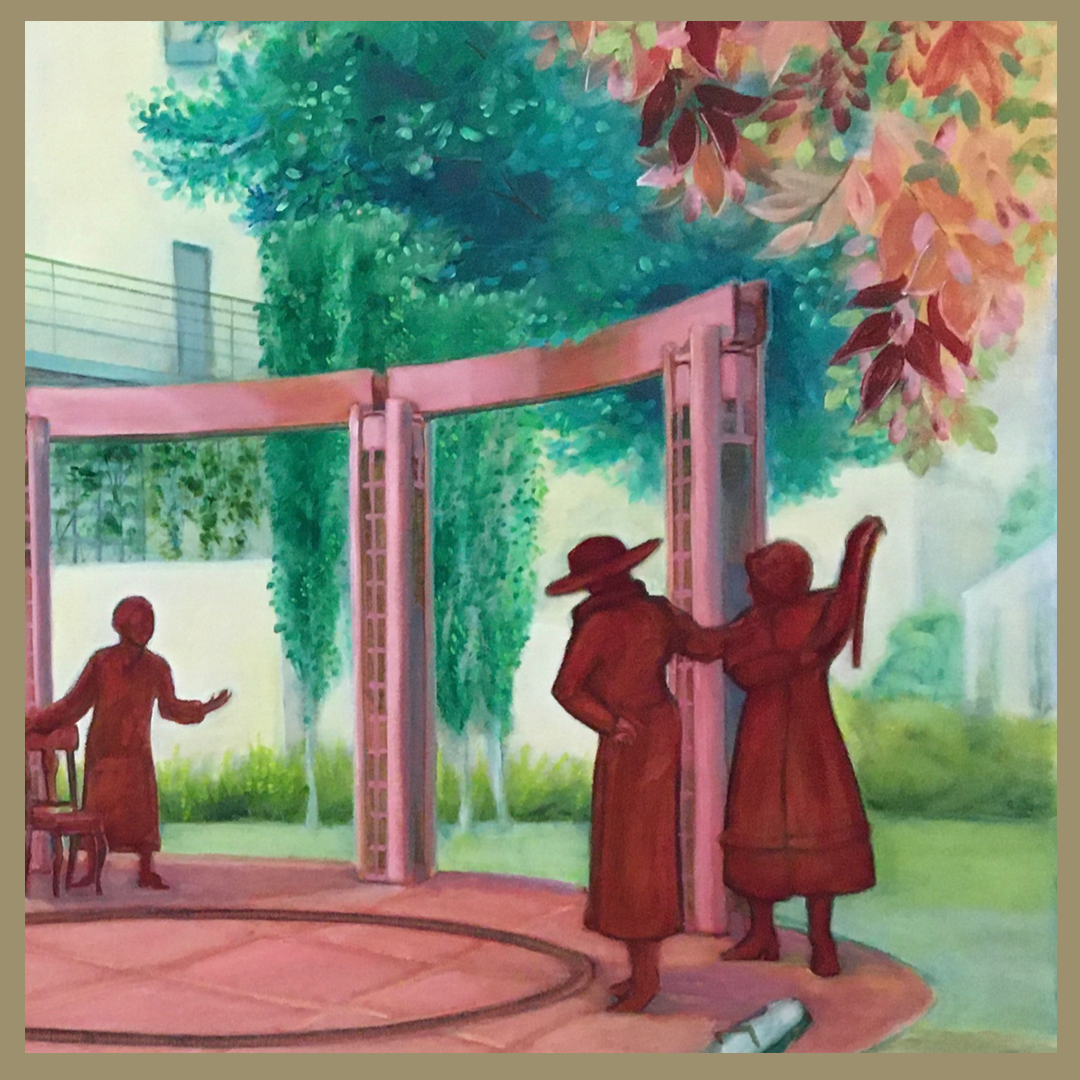
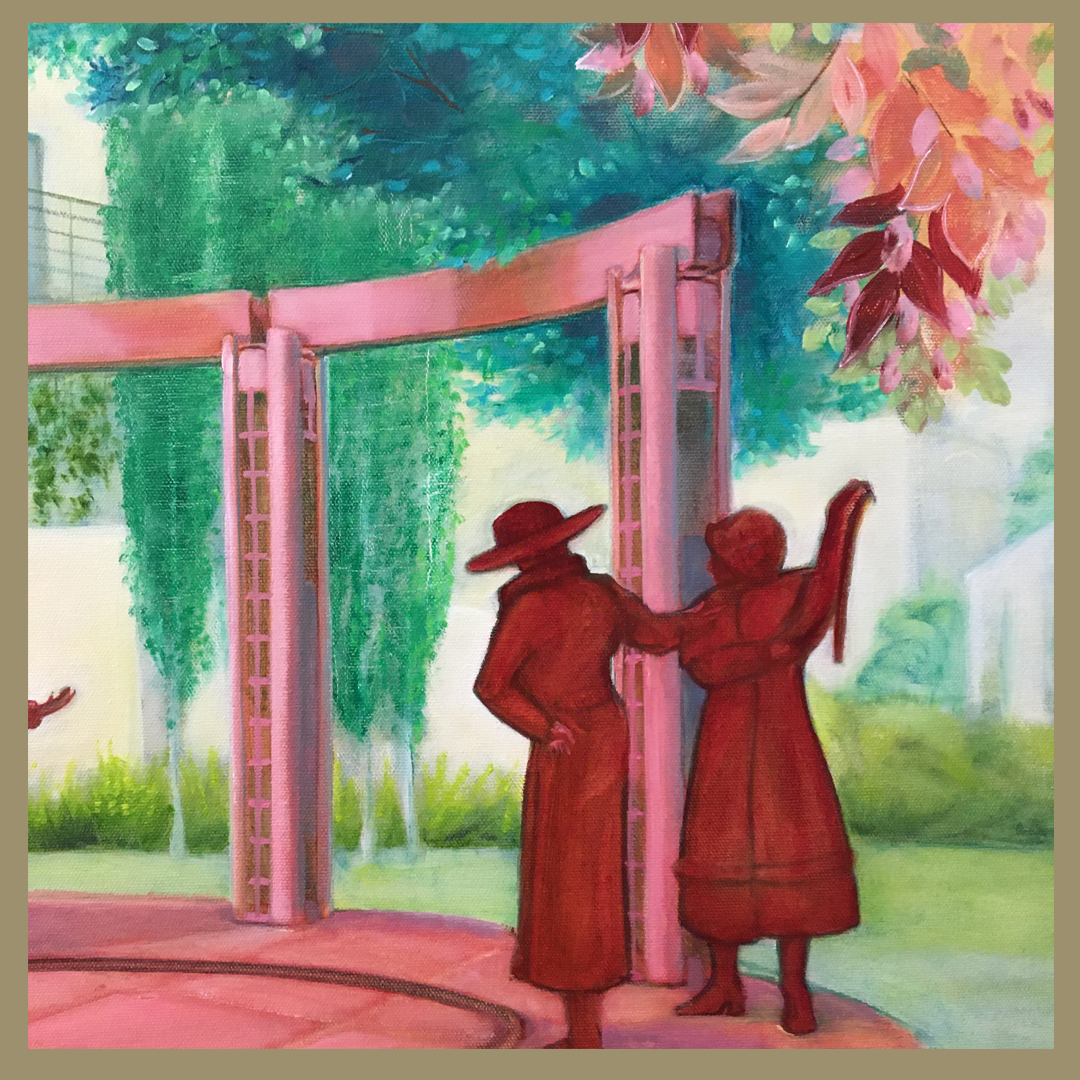
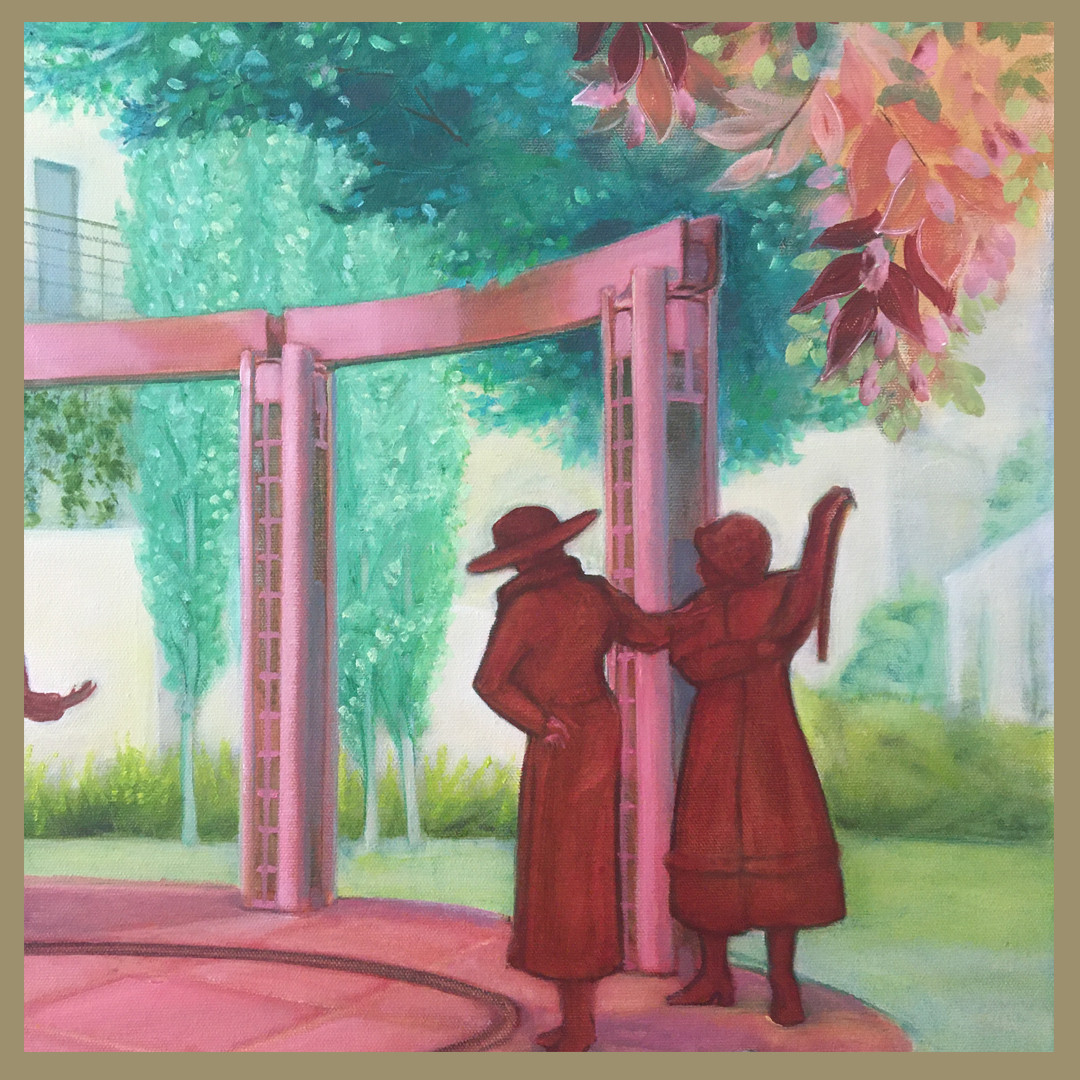
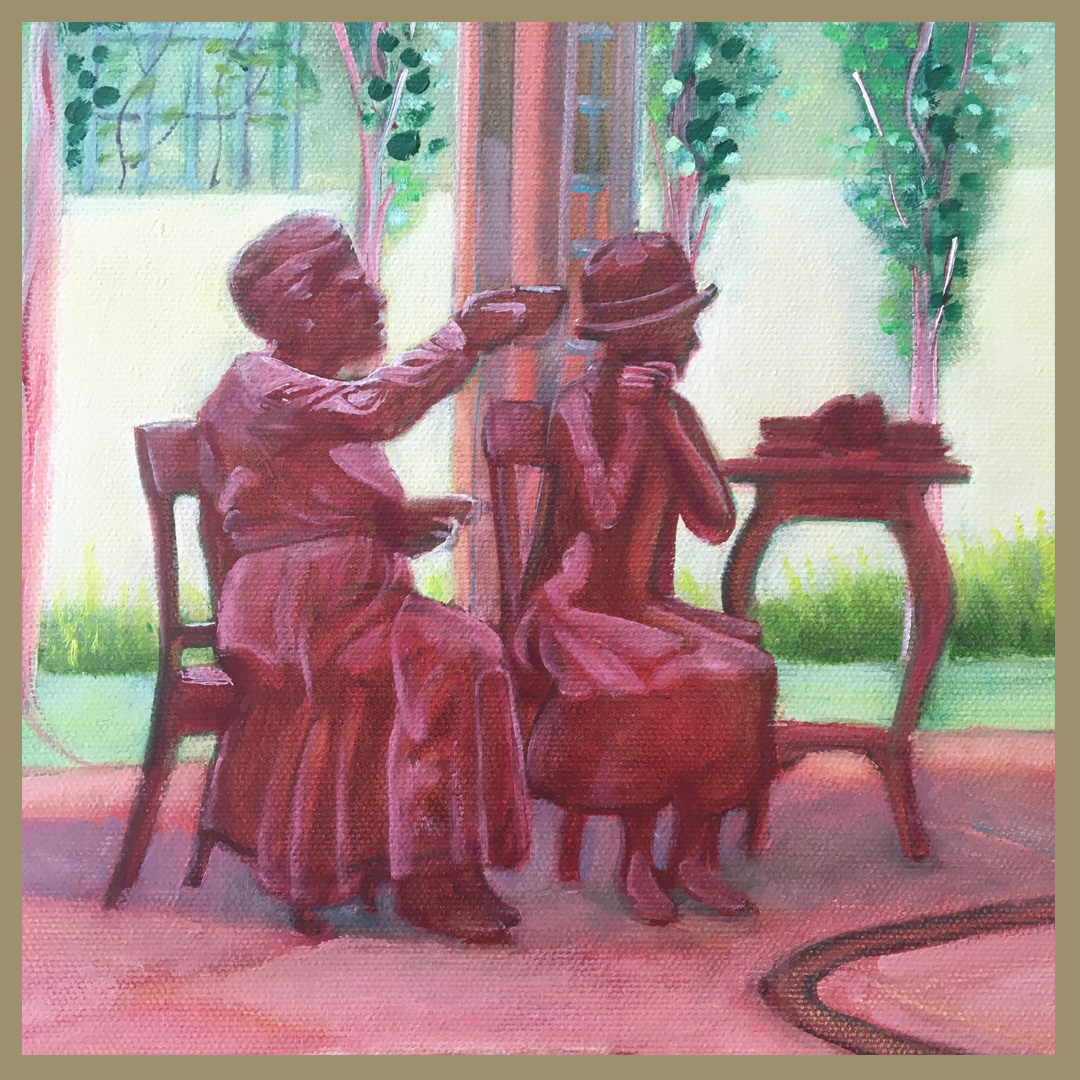
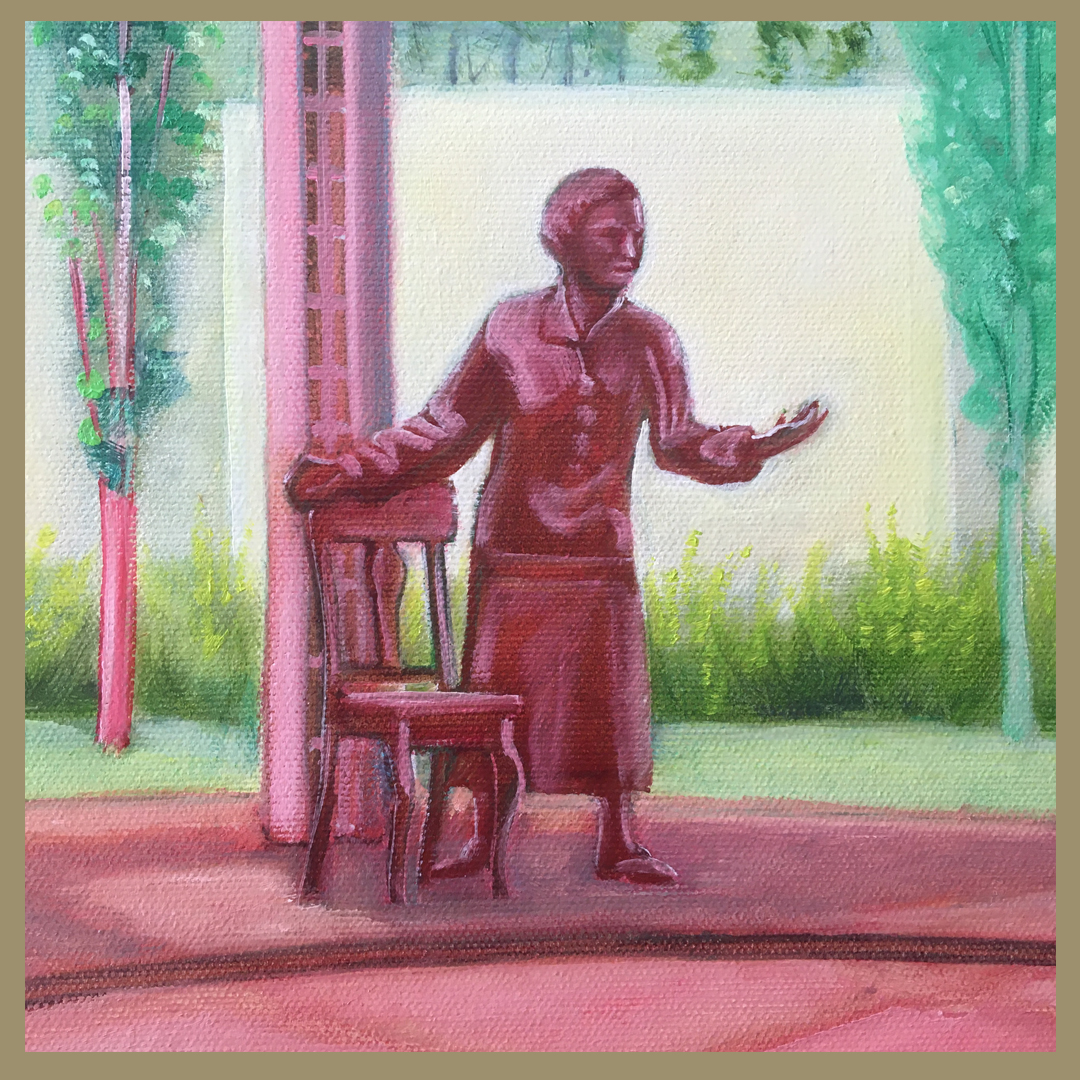
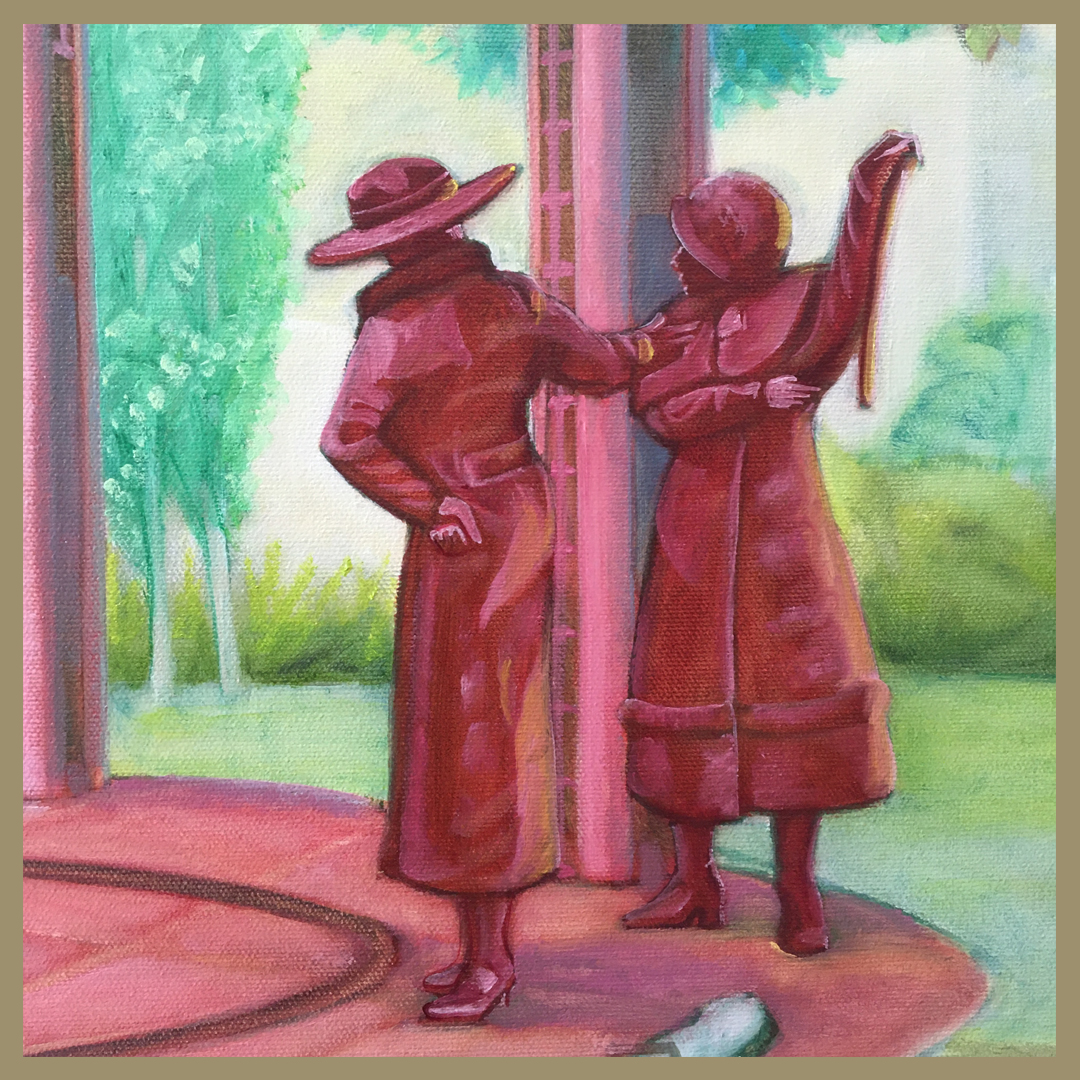
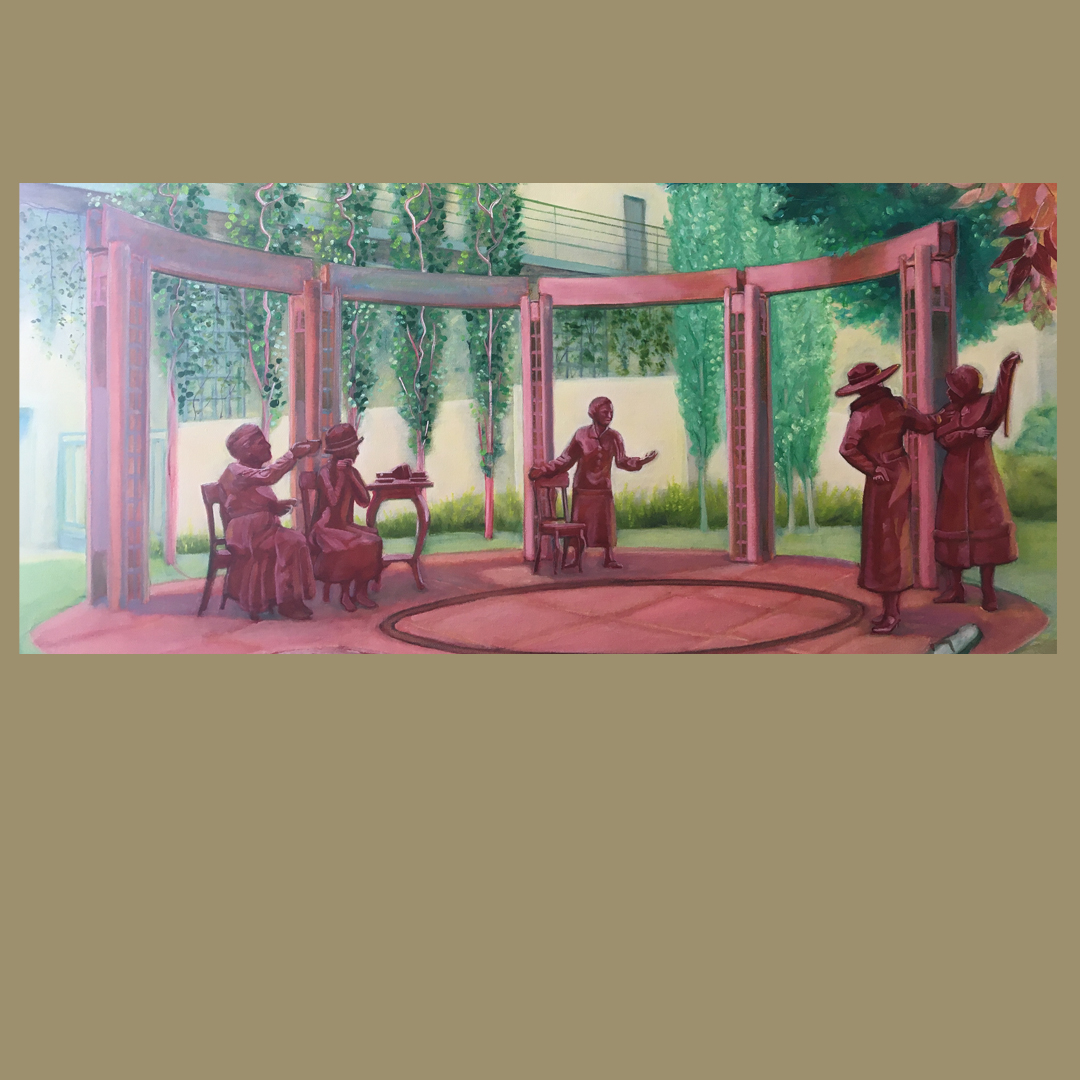
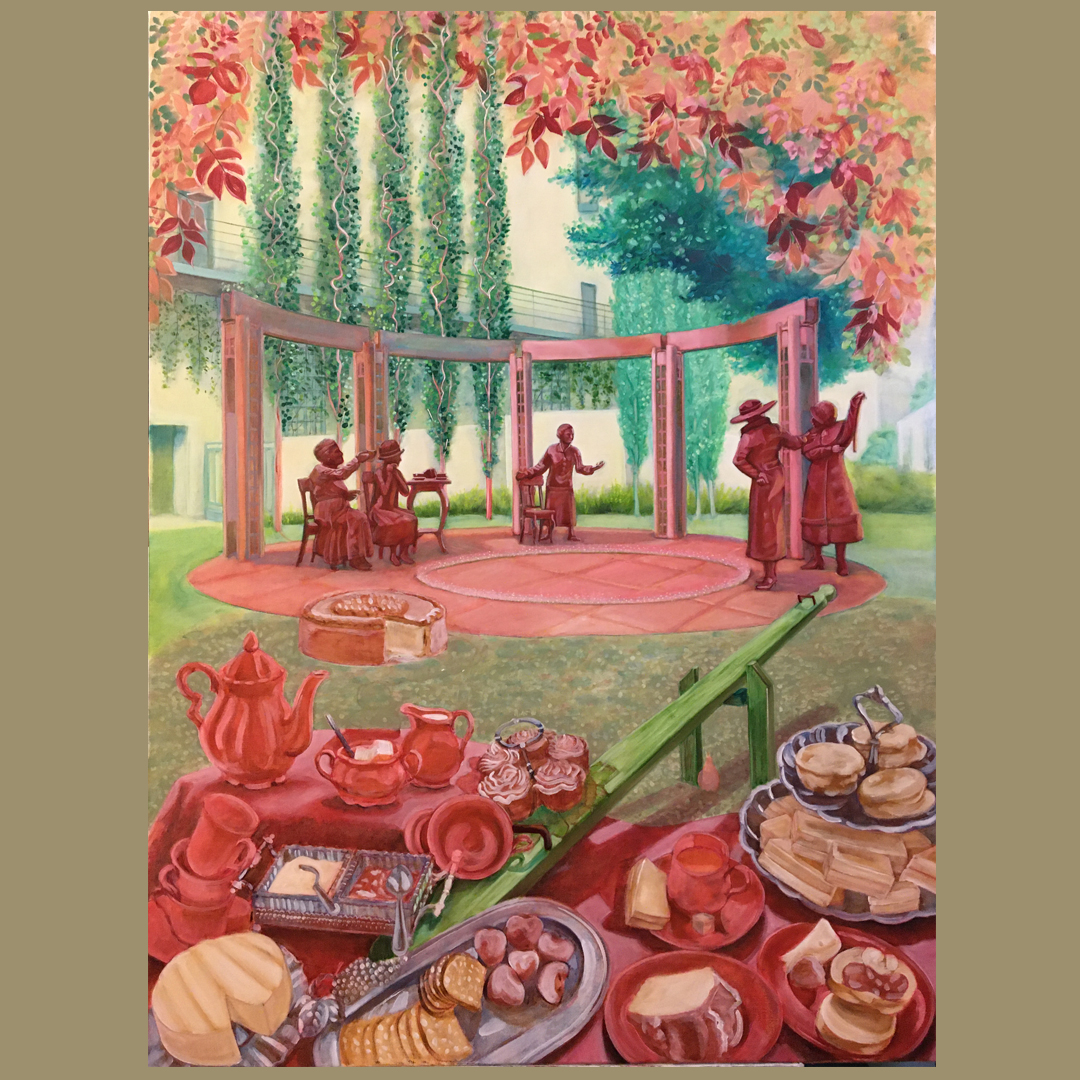
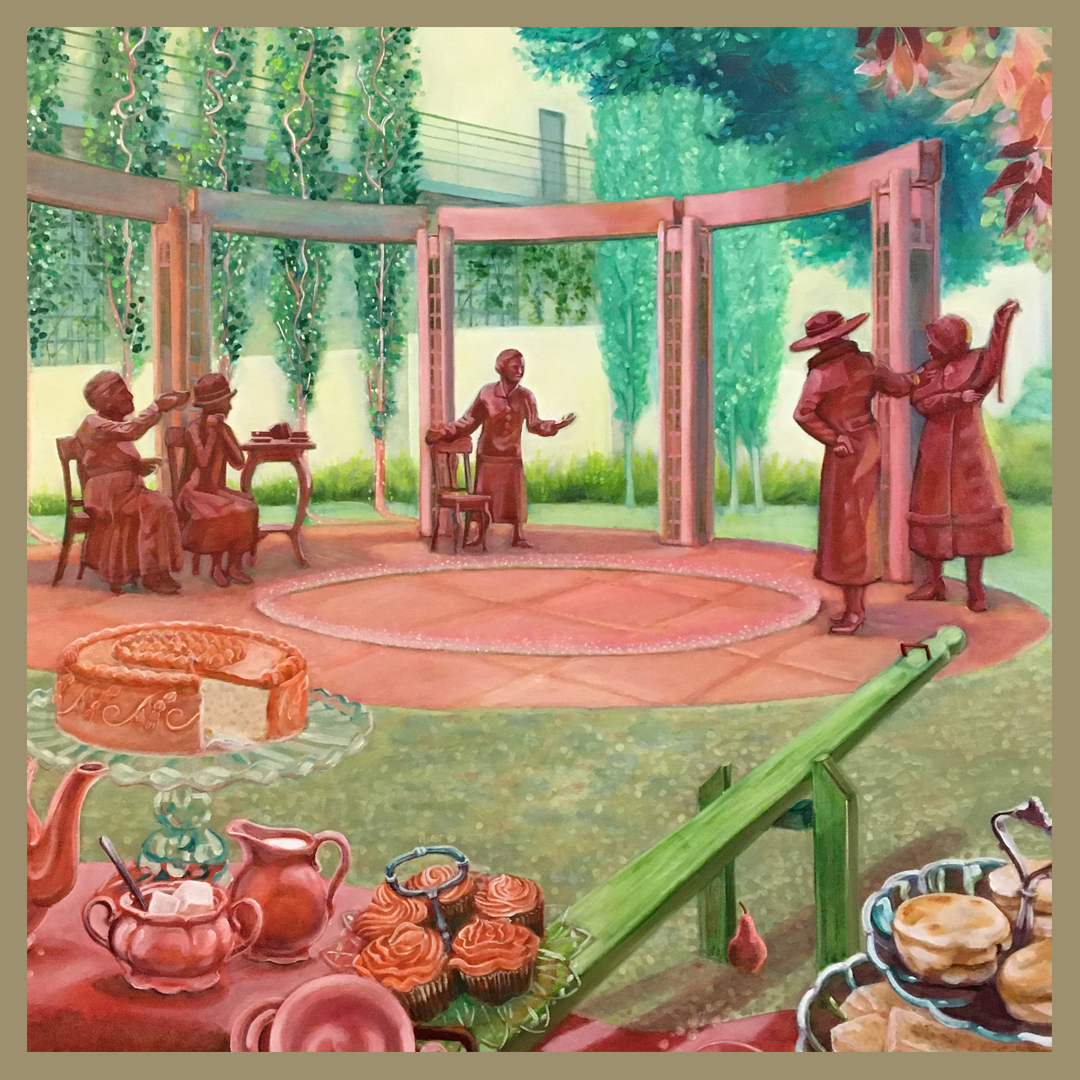
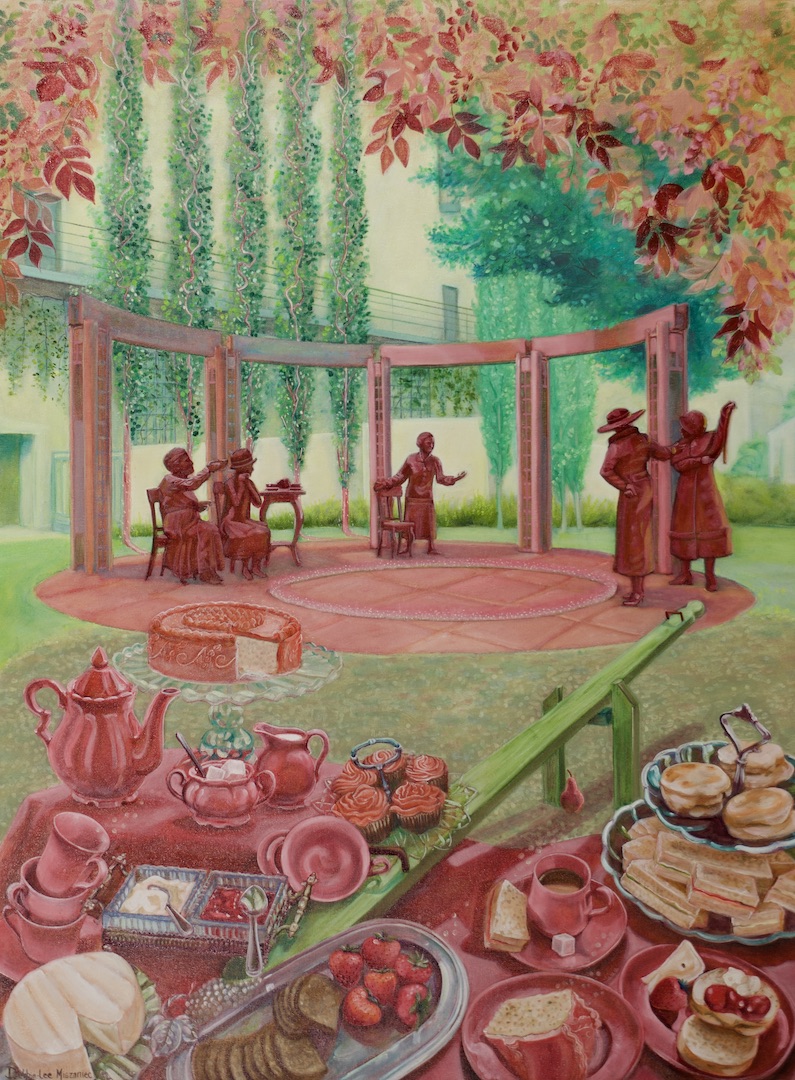
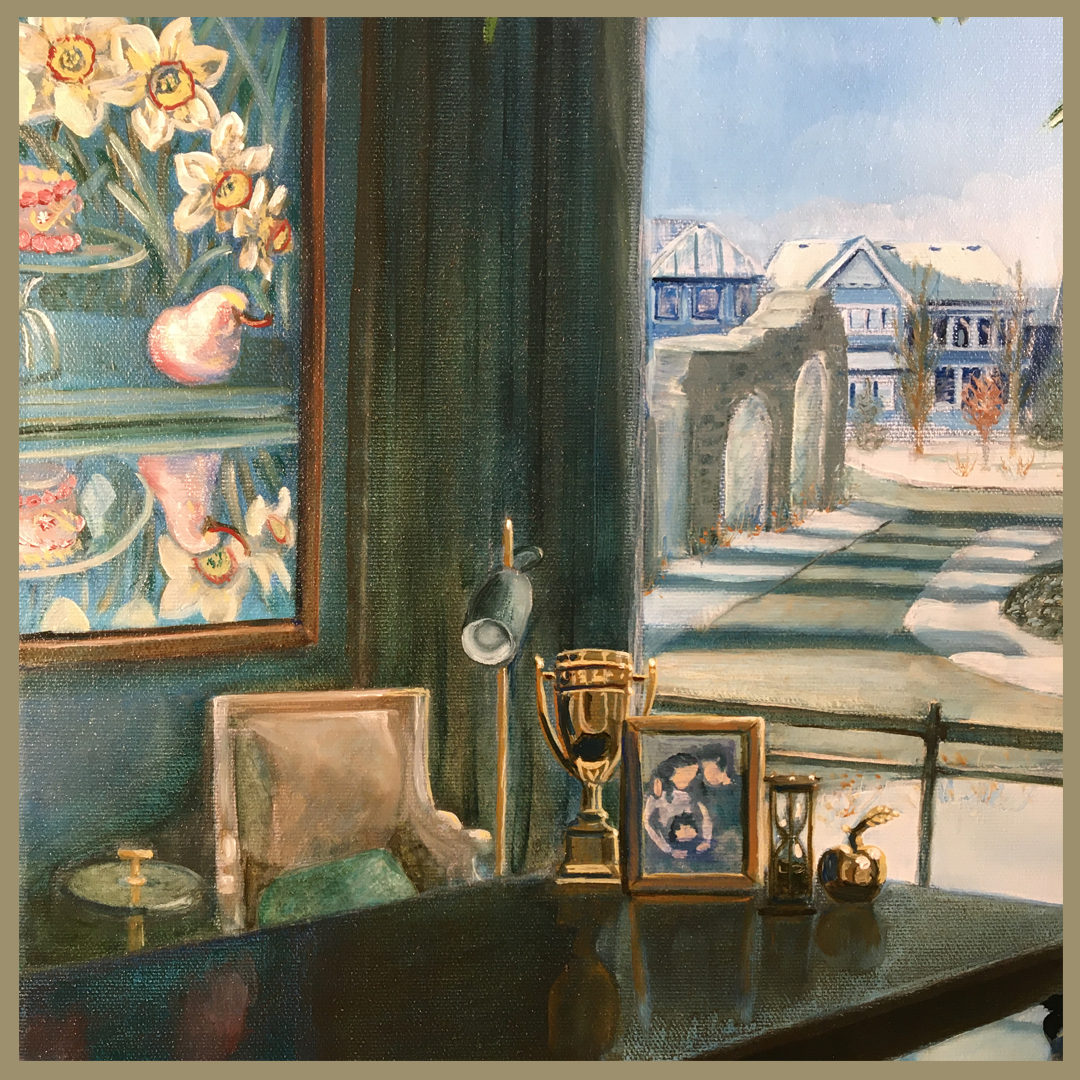
I set the final feast in this series in front of the sculpture in Calgary of the Famous Five, Women Are Persons!, by Barbara A Paterson. The Famous Five were the Albertan women who brought the Persons Case before the Supreme Court of Canada, recognizing that women were indeed persons under the British North-America Act 1867.
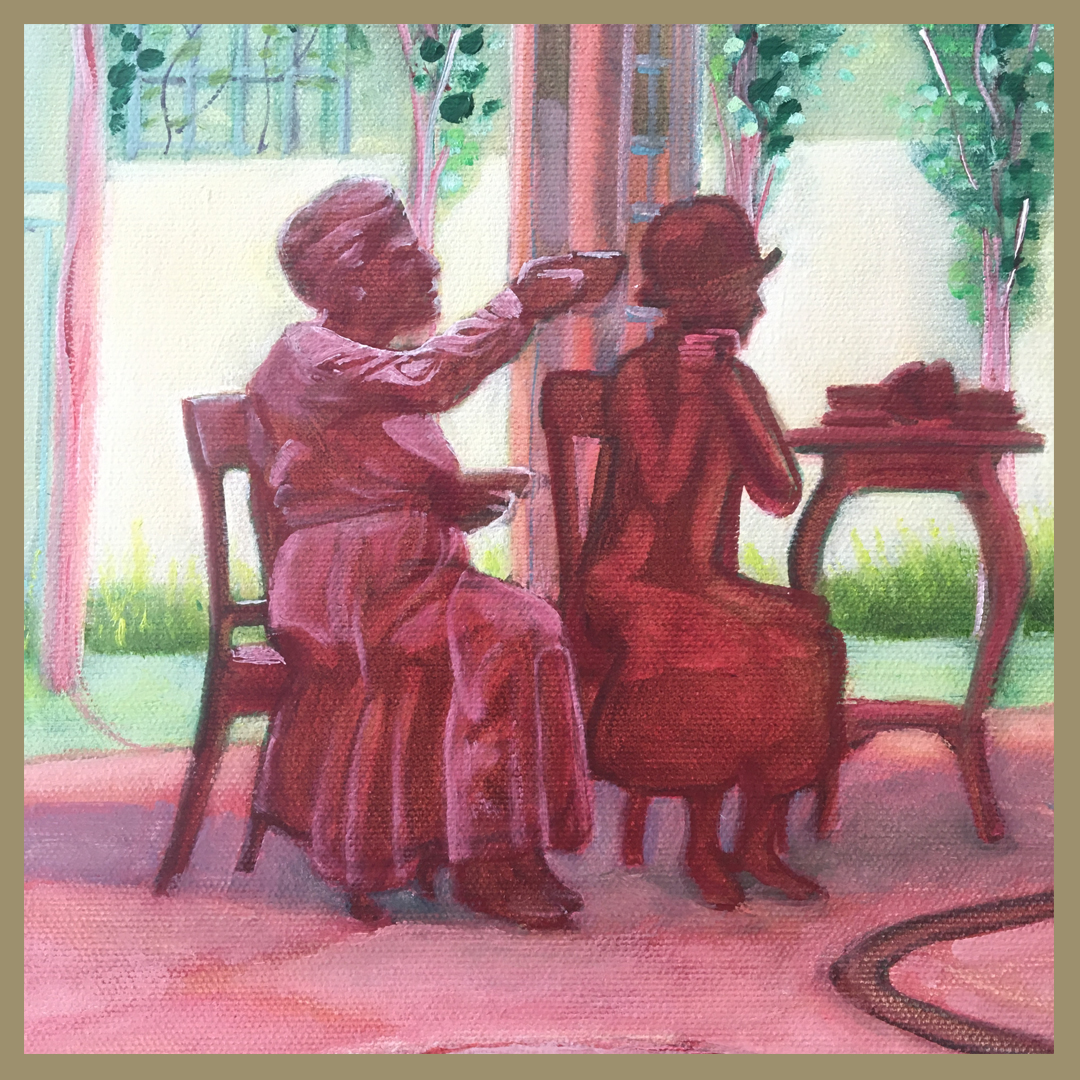
In the suffrage movement women used food and the role of hostess, keeper of the hearth and nourisher, as a tool in the push for women’s right through pink teas, suffrage teas and lunch rooms where they could fundraise, promote and strategize for women’s rights.
However it seems today food has been turned against us. Rather than being the fuel that allows us to accomplish great things, it is the thing we fear. We must limit what we eat to fit the image of the thin, the fit, the ambitious, the hard working, the responsible, the smart, the good woman. In starving our bodies into conformance we spend our time and energy focused on controlling food and controlling our behaviours. We are obsessed with the thought and image and preparation of food we cannot allow ourselves to have. There is no need for anyone else to assert control over us, we are contained, neutralized by our own hand.
It is not only a gendered issue, diet culture targets men as well as women, all ethnicities and economic groups in western influenced culture, but women have been the most prevalent targets, and the most ironic as the keepers of the cook pot.
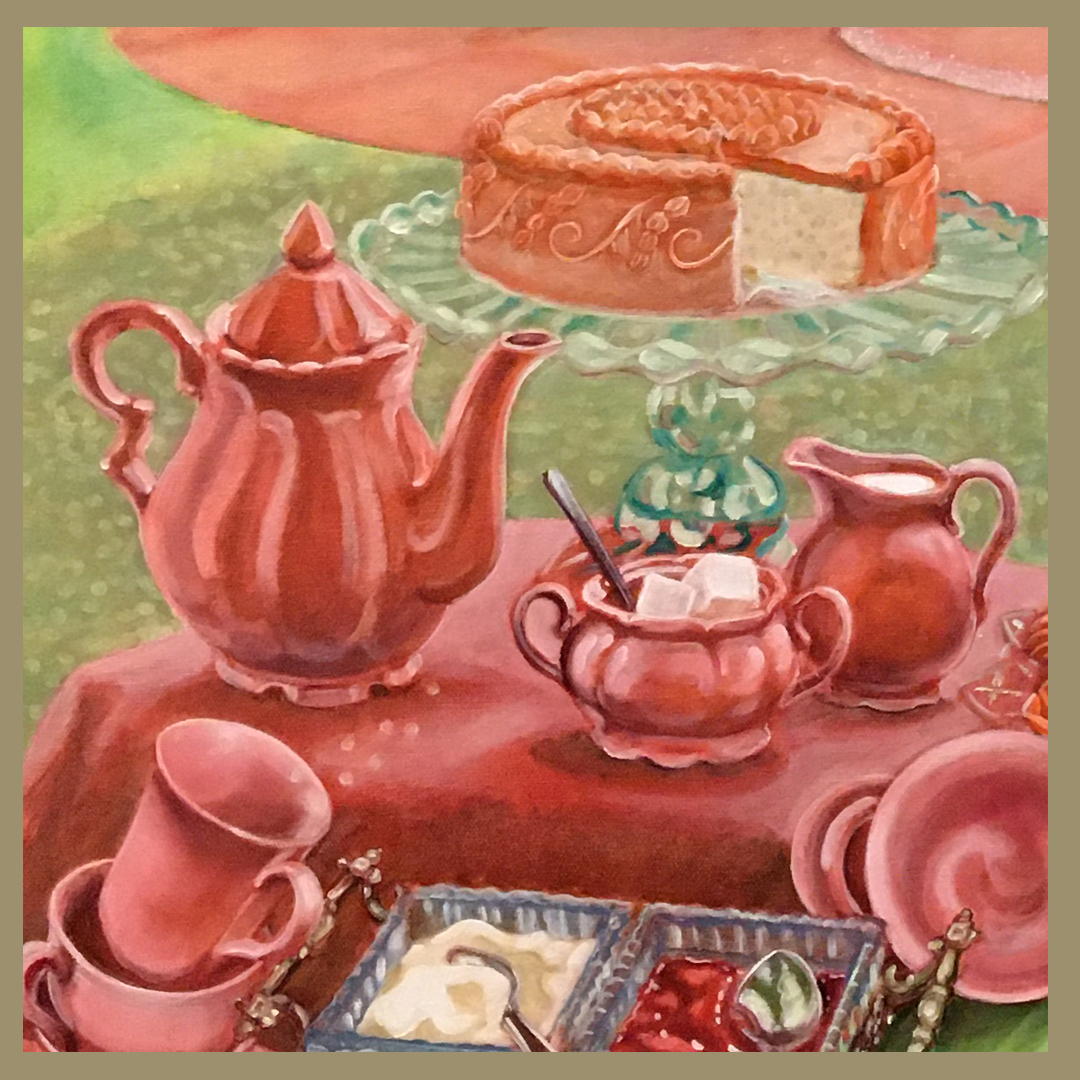
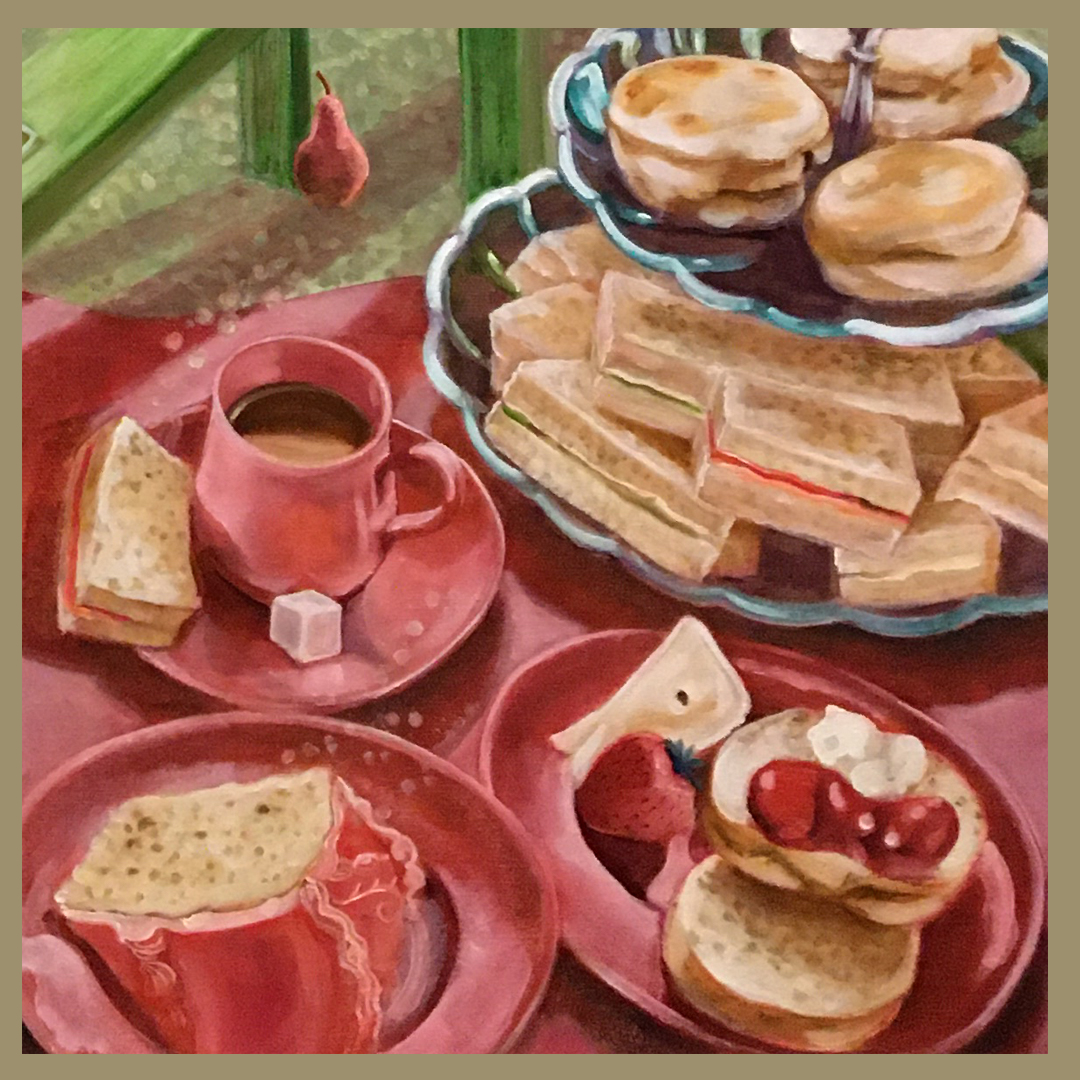
Energy Requires Mass is a question. Placing the feast on the end of the teeter totter reminds us that in order to have the energy to move the world, we need mass to convert. We need to eat. We need to decide, do we want to look like we can do great things, or do we want to do great things?
The Work In Progress – Slideshow
We acknowledge the support of Calgary Arts Development Association and the City of Calgary
Forces of Nature, 30″x30″ o/c, Debbie.lee Miszaniec
Welcome to the ninth instalment of a series of blog posts going more in-depth into the thoughts and ideas behind each of the paintings in the Earthly Delights series. The series is based on my experience navigating health and diet culture as a long term participant. You can read the full background by following the link to that blog post below:
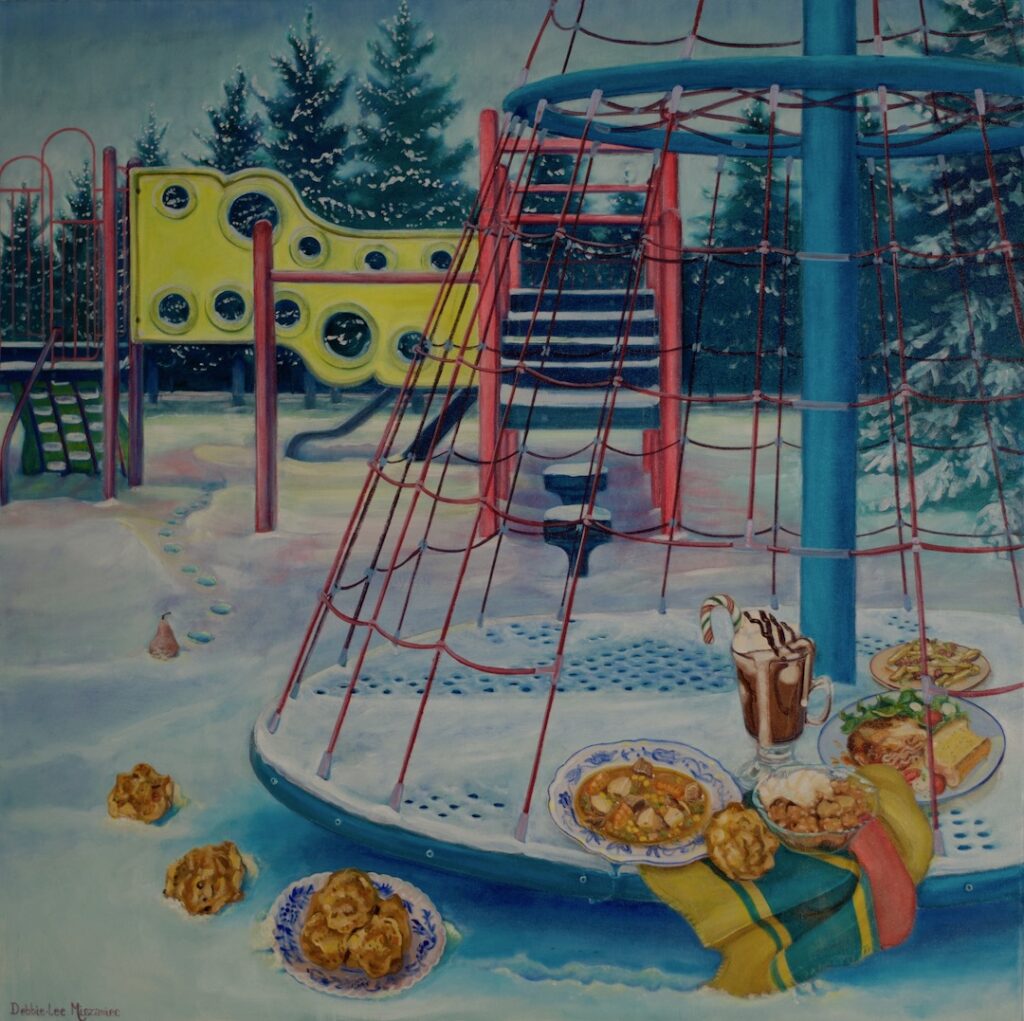
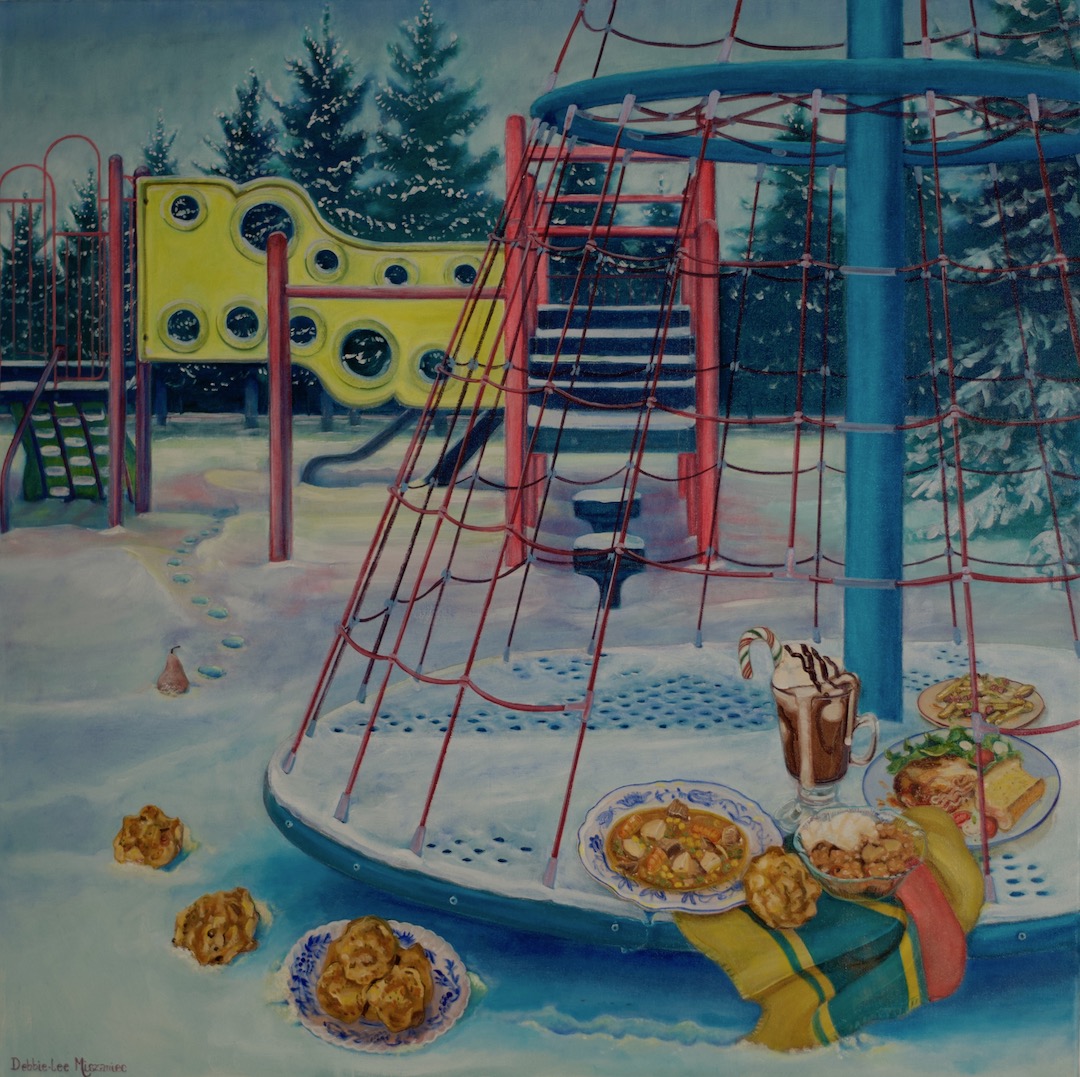
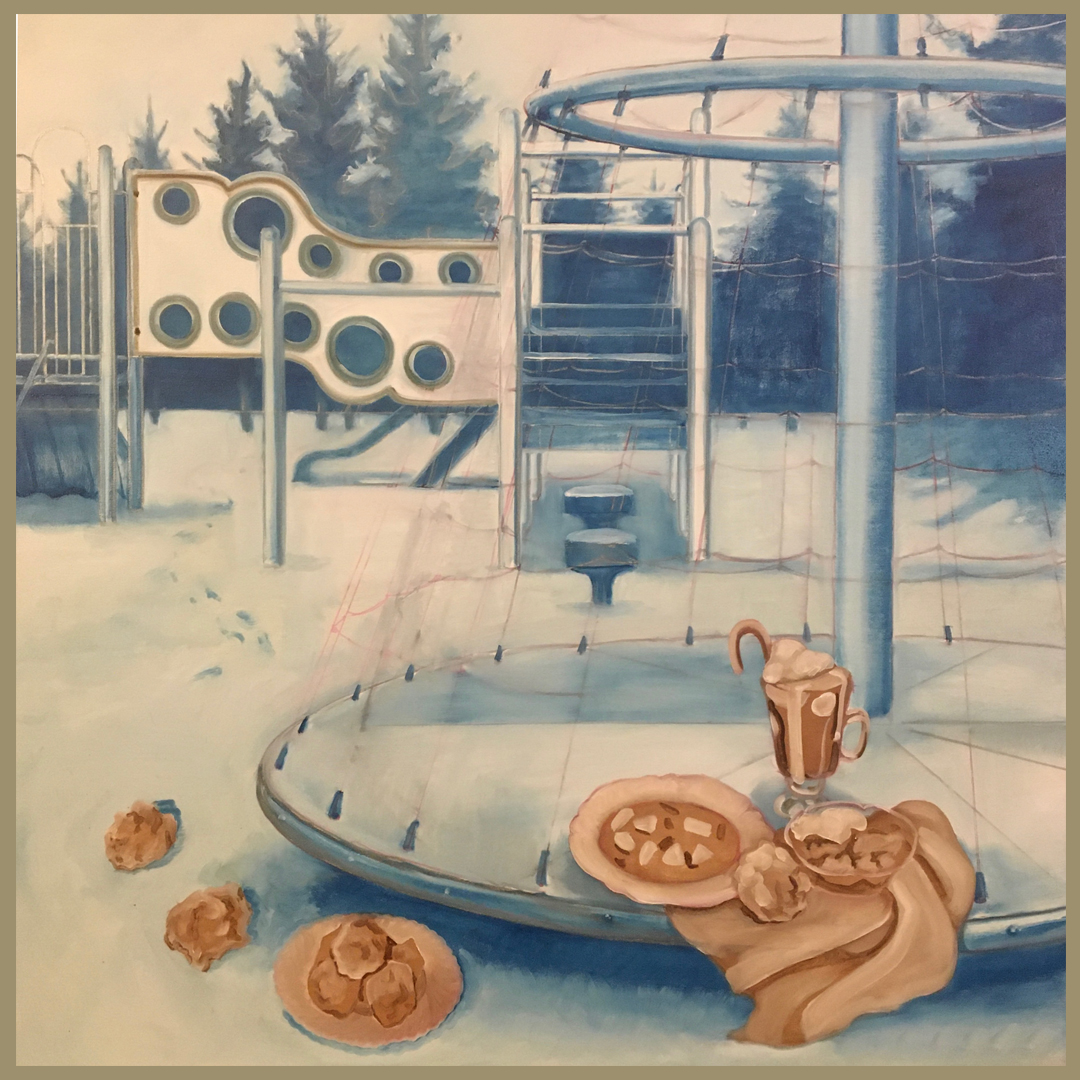
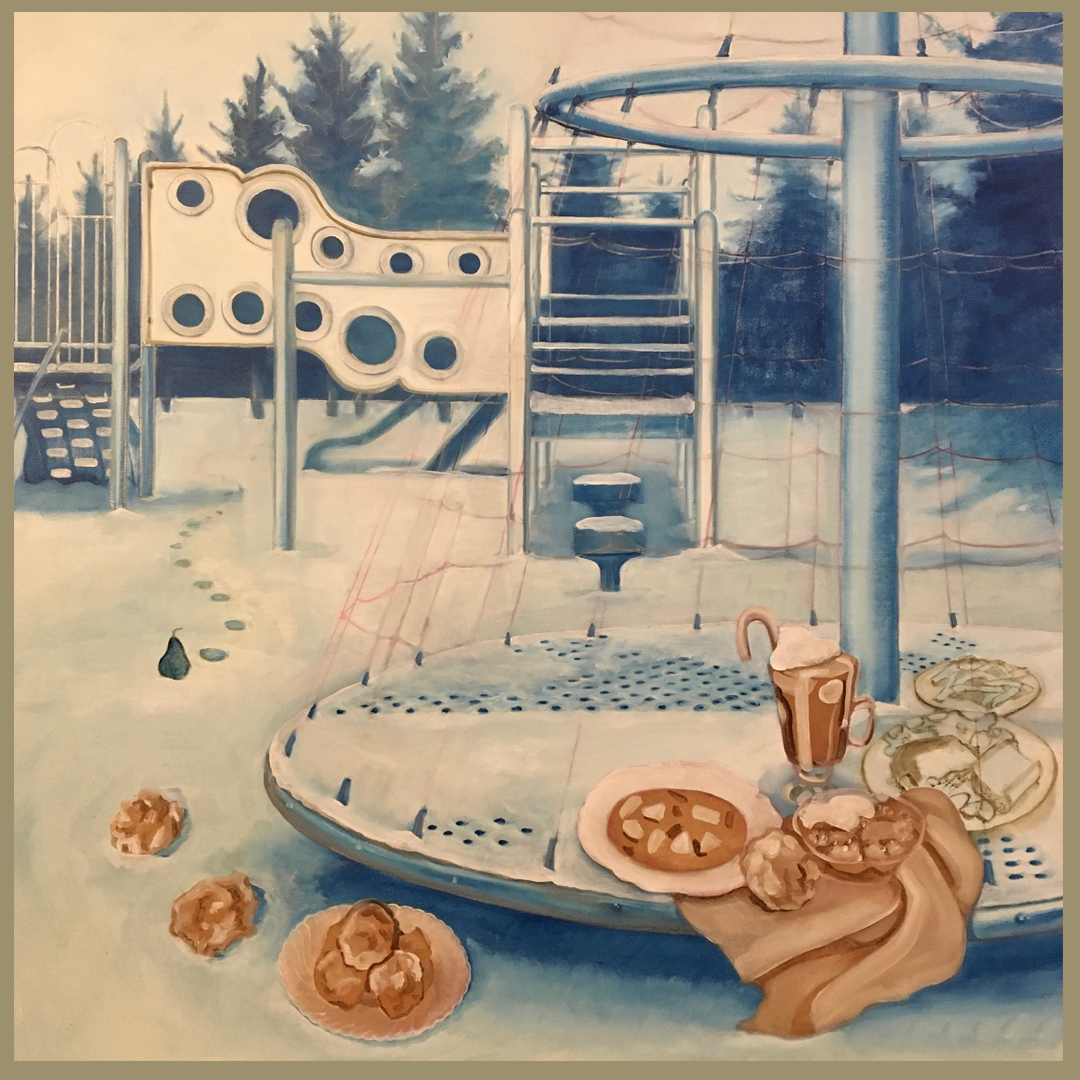
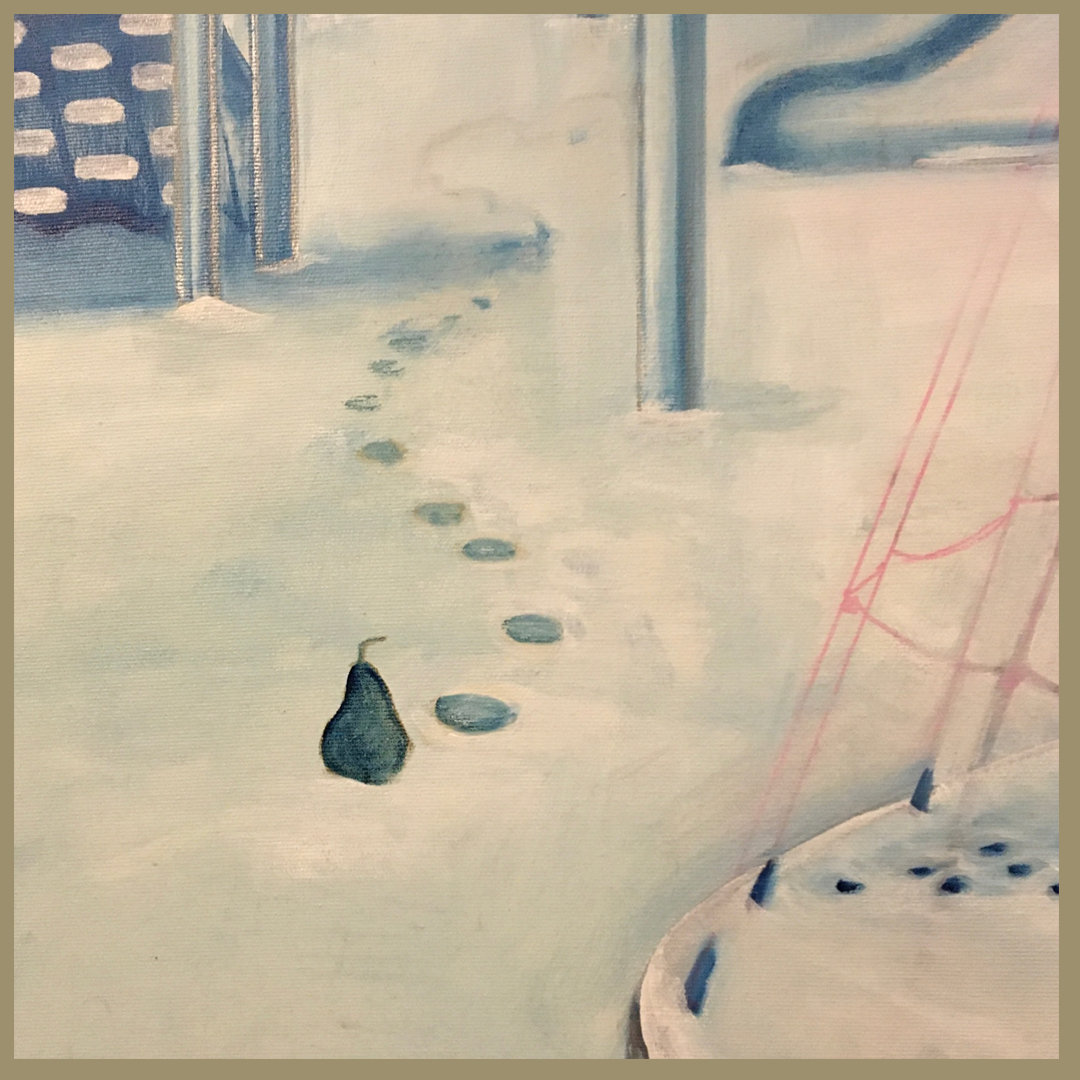
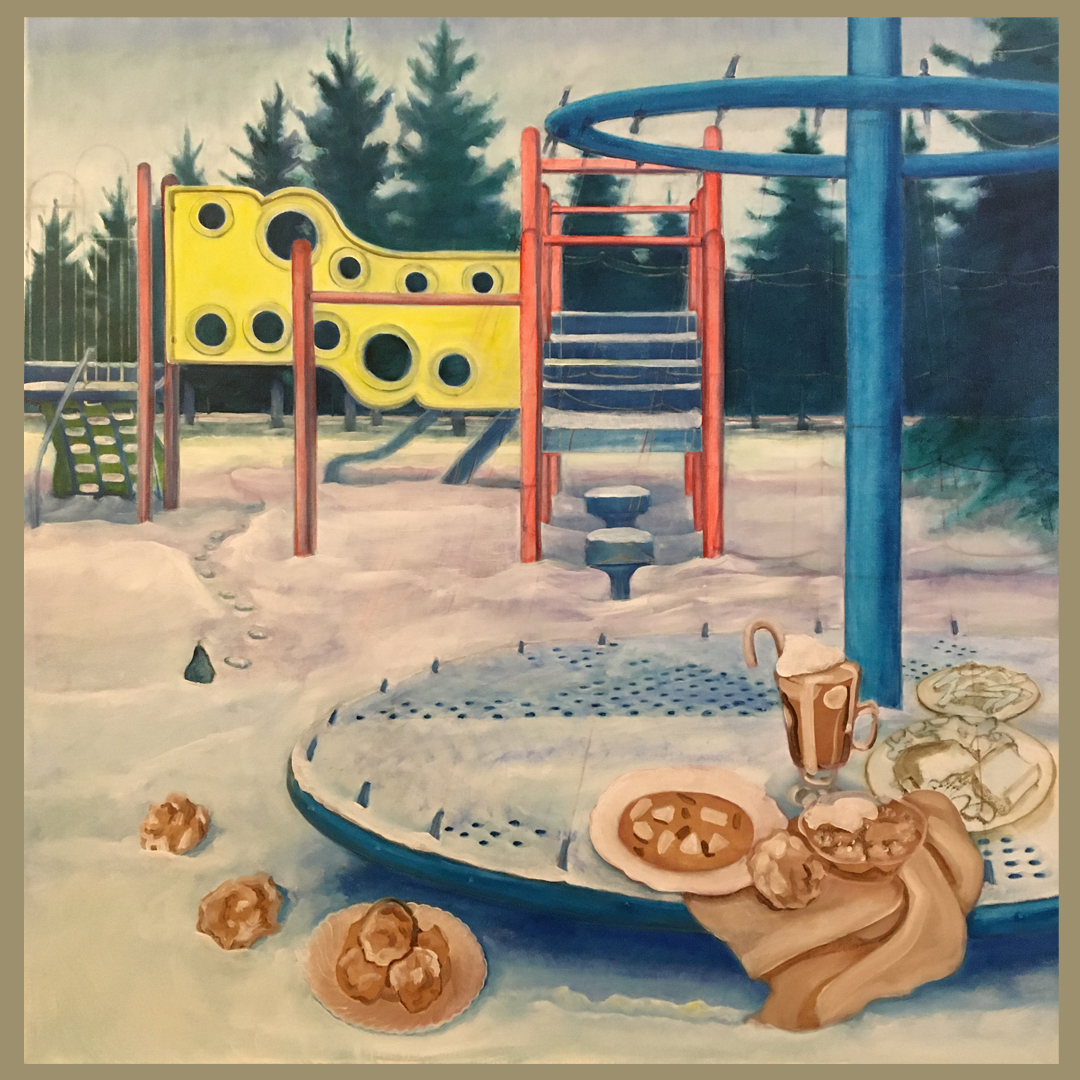
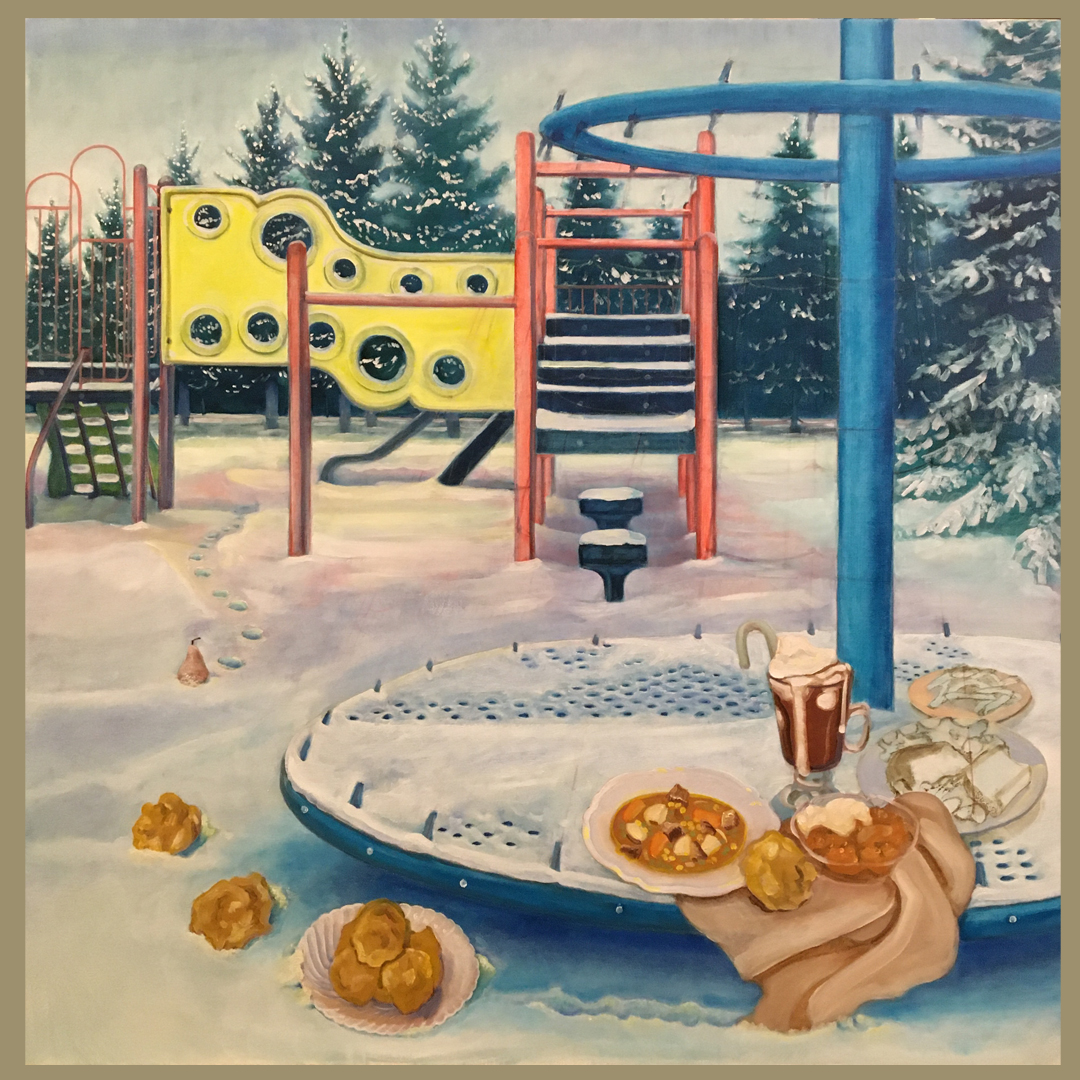
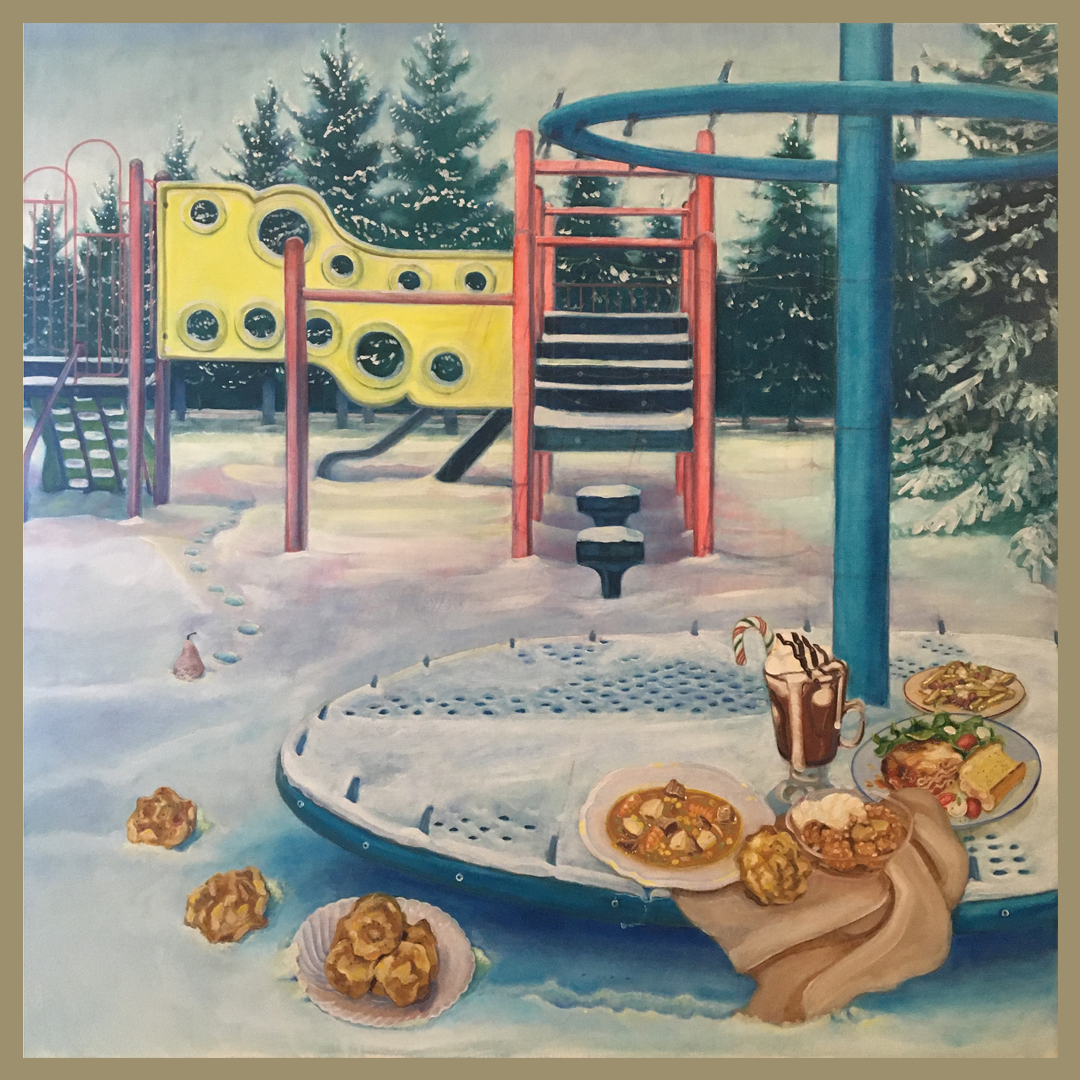
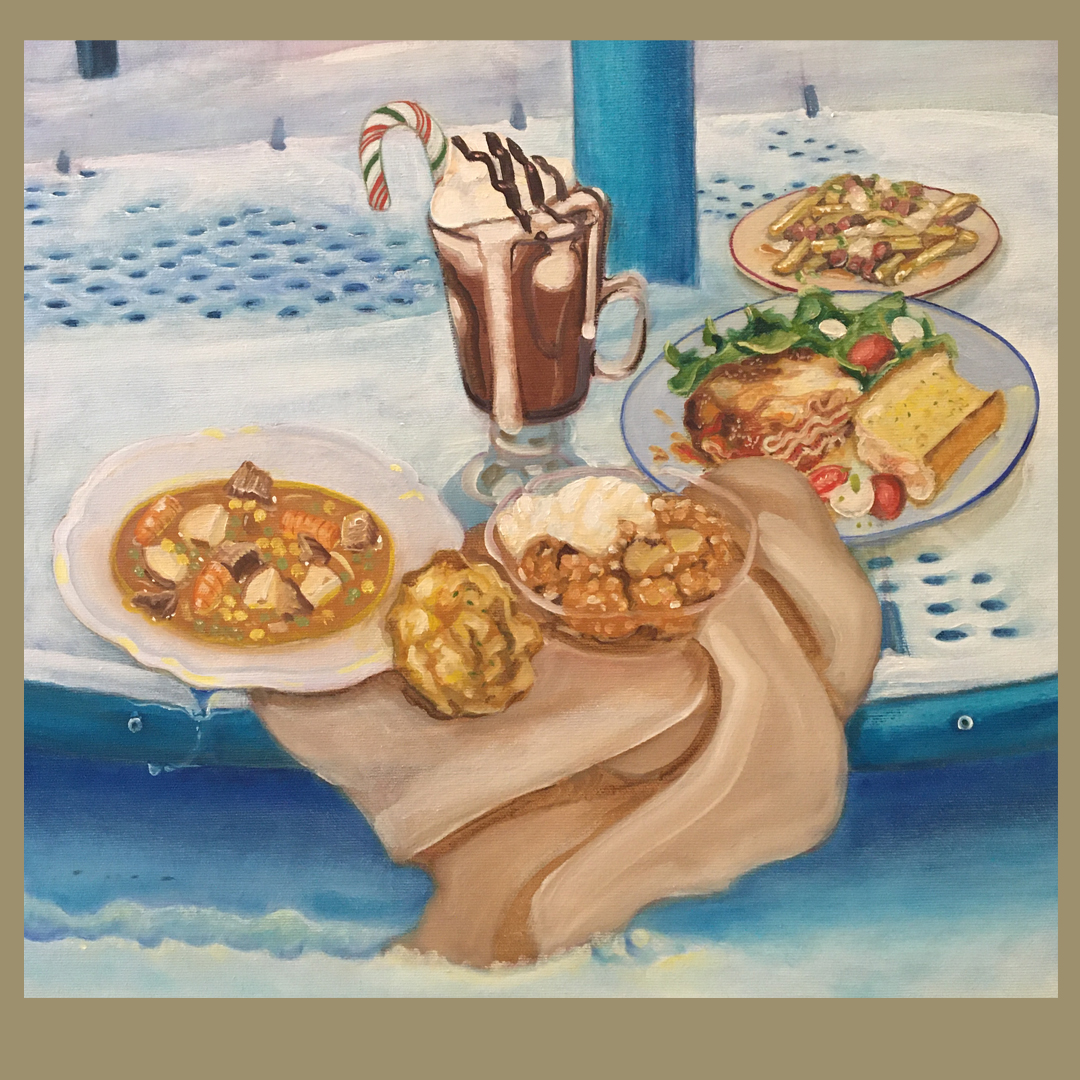
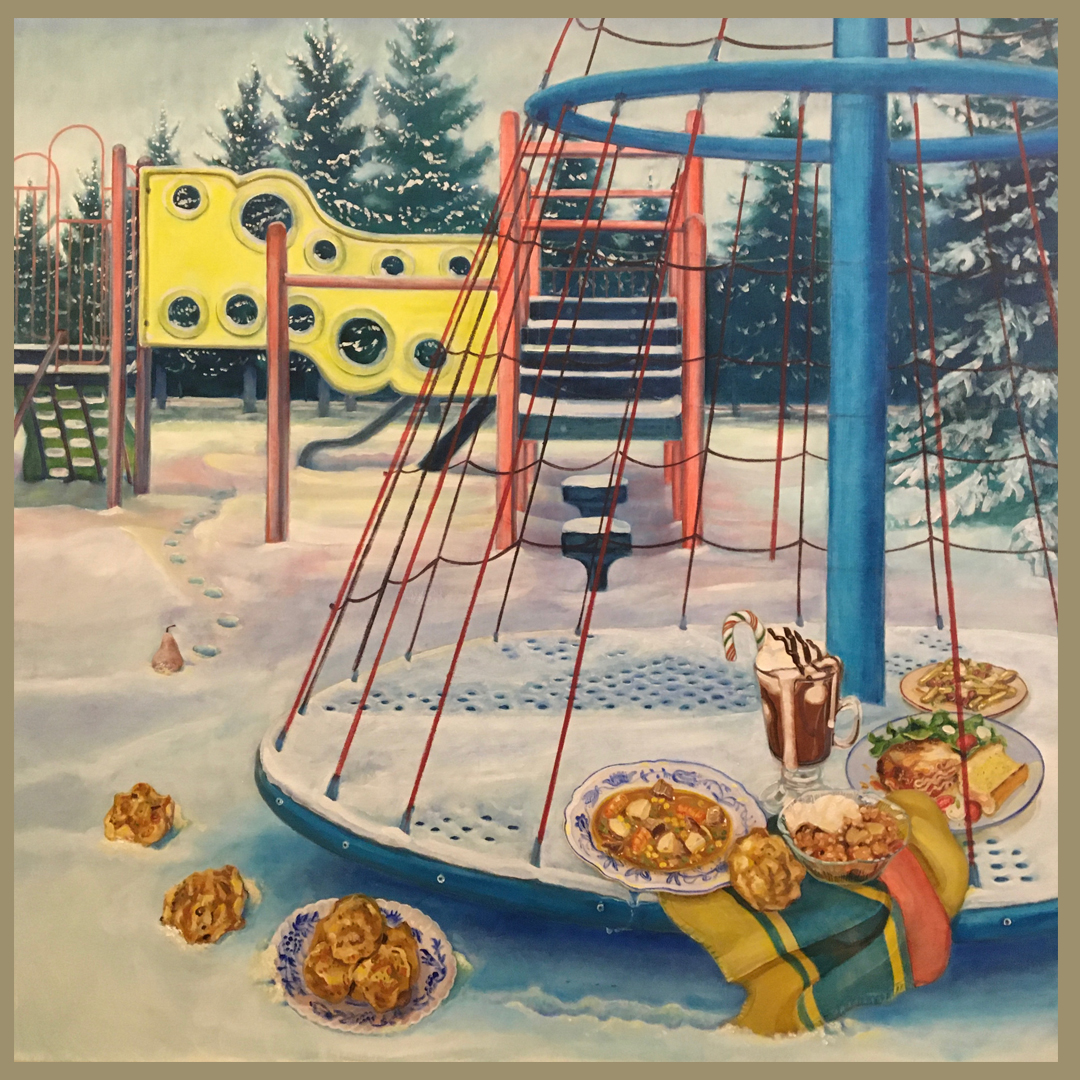
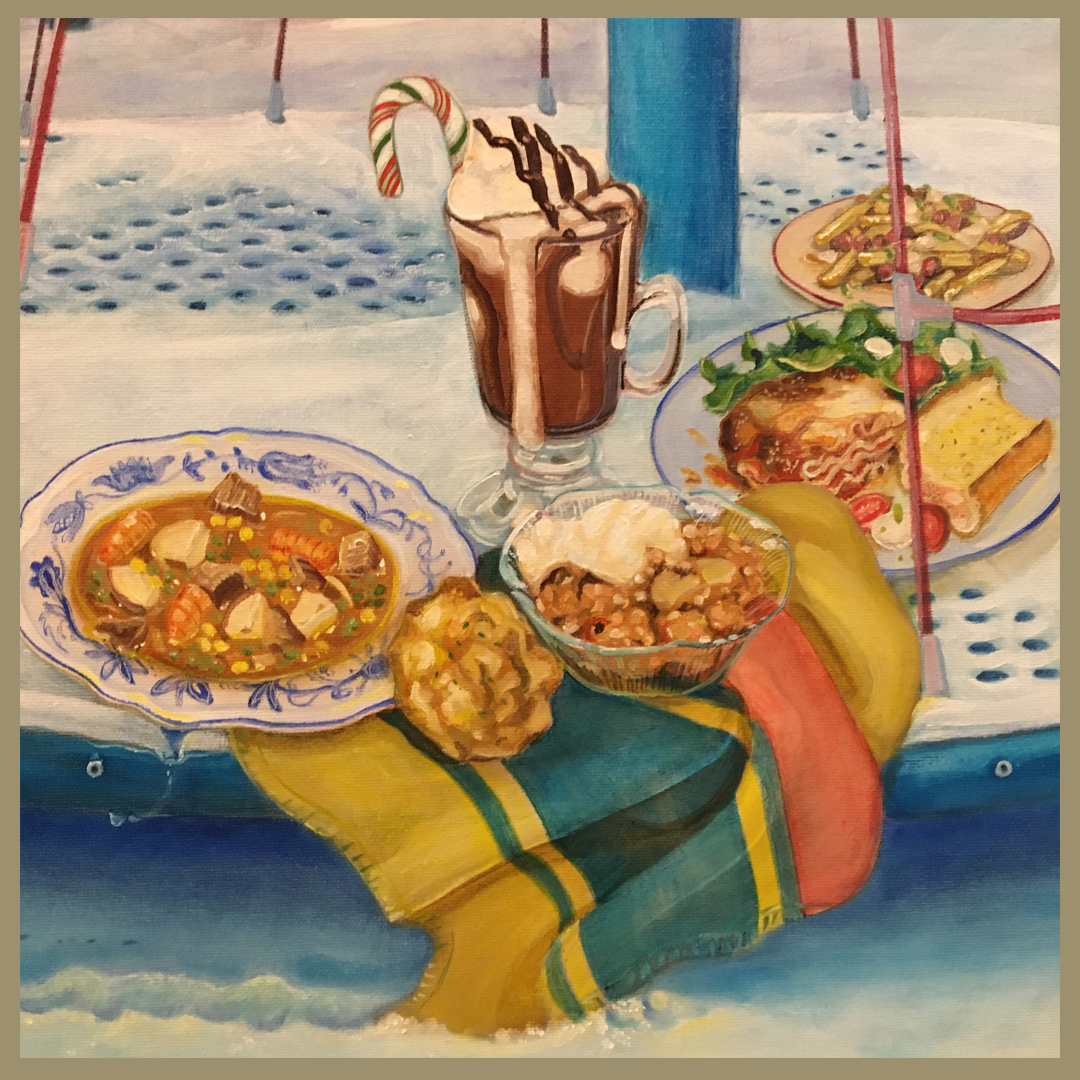
We make our marks in the world trudging through the deep snow. We expend energy keeping warm and keeping moving in our winter playground. What could be better than a hearty hot beef vegetable stew, or a lasagna, or poutine? Warm buttered biscuits, hot chocolate topped with thick whipped cream, fresh from the oven apple crisp with a scoop of vanilla ice-cream? The idea of hot, calorie dense comforting food becomes irresistible the longer we go before taking refuge and repast. Soon no tempting recreation will be able to distract.
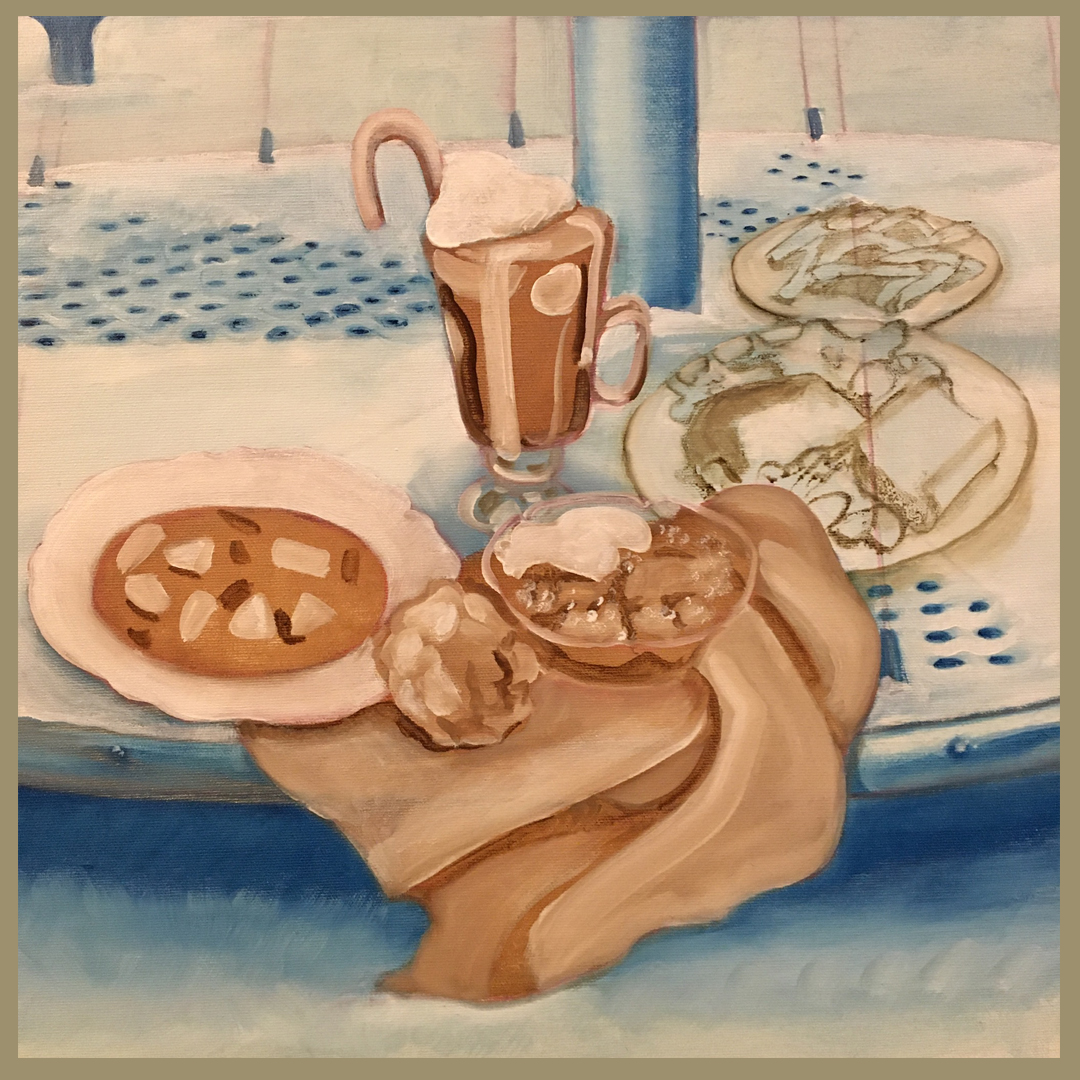
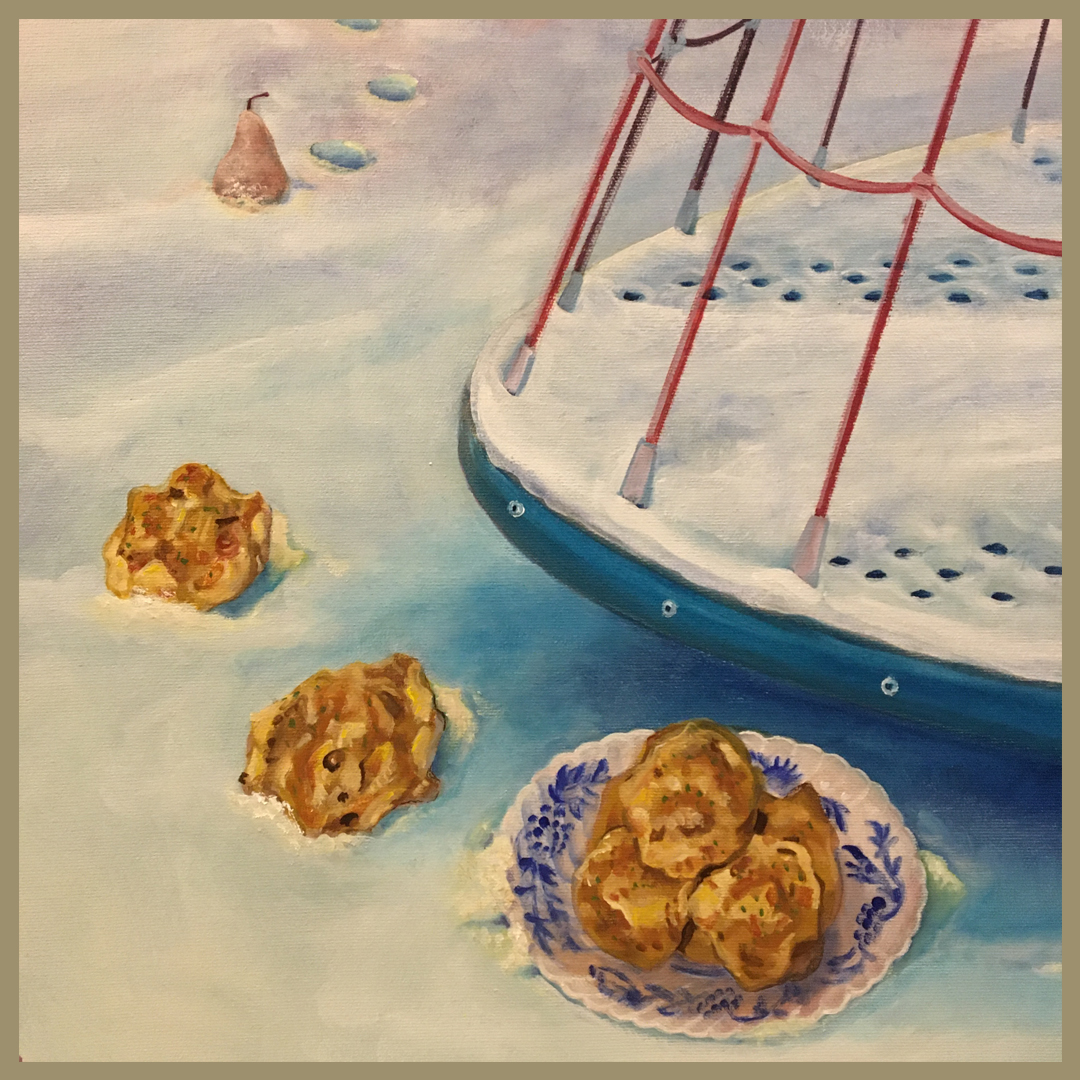
I was thinking about the warring forces of self-preservation and will-power within each of us when I placed this hearty banquet in a winter play ground on a merry-go-round. While we may think we have body fat to burn and our best interests at heart – resisting the draw of food to attain/maintain what we believe are healthy weight goals – the fact that we are inordinately drawn to images of food indicates that our body thinks otherwise and has activated its natural self-preservation mechanisms. It is only a matter of time, exposure and repetition before the forces of nature prevail over force of will, particularly when self preservation is on the side of nature. Each time that merry-go-round brings that plate of food past you, the magnifying effects of the cold, physical exhaustion and your own emptying stomach will seemingly push that food off the merry-go-round and toward you. Force of will vs. force of nature, which will win?
Placing the banquet in that winter landscape for me is a wake up call. Even if one does win a war of wills with nature, what does one win in this environment? Exhaustion? Frostbite, Hypothermia? When one’s body suggests visions of feasts, one should listen. The world can wait until one is rested and replenished.
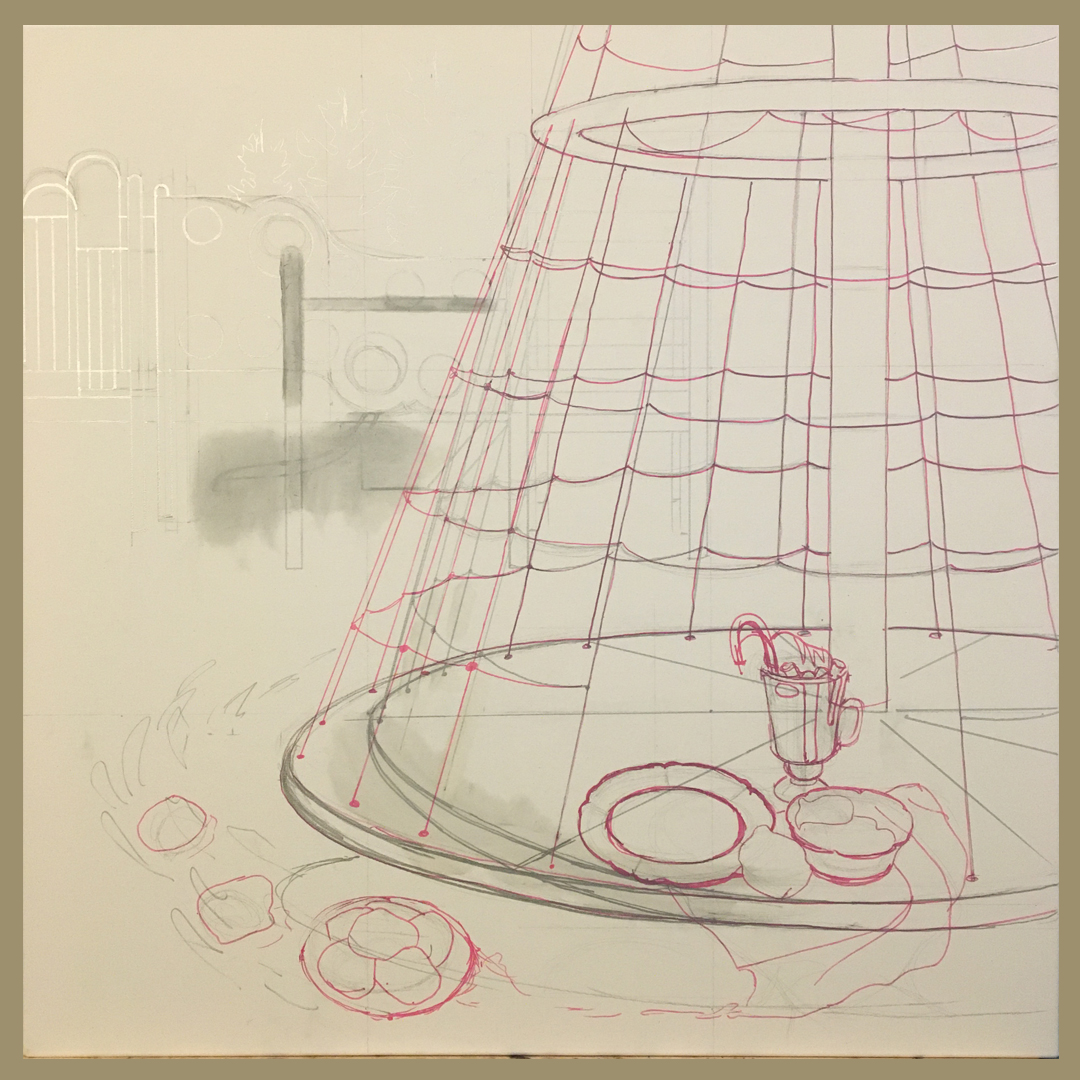
The Work In Progress – Slideshow
We acknowledge the support of Calgary Arts Development Association and the City of Calgary
Welcome to the 8th instalment of a series of blog posts going more in-depth into the thoughts and ideas behind each of the paintings in the Earthly Delights series. The series is based on my experience navigating health and diet culture as a long term participant. You can read the full background by following the link to that blog post below:
Some people appear to have everything, but never seem happy. It’s like they feel that, even with all the blessings in their cup, it’s not quite as full as it should be, and possibly someone else has been sipping from it. Maybe they feel that they have worked hard but the exchange hasn’t been fair, they haven’t got a ‘just dessert’ for all their hard work.
You can never be too rich or too thin, as the old saying goes. For some people life is a series of competitive challenges to demonstrate their worth through the accumulation of accolades and status: The perfect family, a beautiful home in a desirable area, a lucrative and successful career, public respect and recognition, the admiration of society, a thin fit attractive body. For all that work, they expect to be rewarded, they expect to be happy.
I have often wondered why some people of my general knowledge, and even my acquaintance, seem to have it all and yet are not particularly happy people. Why is it that they fixate on someone else getting something, some reward they think they should have had, or at the very least the other did not earn as they did. Why don’t they feel happy, content, satiated?
Then I had an interaction where my own realization of the psychological effects of long term caloric restriction on my thinking led to a flash of insight into that paradox:
I was having a conversation with one such achievement oriented being, one whom I had always known to be very trim and athletic. We happened across the topic of cooking, and I recognized in that person the same obsessive interest in food that I had developed as a result of my years of caloric restriction.
I realized then the unacknowledged efforts this person had to go through to maintain their trim figure. They well and truly earned their body. However, to maintain it meant it was likely they were always living on the edge of hunger.
In the Minnesota Starvation Experiment, conducted on conscientious objectors during the late years of WW2 by Ancel Keys and documented in The Biology of Human Starvation (1950, Keys et al.), participants were placed on a diet that supplied just half of their caloric requirements for a period of 6 months. (FYI, most weight loss diets today recommend a similar ratio for caloric restriction.) The results of that experiment still supply much of our scientific knowledge about the effects of starvation on the human mind and body. Documented psychological effects of starvation on the participants included a fixation on images of food, cooking and eating, as well as an urge to collect recipes, cook books and even cooking implements. The effect was so powerful that during the course of the experiment several participants even changed their aspirations to pursue culinary occupations. In addition to food fixation, experiment participants were increasingly irritable, sensitive to any perceived injustice related to food portions, food waste or delays in food service. They were often judgemental of the physiques of others who appeared more well fed than they.
Back to my acquaintance then, I understood that as a result of this constant low level hunger it was possible they were always just a little grumpy, but didn’t necessarily know why. After all, they had everything one could possibly want, other than a regularly full belly. Instead, the hunger infiltrated their perspective on life; some one else was always getting the serving of success they should have had. They always felt just a little short changed. And honestly, I’d have to agree. Diet culture, the culture of thin and its promised rewards, had short changed them.
But this painting isn’t really about them, it’s a meditation on my dilemma with diet culture. Would I be so in love with my appearance – the socially prescribed attributes of a successful life of which physical appearance is a part – that I would sacrifice my mental health, my sense of gratitude and my happiness to that appearance?
The Work In Progress – Slideshow
We acknowledge the support of Calgary Arts Development Association and the City of Calgary
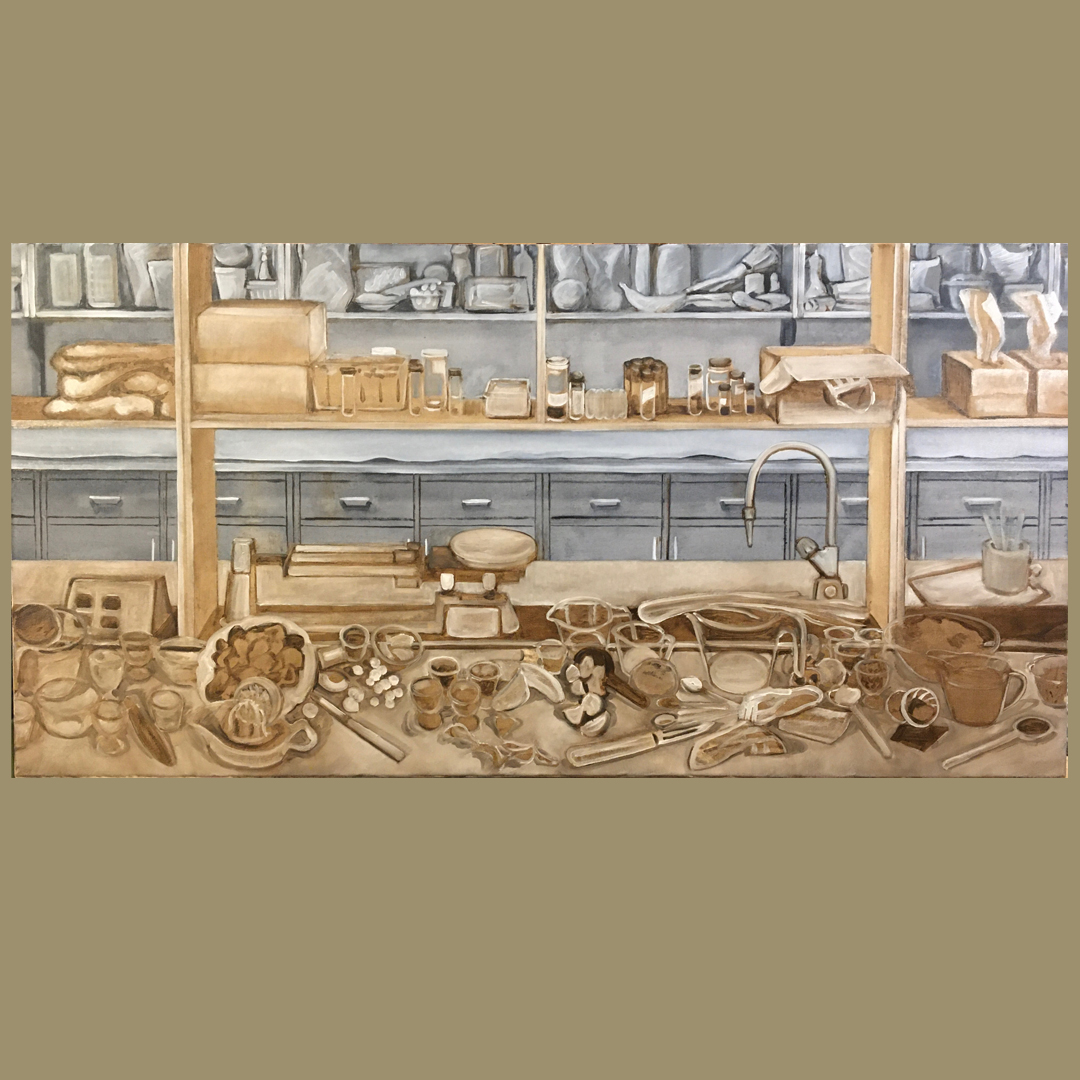
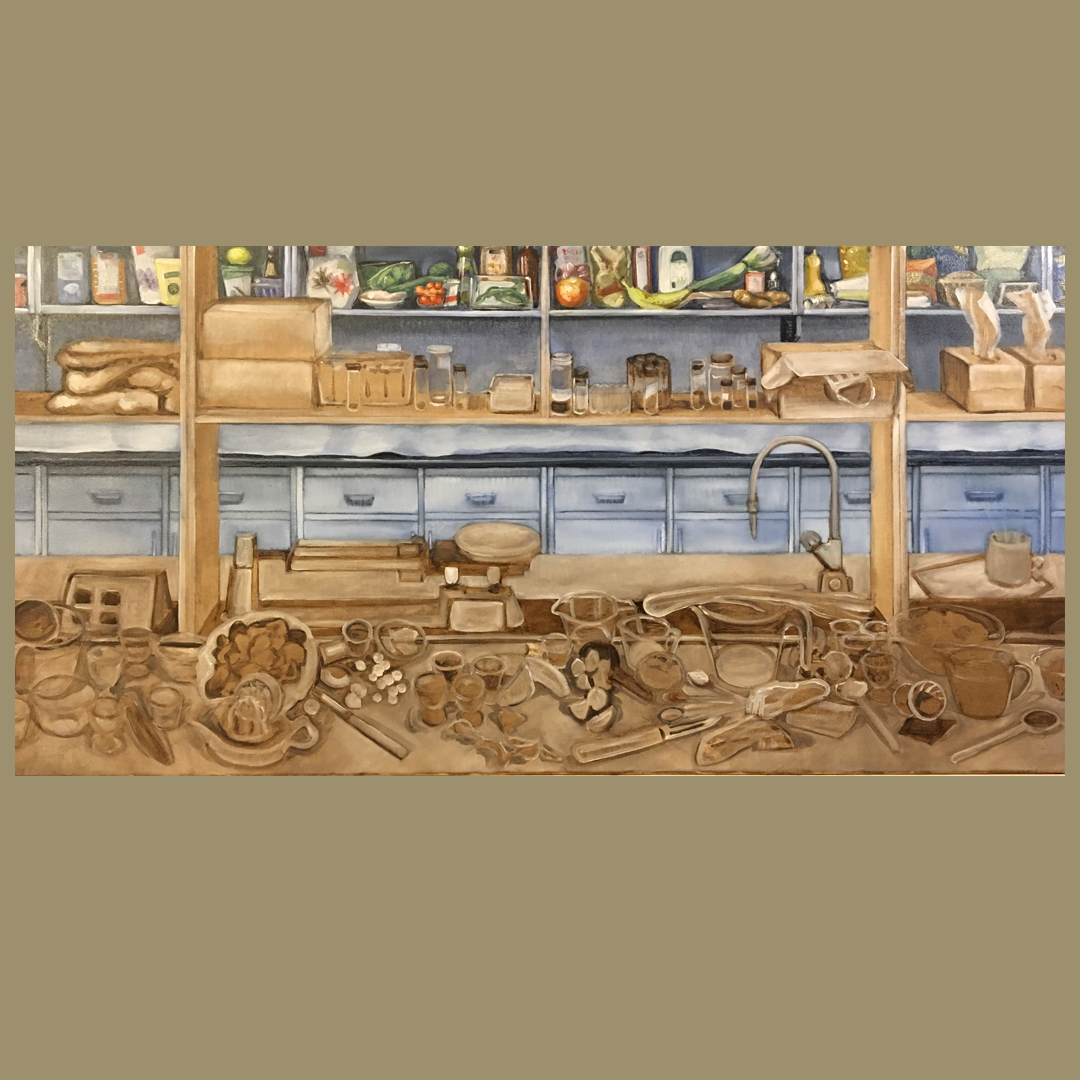
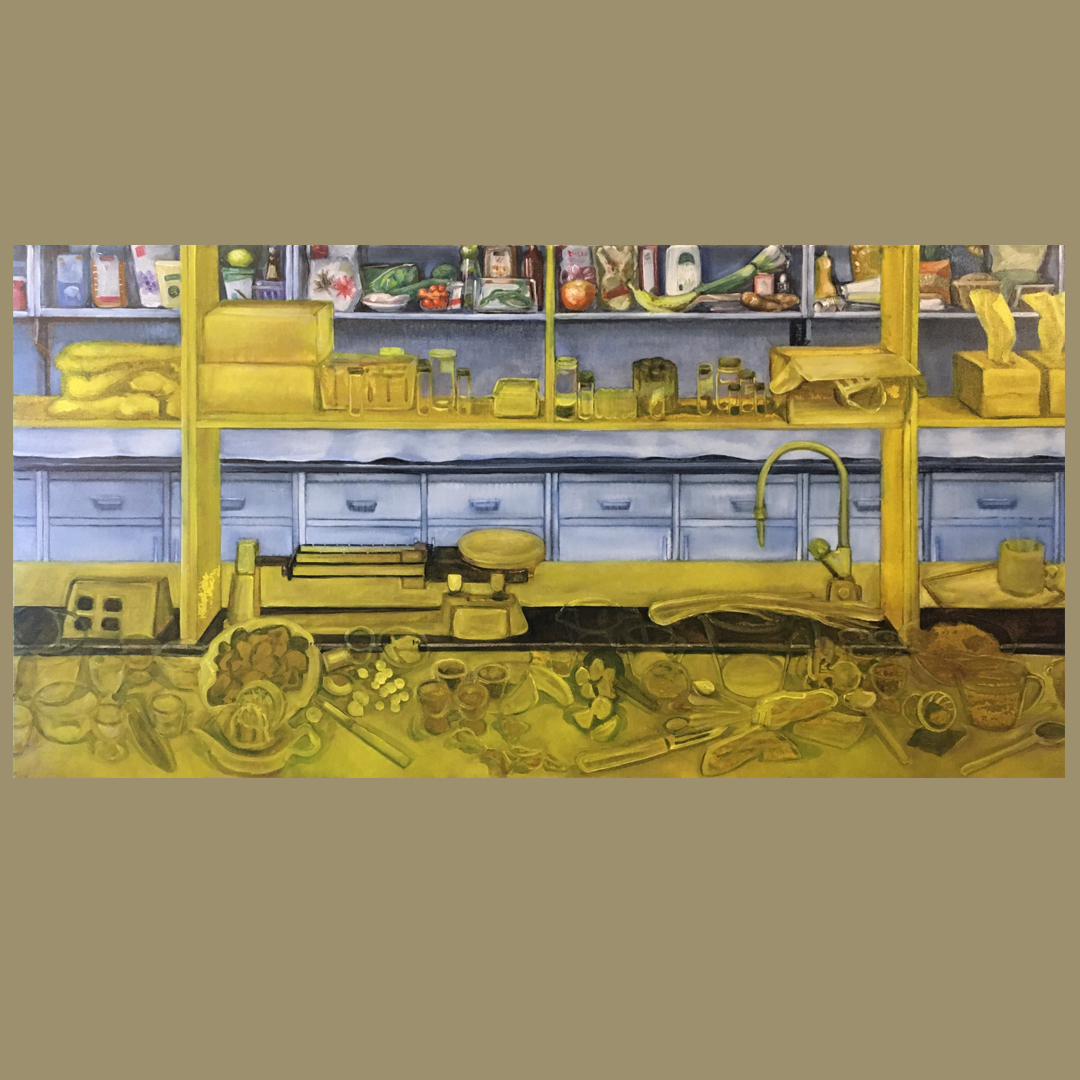
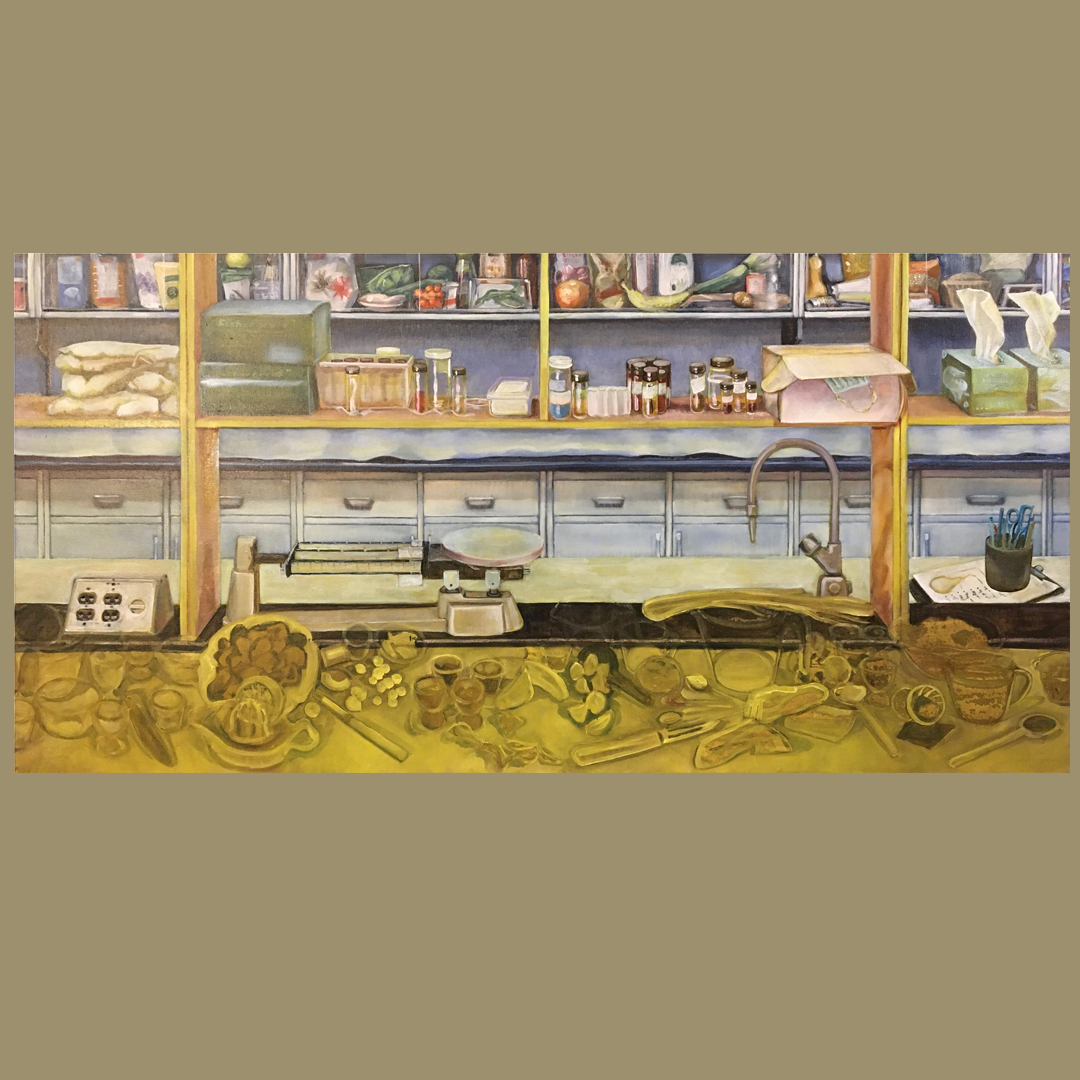
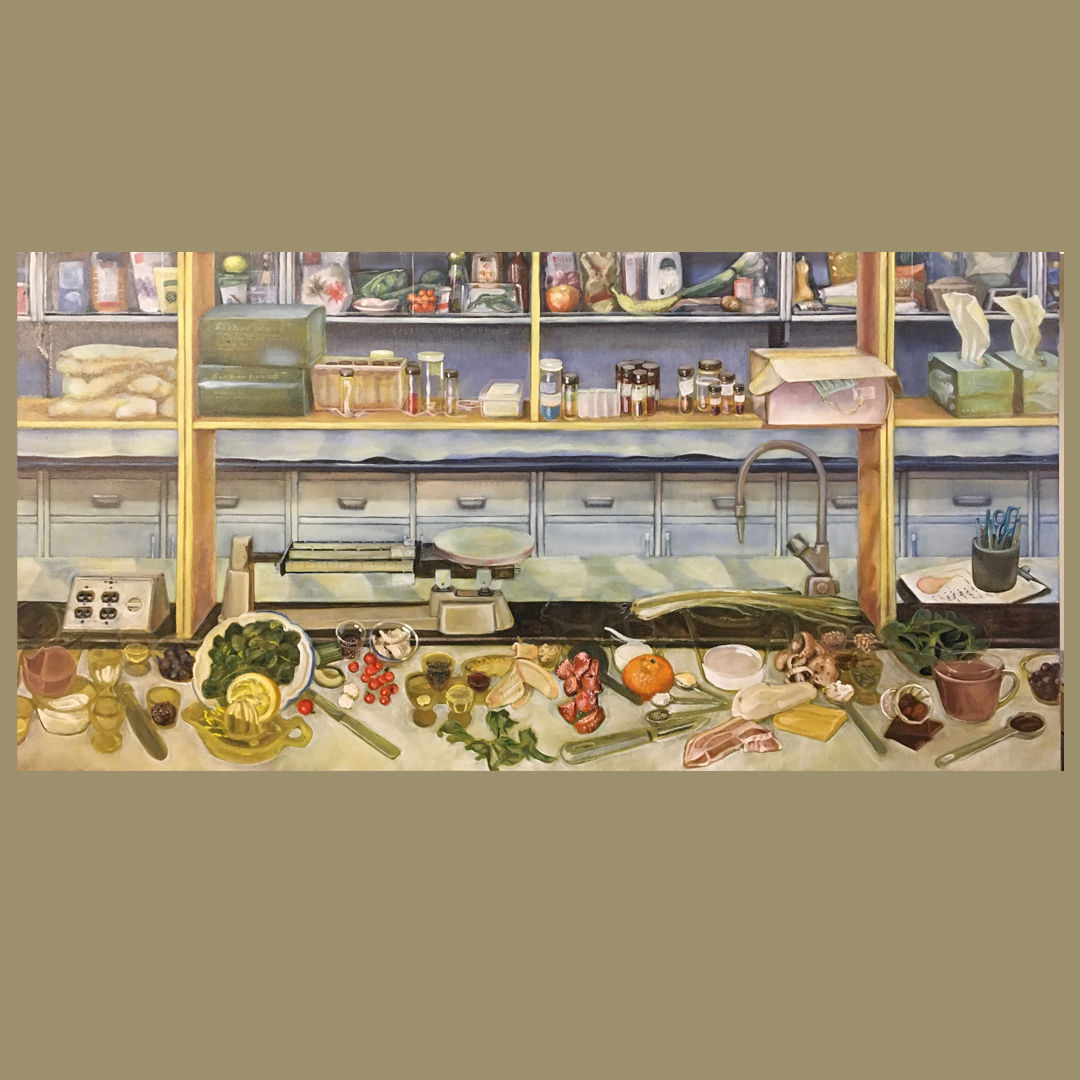
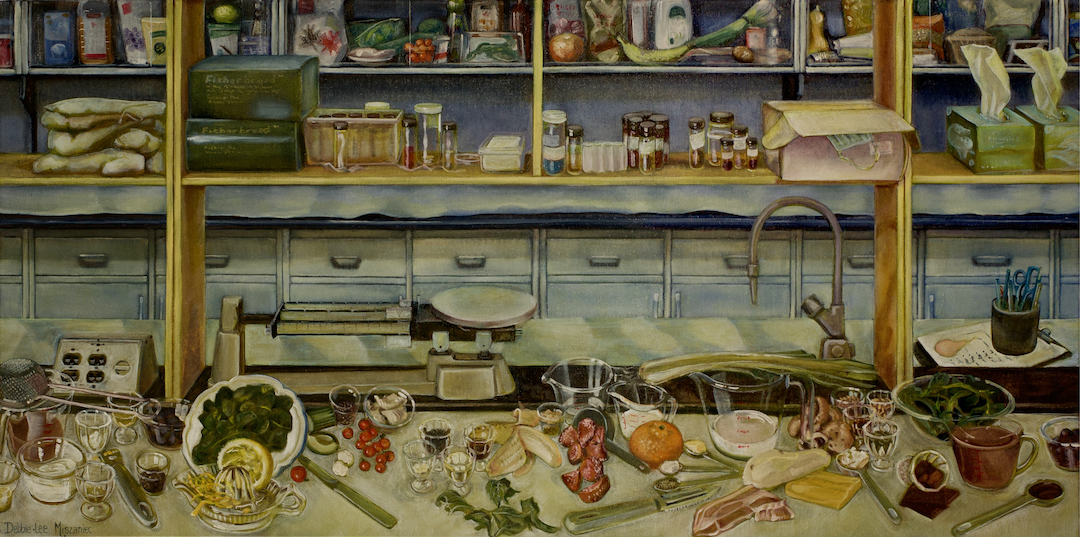
DRI – Getting The Most From The Least, 18″x36″ o/c, Debbie.lee Miszaniec
Welcome to the seventh instalment of a series of blog posts going more in-depth into the thoughts and ideas behind each of the paintings in the Earthly Delights series. The series is based on my experience navigating health and diet culture as a long term participant. You can read the full background by following the link to that blog post below:
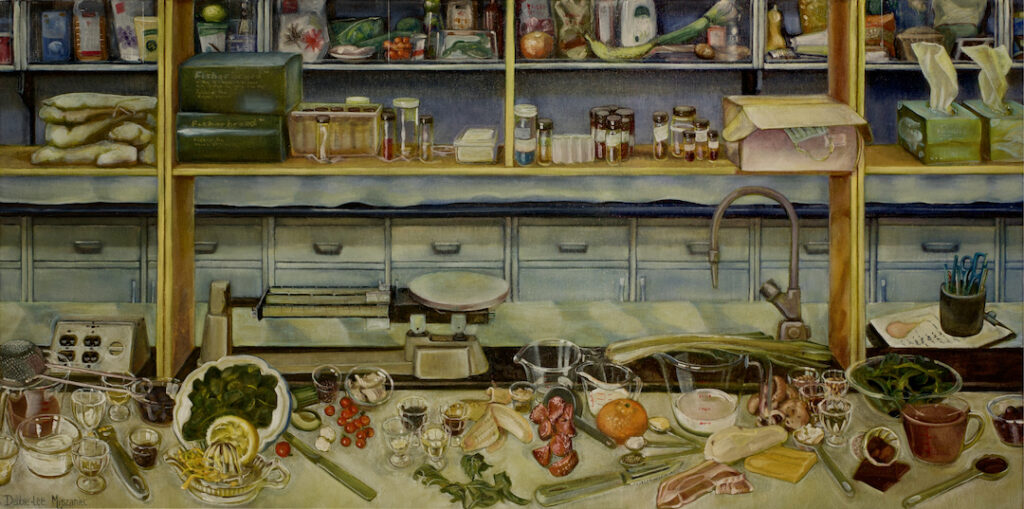
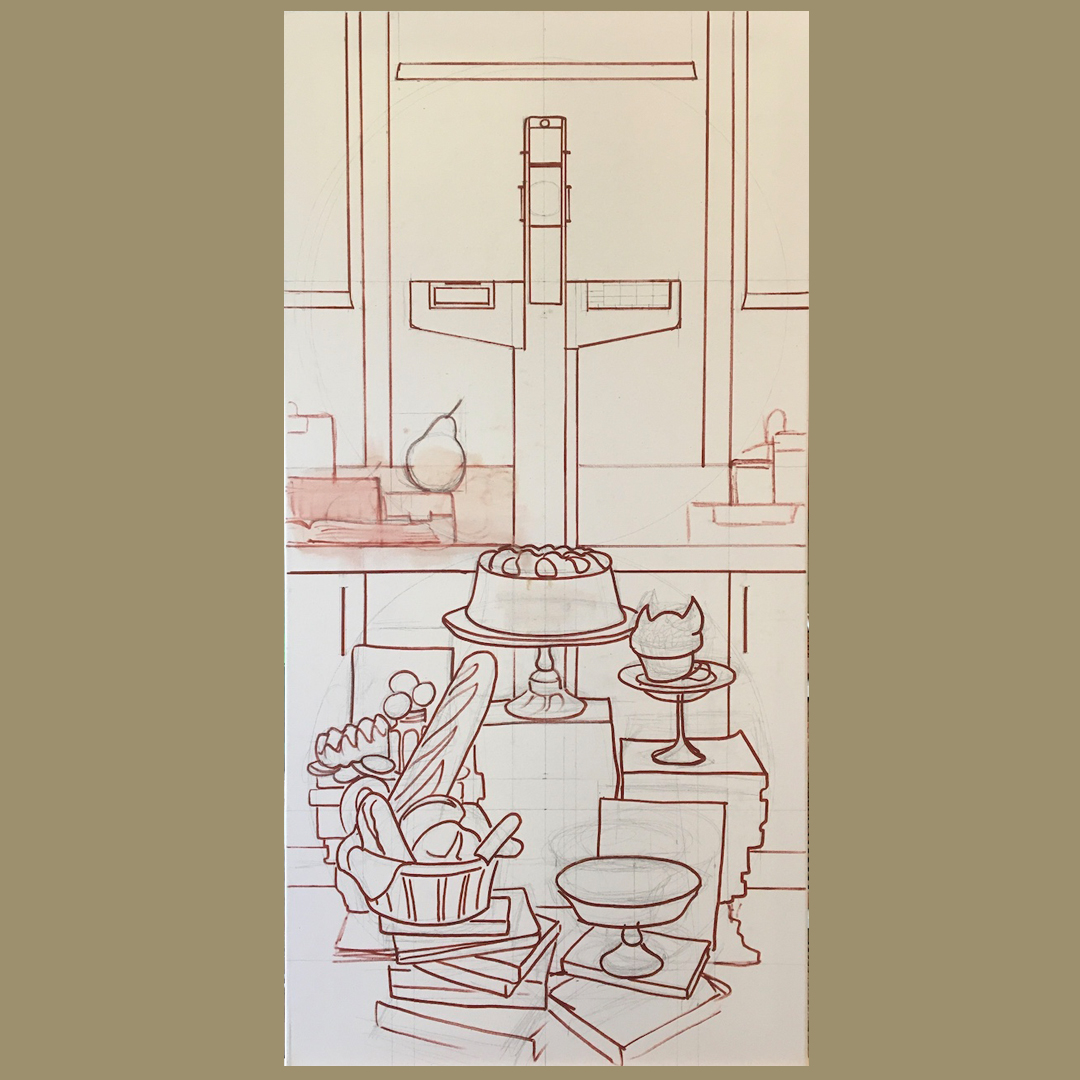
Following from my last post about DRI – Return on Investment,DRI – Getting The Most From The Least shows the ingredients from the former painting in the process of becoming the meals for one person, for one day in the previously mentioned healthy eating plan.
In the last post I wrote about the financial investment that health and diet culture encourages people to believe is necessary to achieve the holy grail of good health and a slim physique that matches our culture’s expectation for what good health looks like.
In this painting I wanted to talk about another form of privilege in health and diet culture. The privilege of time.
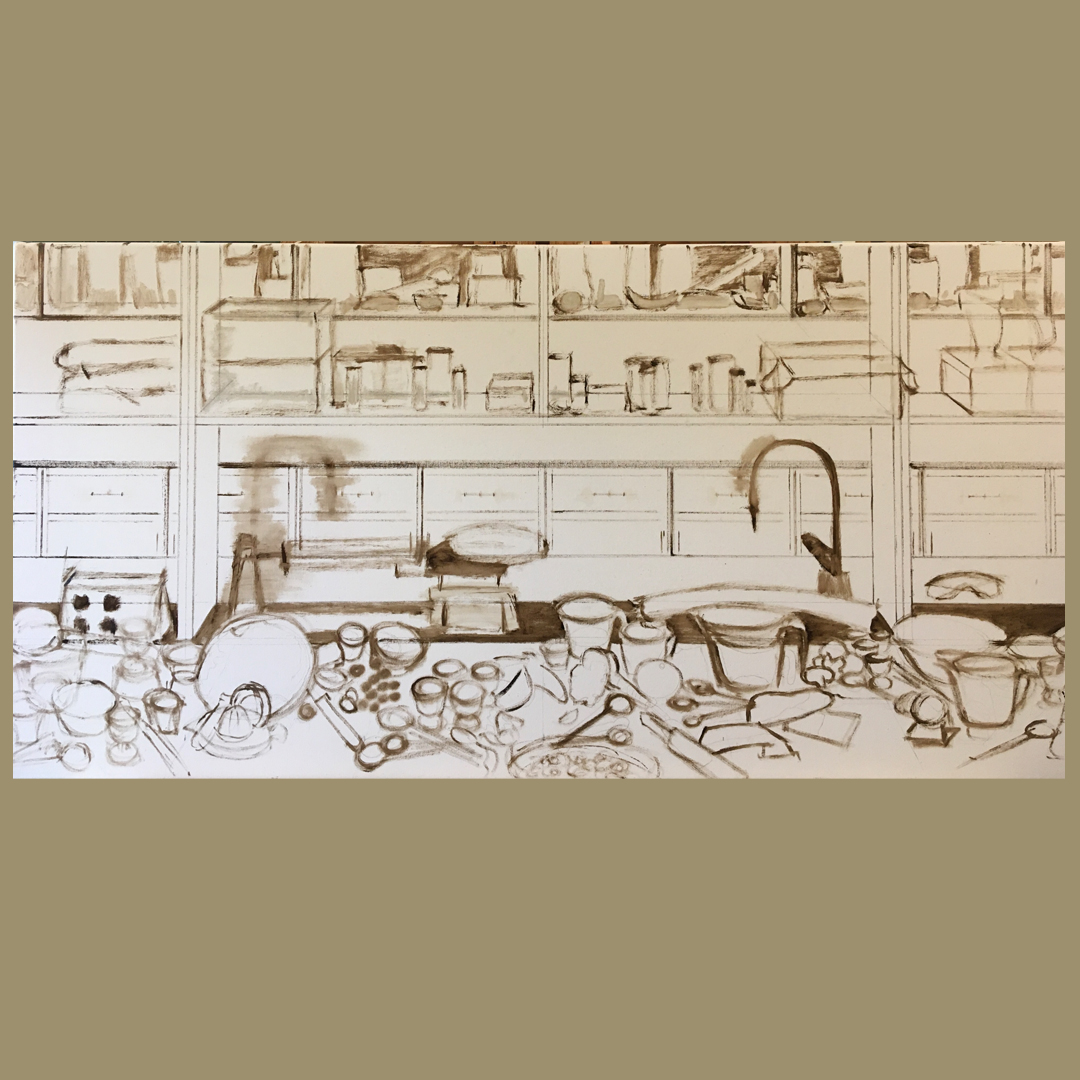
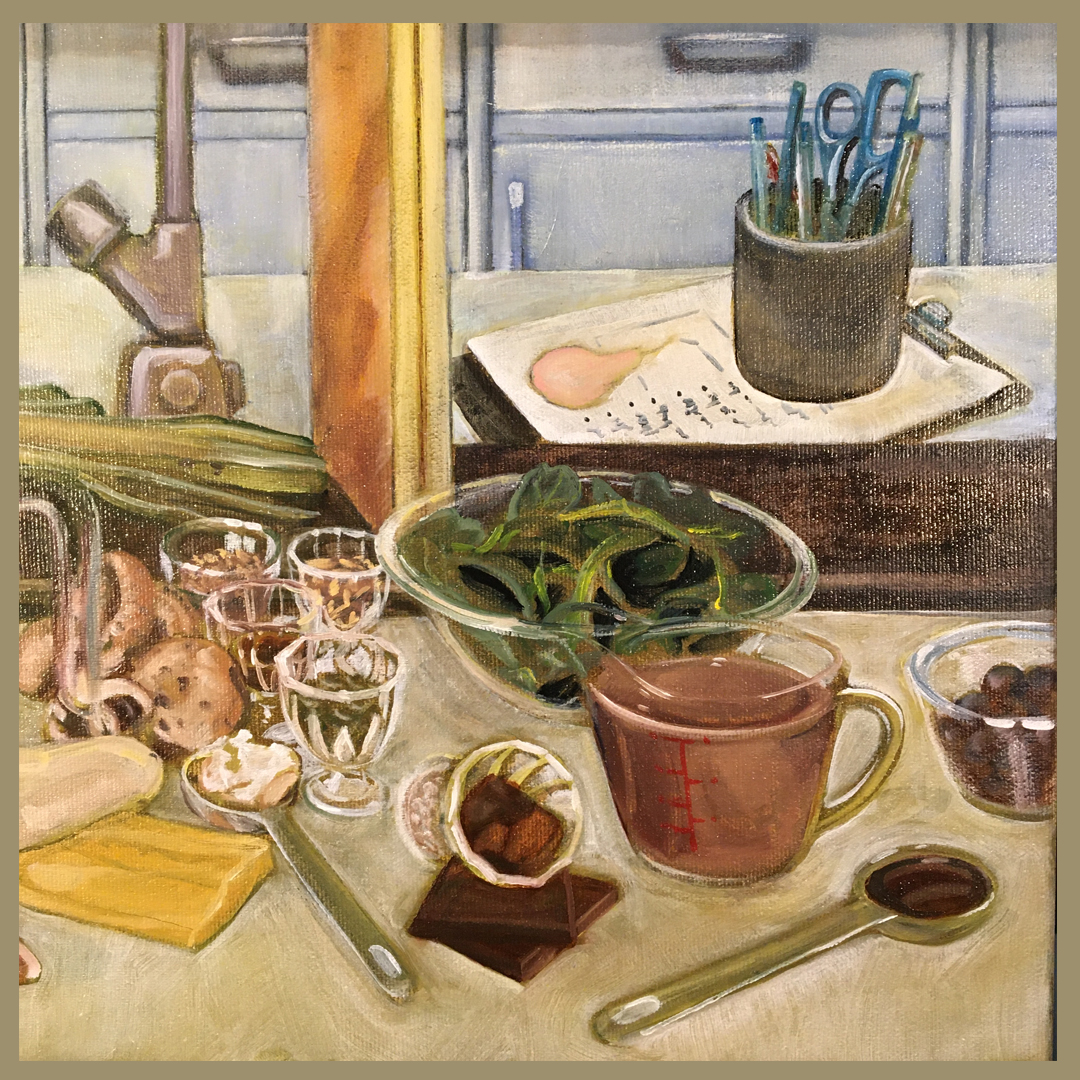
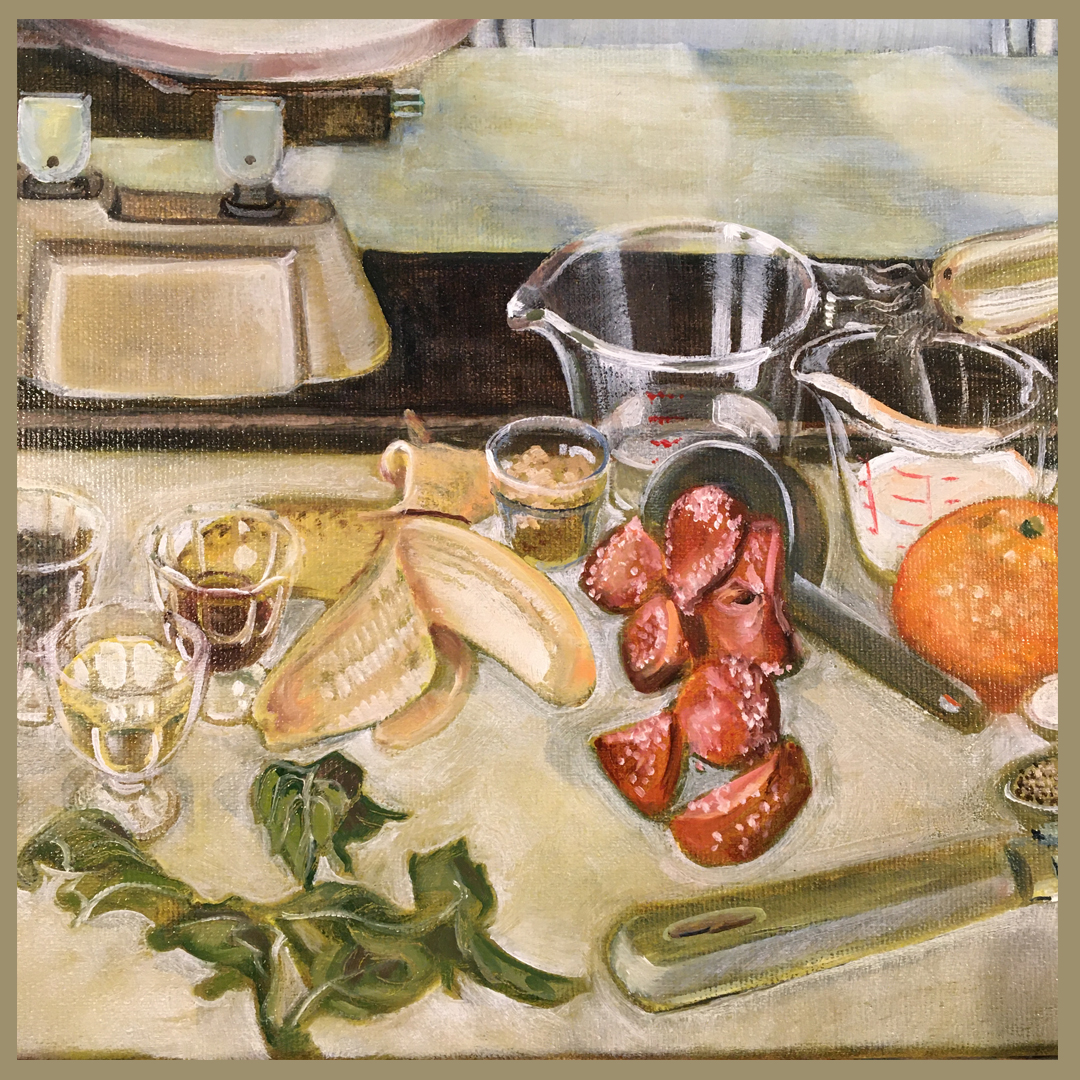
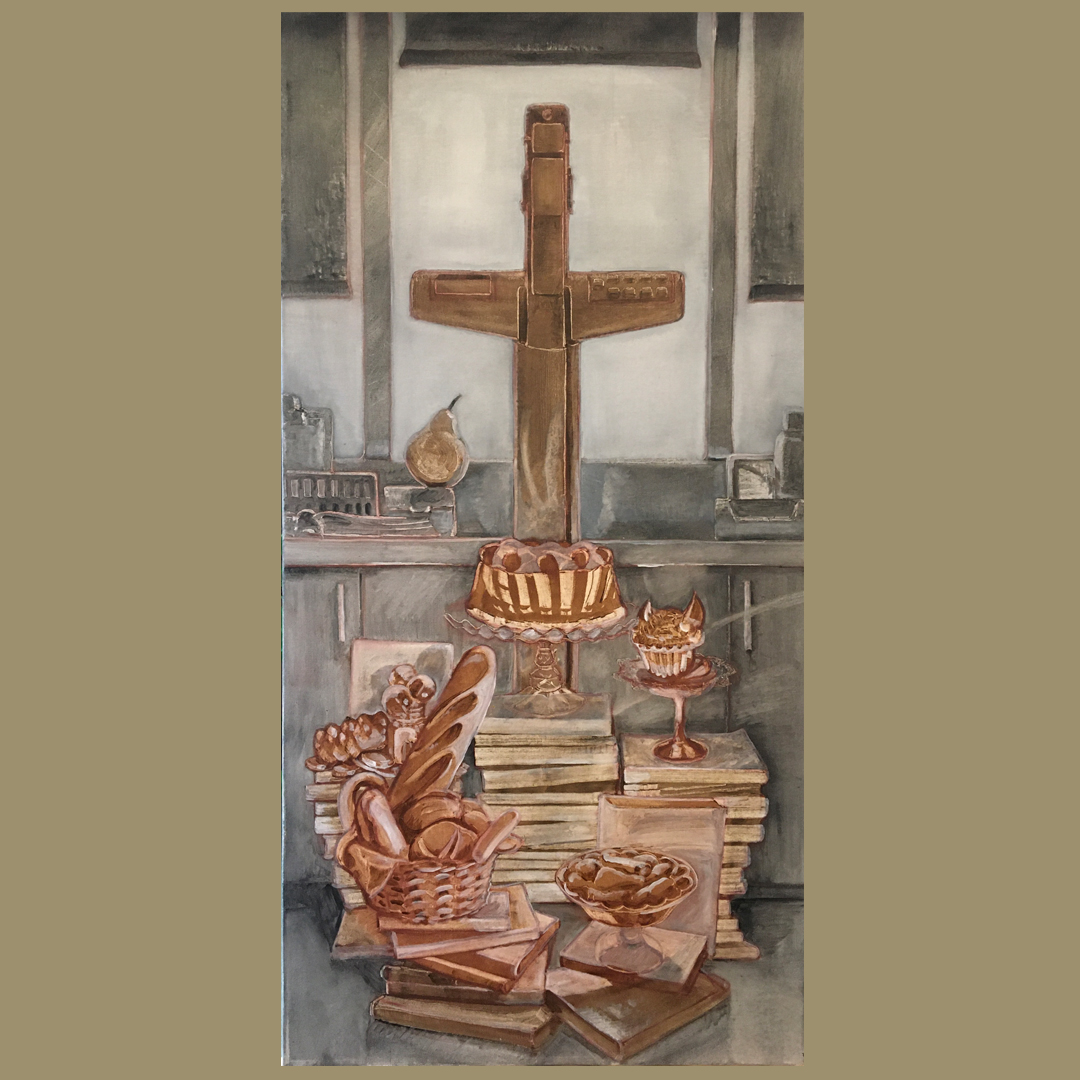
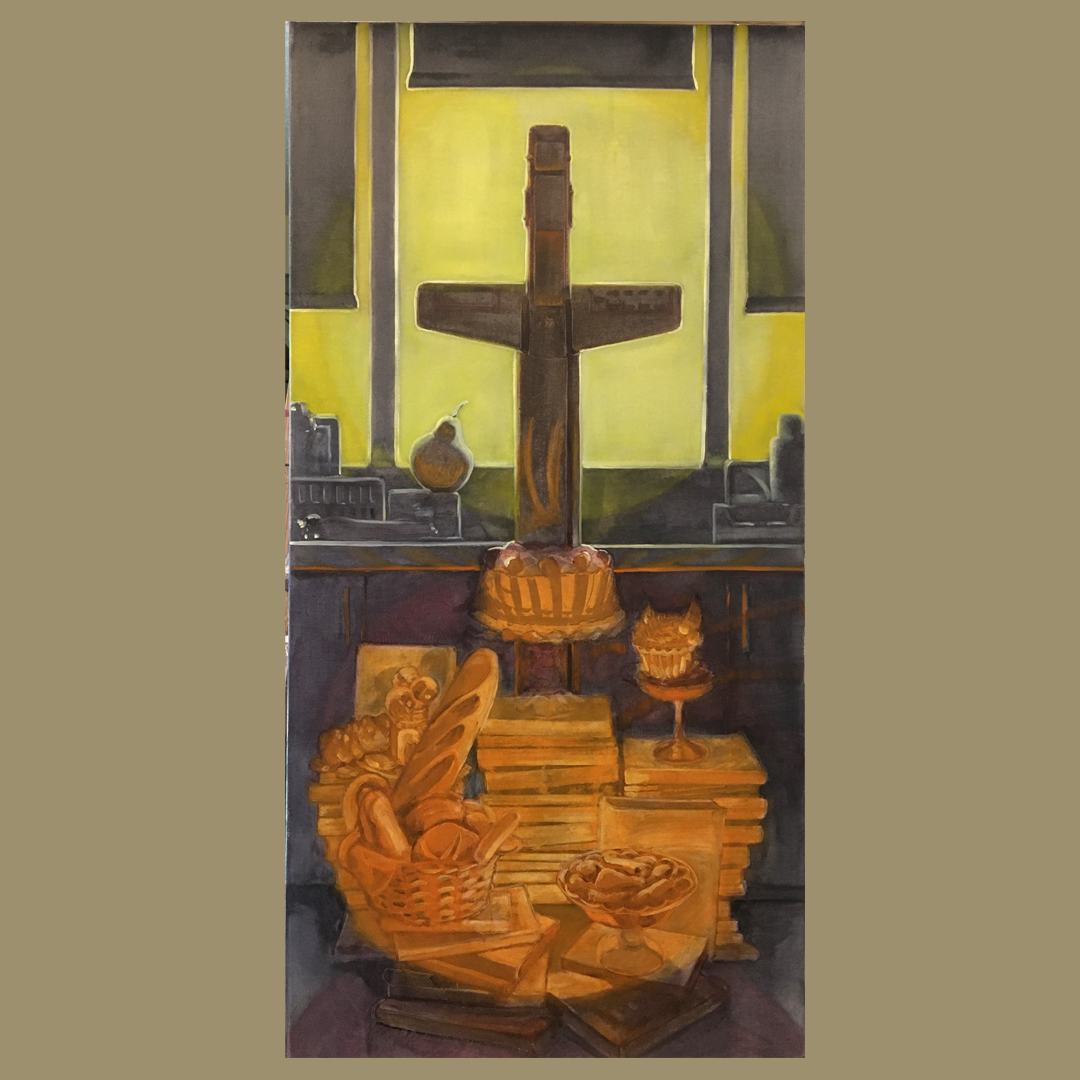
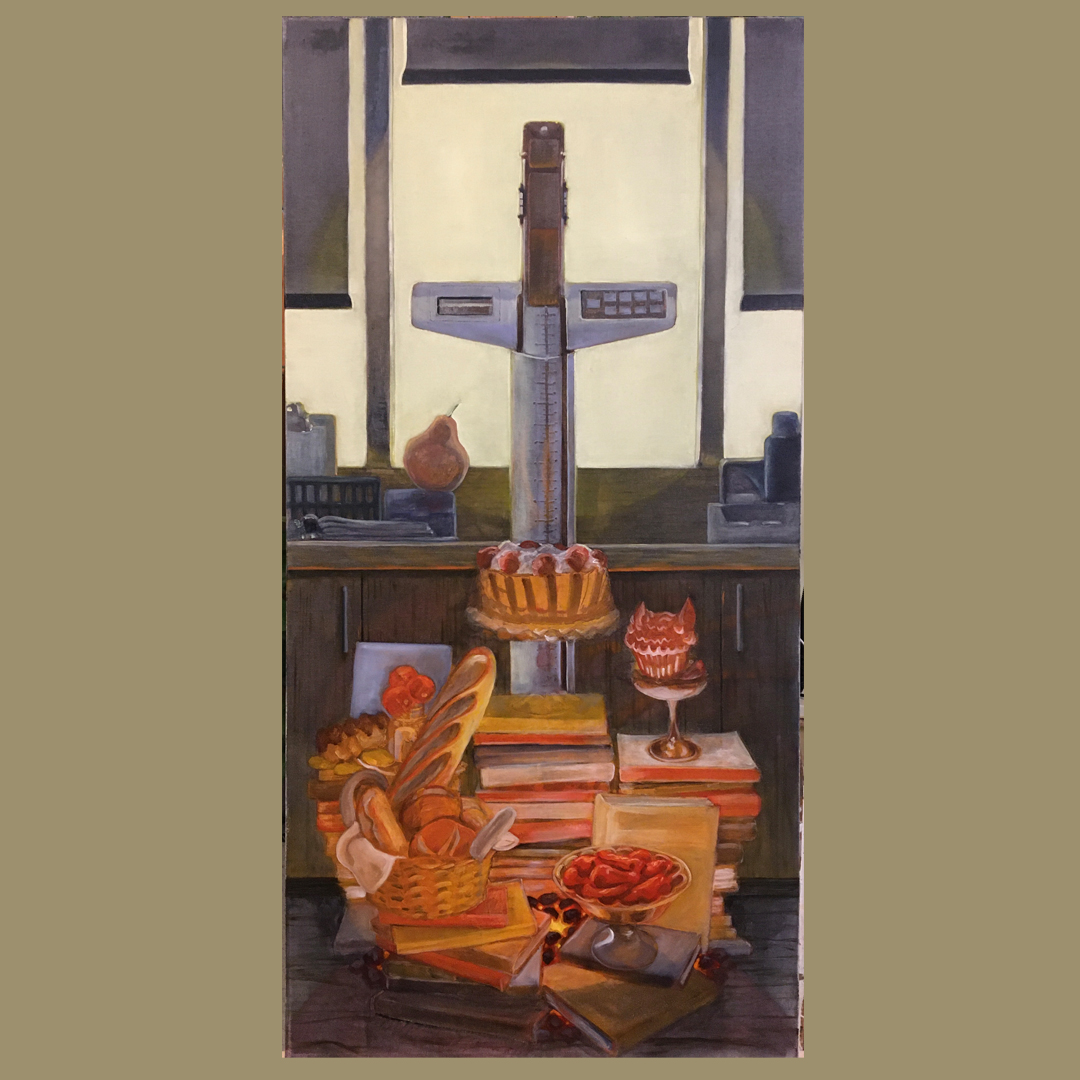
I chose to set this painting in a laboratory setting (Thanks to Professor Jalilehvand at the University of Calgary for sending me images of the BioXAS Laboratory to use as reference for this painting) to highlight the near scientific level time, precision, dedication and attention it takes to meticulously weigh, measure and prepare perfectly balanced nutritious low calorie meals from many popular healthy diet plans on a consistent basis.
Not only does one require the wealth to afford the food, but also the wealth to afford someone time and mental space to dedicate to food preparation. This is not a ham sandwich on whole wheat with a handful of baby carrots and a piece of fruit. We are talking complete control of ingredients for every meal and snack, including home made vinaigrettes, salads with grilled chicken or cooked grains, smoothies, healthy chocolate drinks, potato and leek soup, and lemon zest for the chia pudding with a cooked blueberry sauce, all on a week day. Can it be done for a working family? Sure. But can it be done consistently? Probably not without incredible organizational skills and a willingness to give up a lot of other things. Add the second healthy lifestyle component to that schedule, exercise, and there isn’t much time for working parents to attend to anything past the necessities of life.
In my own experience I had my biggest weight loss progress when I inadvertently ended up with a part time schedule. The unexpected silver lining to the situation was the additional time for exercise and food preparation. However for anyone earning less than an upper middle class income the accompanying economic stress, including dealing with periodic food insecurity, will be enough to deter them from cutting back working hours. I think you would be hard pressed to find a popular health and diet plan that would advocate you cut the income that is paying for the plan in order to make that plan achievable.
However, add a level of wealth to the mix and one can afford to hire food preparation done, or afford one parent to devote all or part of their time to the health of the family.
While health and diet culture may be primarily advertising to the wealthy and the upper middle class, who have the money to pay for books, trainers, special foods, or free time, it’s not like the lower middle and working class are deaf to the message. For anyone who relies on their ability to exchange their hours for dollars the competitive advantage of health, stamina and slimness in an image obsessed culture resound strongly. Add a good dose of parental guilt to the mix and it seems like one absolutely must spend as much time as the books recommend weighing, measuring, counting and preparing meals.
Time seems to be the most limited commodity in the majority of working Canadian households. This being so, I wonder if pouring those precious remaining hours into obsessively counting calories, macro’s, grams and points into expensive health and diet programs is the best use for them? What else might one be able to do to improve ones life with that time and money?
The Work In Progress – Slideshow
We acknowledge the support of Calgary Arts Development Association and the City of Calgary
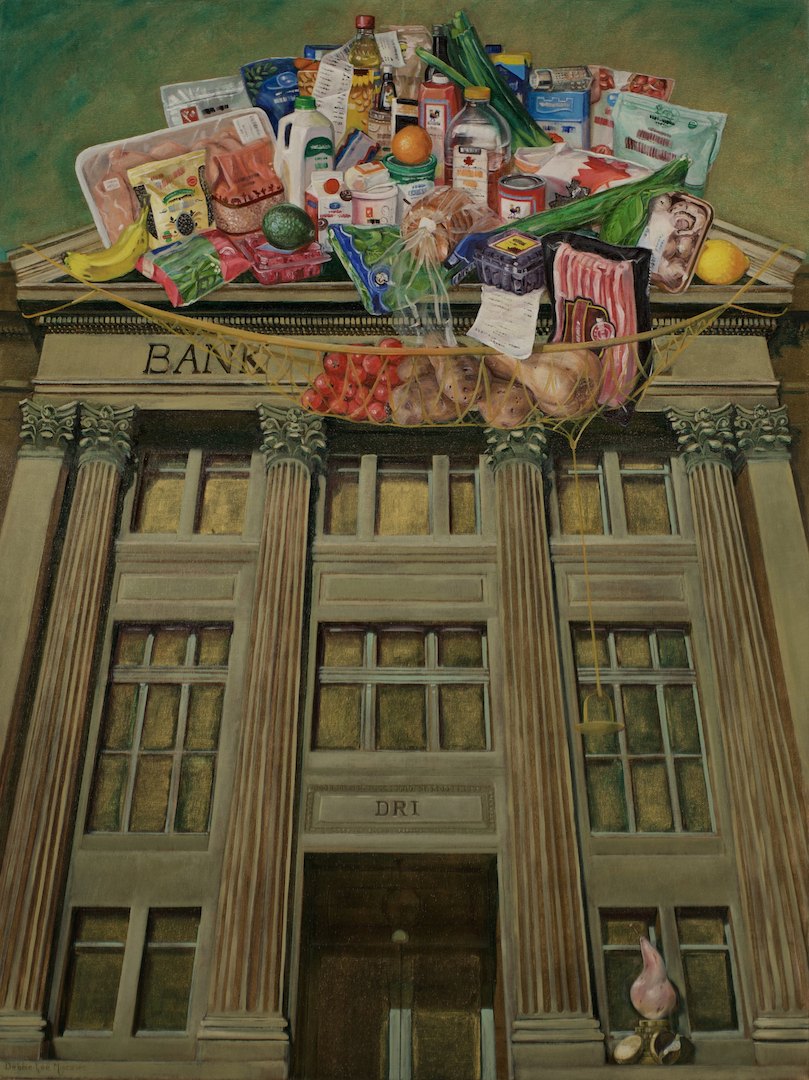
DRI – Return on Investment, 30″x40″o/c, Debbie.lee Miszaniec
Welcome to the sixth instalment of a series of blog posts going more in-depth into the thoughts and ideas behind each of the paintings in the Earthly Delights series. The series is based on my experience navigating health and diet culture as a long term participant. You can read the full background by following the link to that blog post below:
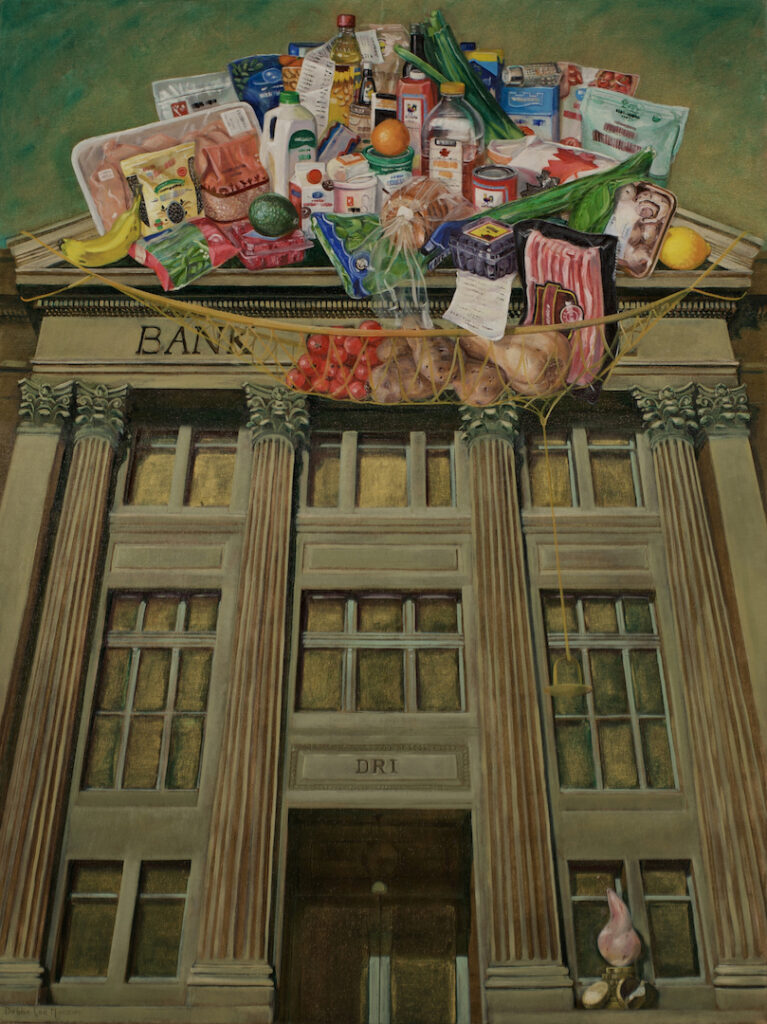
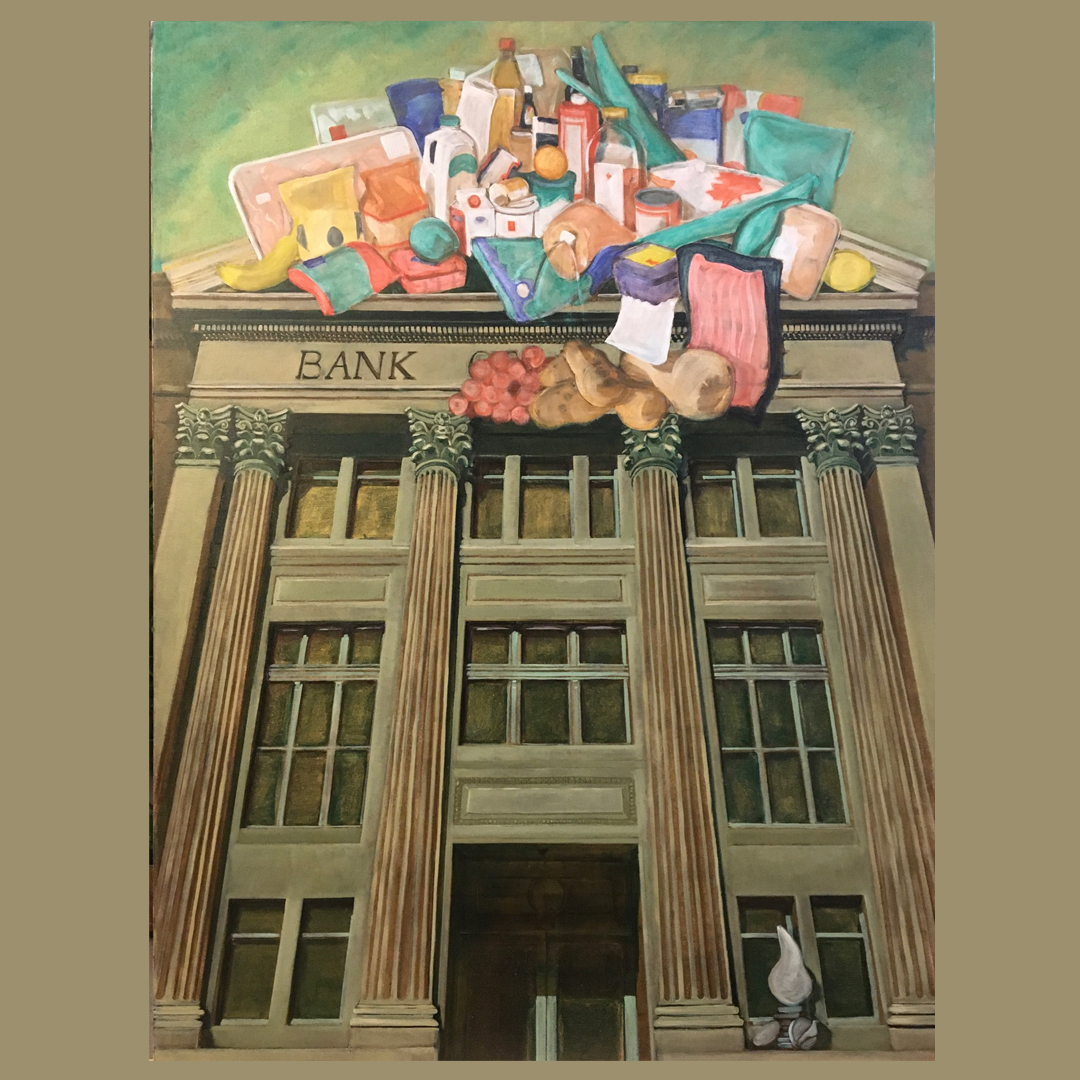
Daily Recommended Intake (or Dietary Reference Intake, or Recommended Daily Allowance) – Return on Investment. Healthy eating doesn’t have to be expensive or time consuming, or so articles on eating on a budget claim. Canned and frozen foods are just as nutritious as fresh produce etc.
However for every ‘eating well on a budget’ piece of advice out there, one will find many more healthy diet plans that come with a healthy price tag too. The idea is you get back what you put in, and if you want to be skinny AND healthy, you’re going to need a specialized plan. Healthy eating, as promoted by health and diet culture, seems to be a bit of an exclusive affair:
At some point I decided I should be focusing on getting my body’s nutritional requirements, but didn’t want to risk gaining weight, so I was looking for a plan to do it within the lowest amount of calories possible.
This is why it is called health and diet culture, and not just diet culture. Because the pursuit of health has become tied to the cult of slim as it’s visible proof.
Enter mynew salvation, (I will not name names here, but feel free to contact me if you want to know the name of the plan). This one was actually a set of menus carefully constructed to meet all of an individuals daily macro and micro nutrient needs within three different caloric levels (1500, 2000 & 2500). Significantly, there is not a caloric level which corresponds to the most common diet recommendation of 1200 calories/day, let alone the more extreme celebrity diets clocking in at 800 and 500 calories per day. The author specified that below 1500 calories per day one would require specialized medical instruction to meet their nutritional needs (mull that over). I didn’t have an objection to the plan itself (although at the time I thought 1500 calories was too many). I actually think the plan is quite an impressive effort, however the investment in terms of money and time is another matter. This investment is a problem with most popular ‘healthy’ diet plans.
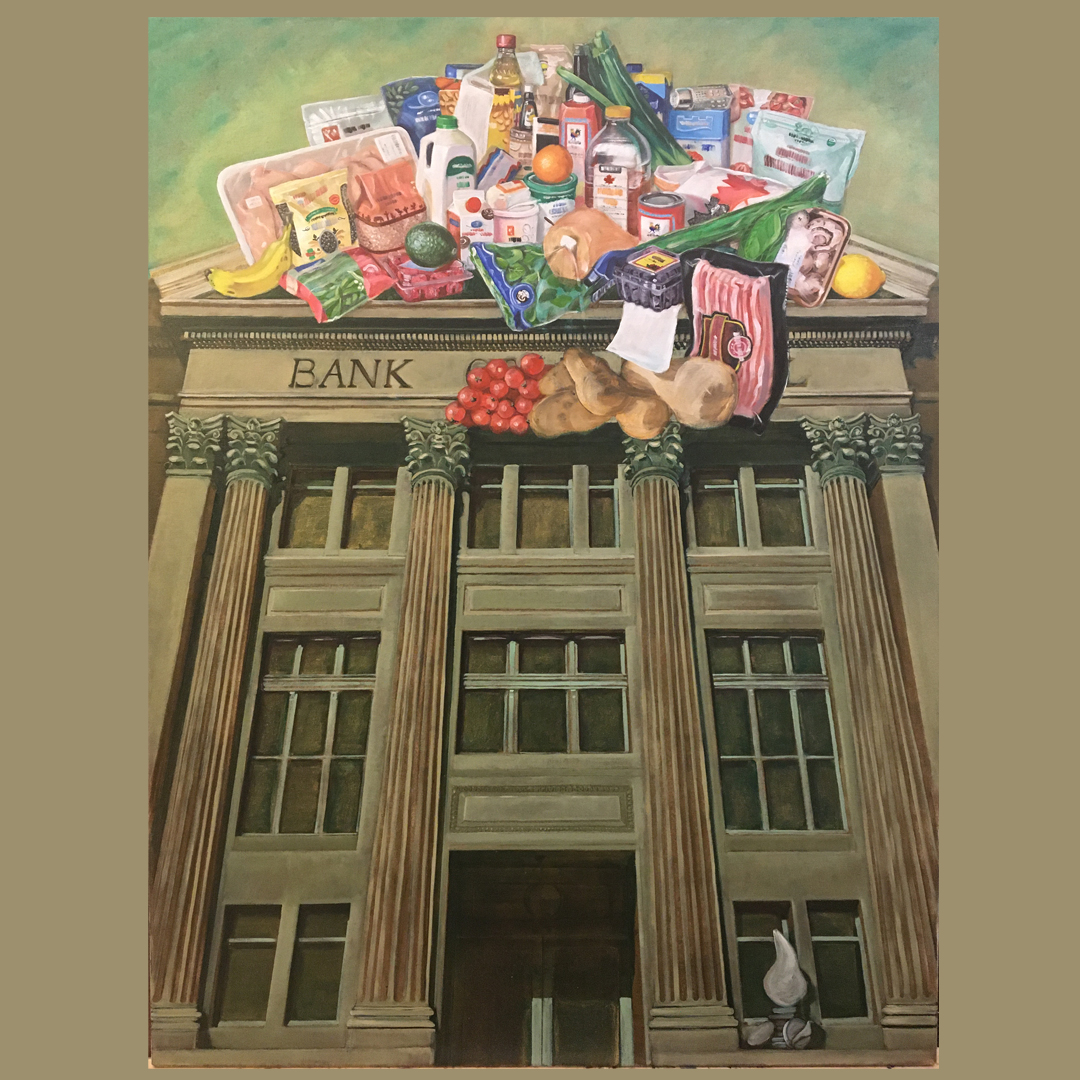
The food in the painting represents the ingredients (in purchased quantities) for a single day’s menu, at 1500 calories. Not that I would be eating all that food in one day, the menu might only call for a tablespoon of an ingredient, but one must purchase bags of buckwheat, barley or nutritional yeast as opposed to tablespoons. That is a lot of different types of food to be purchasing and storing, for one days meals, if I want complete nutrition within 1500 calories. (I challenge you to go price the entire still life, see what it comes to in your local dollars, and report back.) Yes, you will likely be using those ingredients in multiple menu (should you carry on with the plan), and things like cocoa powder and chia seeds will keep well in the pantry. However, it is typical of every new diet to not only have you invest in an entire new pantry of food, but clear your cupboards of all your old food. Often the new foods are expensive, exclusive, trendy, and difficult to source if you are not in a large urban centre with access to specialty markets and international food imports.
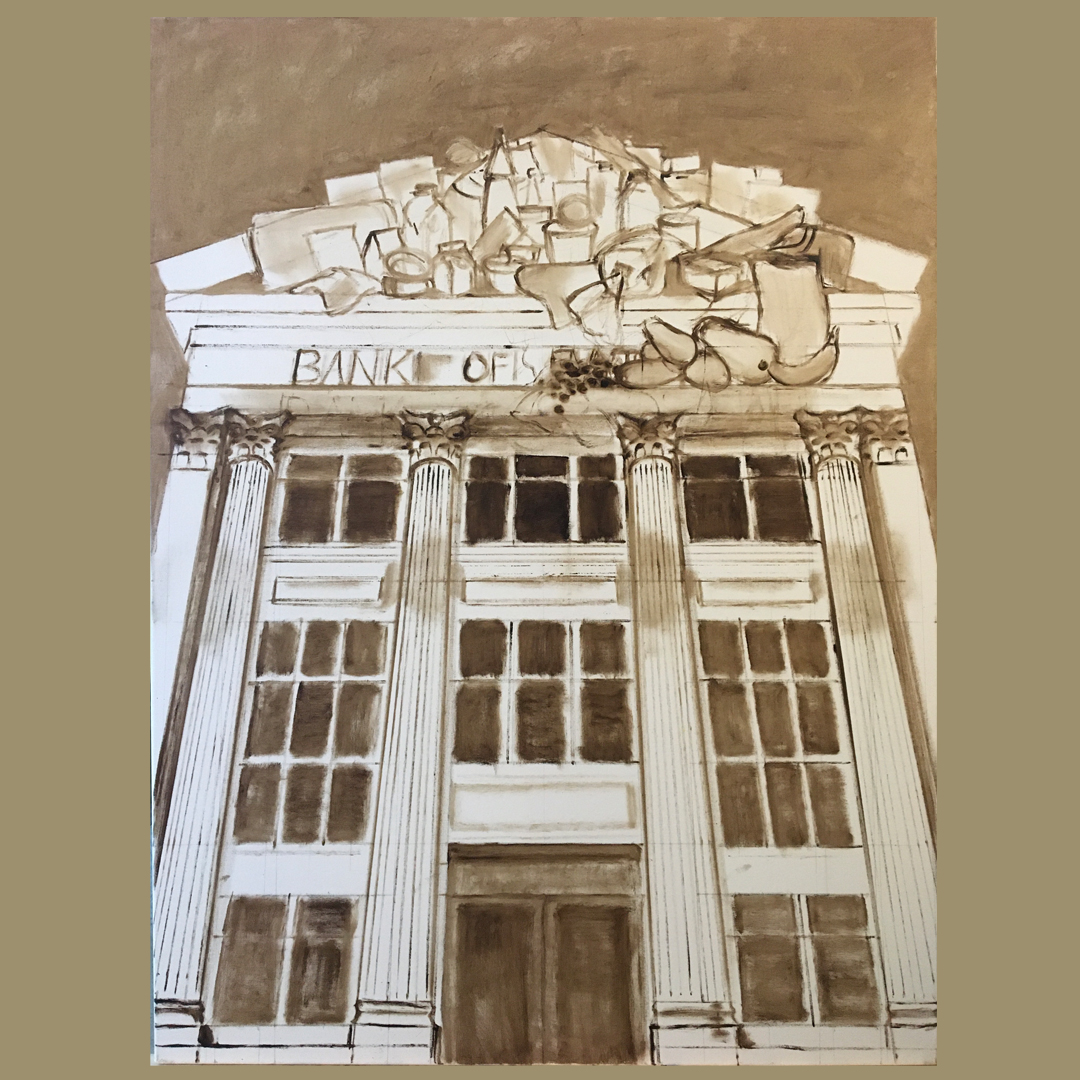
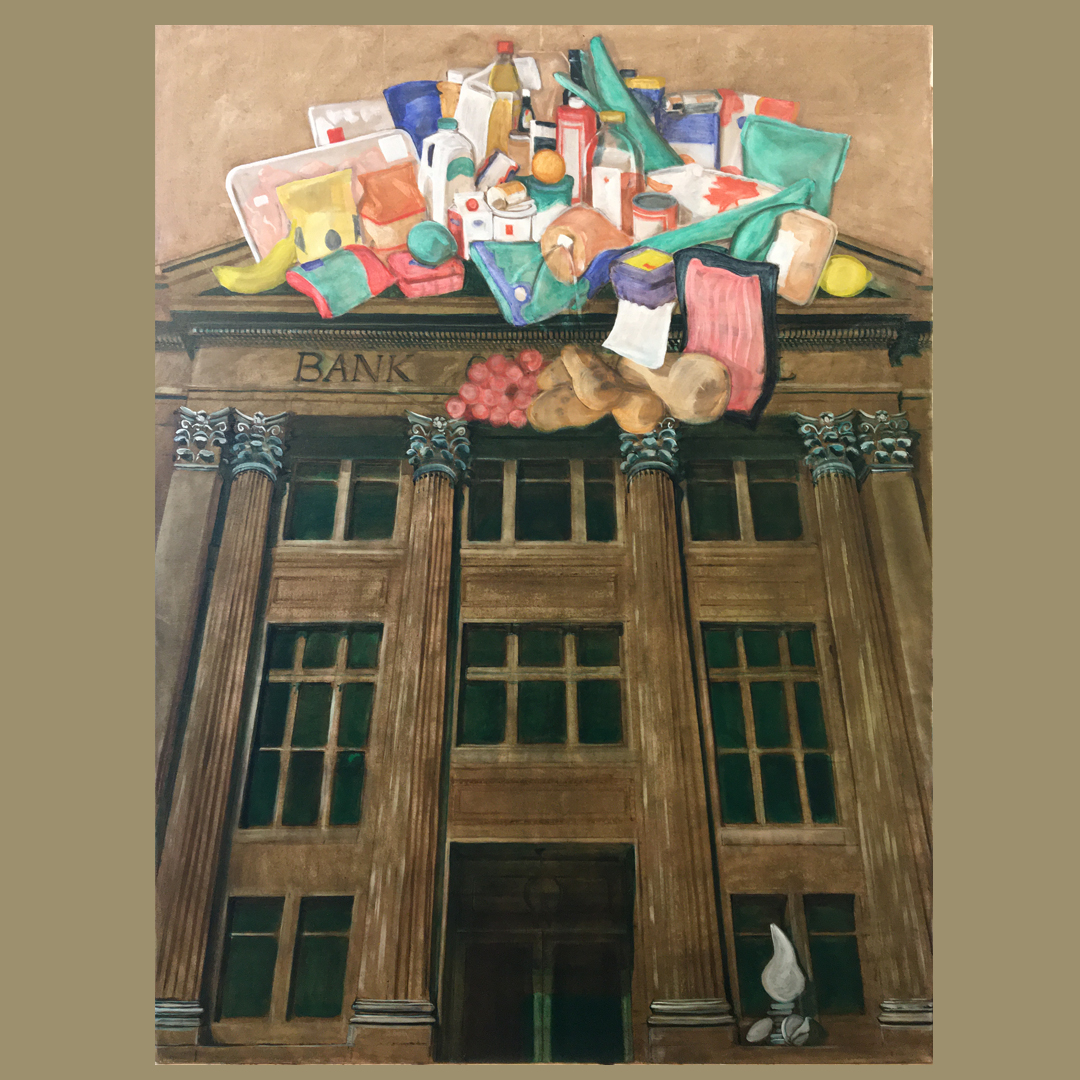
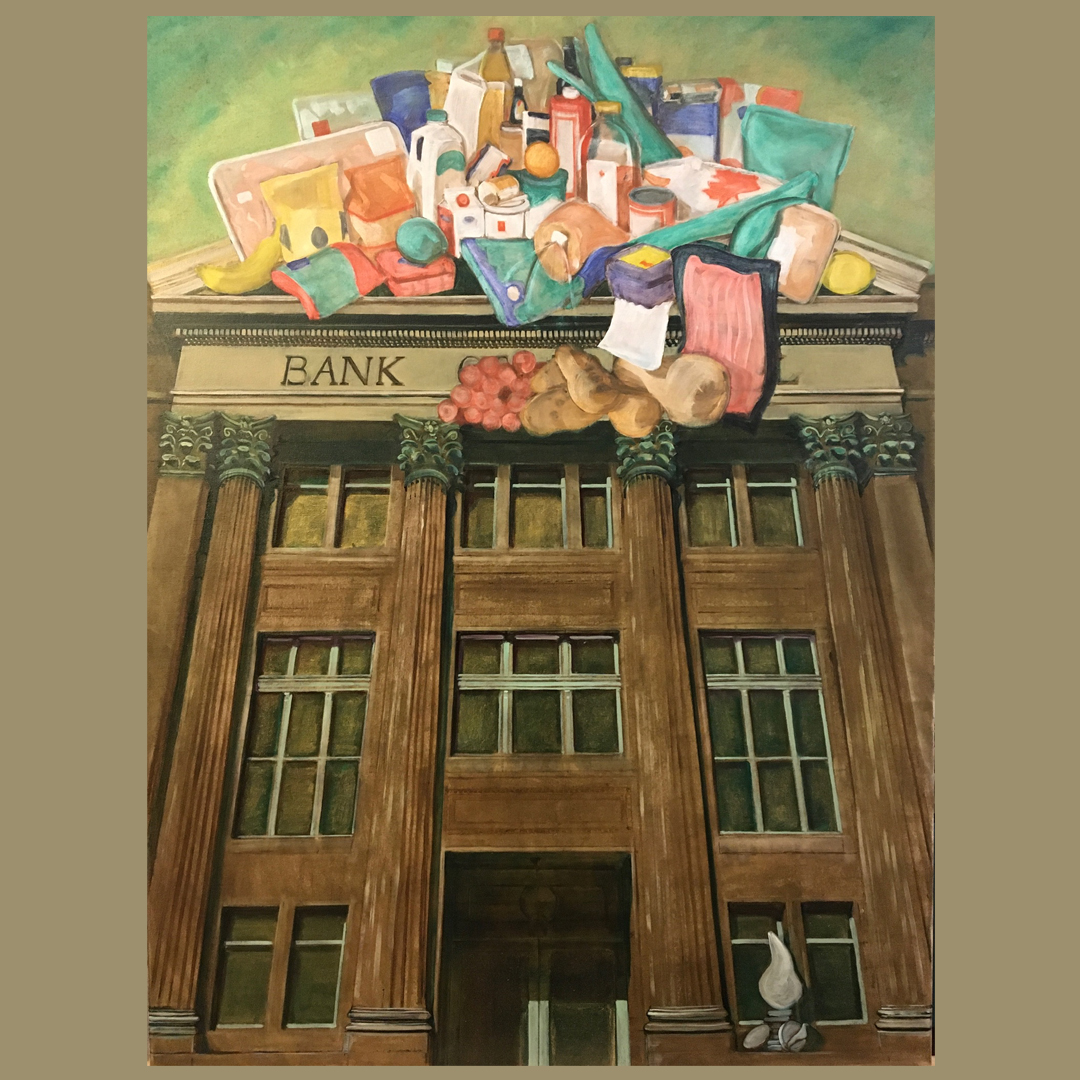
The setting for this super market banquet is a historic Bank of Montreal building on Calgary’s Stephen Avenue. Many of these heritage bank building are no longer banks: a few have been repurposed as high end restaurants and this one currently houses a Good Life Fitness. I wanted a bank as the setting, and I liked that in life as in art, health and diet were being coupled with wealth.
In DRI-Return on Investment I was interested in exploring several thoughts:
Are diets and dieting promoted by the food industry? Who gets wealthy from advising consumers to toss their inferior food before reloading with expensive ‘healthy’ alternatives with every new diet?
Are ‘healthy’ diet plans only for the comparatively wealthy, or is it that they are written by and geared toward the wealthy? According to an economic definition of middle class income as being between 75 and 200 % of Canada’s median household income after tax of $68400 in 2023, a middle class income is somewhere between $51000 and $137000. Working class incomes then would generally be below $51000 (although not necessarily). Most financial guides suggest a household grocery budget of no more than 15% of income for a family of 4. The average family (of 4) grocery spend is, as of 2023, about $313/week, or $45/day. That level of spending on food only fits current budget criterion for a household that, at $108507 CAD, has just crossed over into an upper middle-class income level. the pictured food here came in around $150 CAD, not including the dozen items I already had in my pantry. So taking into account the bulk nature of some of the ingredients, my guess is this would work out to about 60 – 65$ per day. For that same barely upper middle class household this would represent nearly a quarter of their budget. At the median income in Canada this represents over a third of household after tax income and 46% at the bottom end of the middle class income bracket. For a lower middle-class or working class family, not only is ditching a pantry of existing food financially wasteful, but the replacement cost for the proposed healthy alternative is a financially unsustainable way to eat
Are popular healthy diet plans sustainable? This still life presents the agricultural production of Canada and the world. Coconut, banana and avocado are commonplace in the modern Canadian diet. However Covid-19 and it’s supply chain disruptions presented the question of how sustainable or even accessible are ‘healthy’ diets that require a smoothly operating global supply chain providing international ingredients on demand to privileged markets? As supply was inhibited in countries used to near constant availability prices rose and accusations of gouging and profiteering flew. Sometimes the ability to pay did not matter as the goods simply weren’t there to be bought (looking at you toilet paper). However generally rising prices on limited supply means choice in diet becomes the prerogative of the even wealthier and more privileged. Meanwhile someone(s) happily made more money from less product.
Stay tuned for the next post exploring the time investment required by health and diet culture in DRI – The Most From The Least.
The Work In Progress – Slideshow
We acknowledge the support of Calgary Arts Development Association and the City of Calgary
Every New Salvation, 20″x40″ o/c, Debbie.lee Miszaniec
Welcome to the fifth instalment of a series of blog posts going more in-depth into the thoughts and ideas behind each of the paintings in the Earthly Delights series. The series is based on my experience navigating health and diet culture as a long term participant. You can read the full background by following the link to that blog post below:
Every New Salvation comes along when you are suffering the consequences of your actions.
Maybe you’ve reached your goal weight or maybe you haven’t, but at some point you notice that the old equation of calories in and calories out stops working. Or rather, it works less effectively than it has in the past. Portions have to be smaller and the exercise has to increase to get the same effect as last year. Reduced caloric needs don’t answer the entire question. At this rate you can see that you will be living on baby food portions or working out more hours than you have available. It seems necessary though, because you don’t want to die early. You don’t want to suffer from obesity related diseases, or obesity related discrimination. The body has begun to ratchet up its defence mechanisms against starvation and so, tortured by visions of forbidden foods, you desperately looks for ways to hack the system.
Enter the diet gurus. They have done it and they can show you how to do it too. They’ve been telling people how to eat since 1558 when Luigi Cornaro wrote The Art of Living Long.
Every new diet becomes a new salvation. Each diet requires complete dedication and belief. They ask you to surround yourself with supporters and get rid of negative influences. They turn you into evangelists for the new diet, at least in the beginning while you still believe you have found the truth. Like Christ fasting in the desert you know the rewards of everlasting life and good health will be worth the struggle of remaining virtuous in the face of the temptations the devil within uses to lures you away from your diet & exercise regime. But you have the word on your side, the word of Paleo or Veganism, or Peiganism (what is left to eat at that point? Not much, which brings us back to Coronaro who in his later years limited himself to an egg yolk a day with a few spoonful milk, & bread) Keto, South Beach, Blue zone, All In, Raw Food, Intermittent Fasting, Time Restricted Eating, Master Cleanses and Cabbage Soup Diets. Whatever ails you, you can also find a diet guru to tell you what to eat to fix it. Look great, feel great, live forever, it’s all about what you put in your body, or what you don’t.
Eventually each diet fails to deliver, or starves us into breaking, or damages us further. And on to the next guru. the one that either interprets the old texts the right way, or the one that utilizes all the newest scientific discoveries to help us get and stay thin (and healthy, because that’s really what we want, we’re not that shallow right?). Maybe this one will work.
But what if we entertained the idea that our body was not evil, was not the devil luring us with temptation to eat things not on our list, and the diet gurus were not saviours? What if our body was trying to save us by telling us to break our fasts, while the gurus were the devils tempting us to harm ourselves with new damaging diets in the name of achieving worldly glory?
The Work In Progress – Slideshow
We acknowledge the support of Calgary Arts Development Association and the City of Calgary