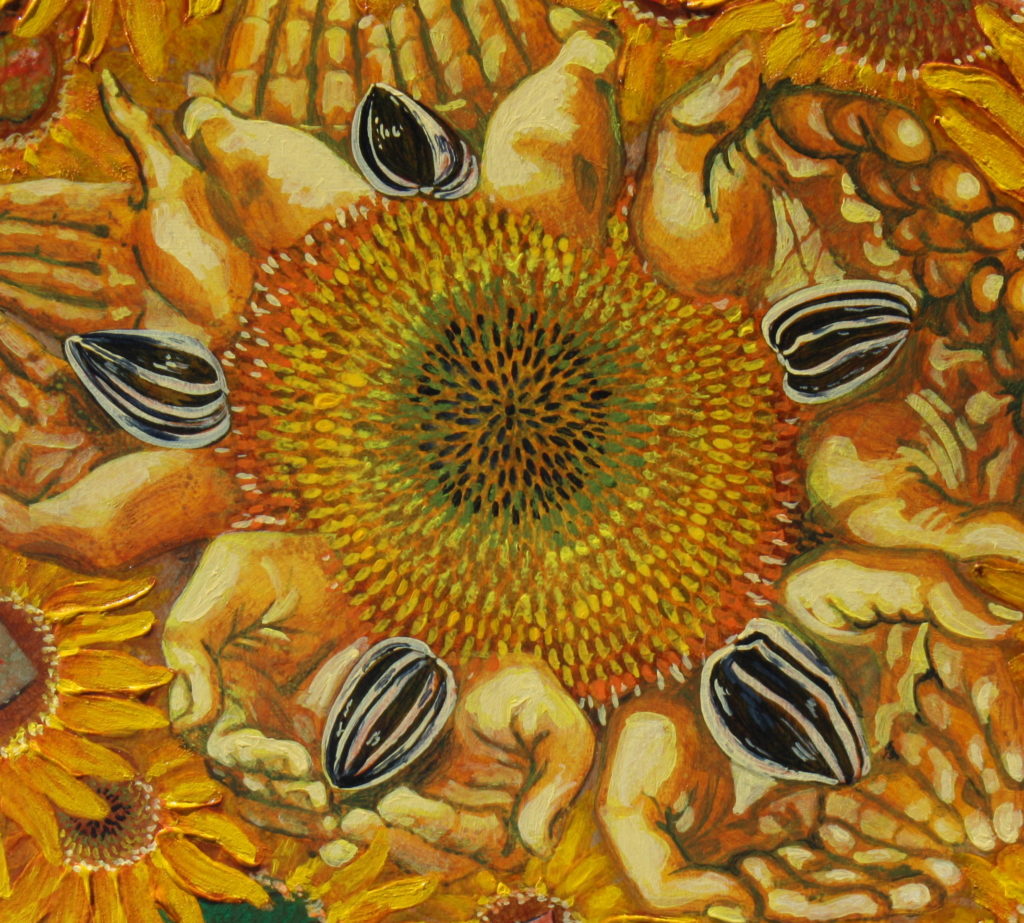
Category: Notes from the Studio

Happy Family Day Alberta!

Because families start with love:

I love that Family Day follows Valentine’s Day here in Alberta! Because, as the song says, (insert name here) & (insert name here) sitting in a tree, K-I-S-S-I-N-G; first comes love, then comes marriage (or whatever relationship definition works for your reproductive unit), then comes (insert names here) pushing the baby carriage. So in honour of that special bond that grows between two people and then is shared with the next generation, Happy Family Day from my family to your’s!

I hope you will enjoy watching this Valentine’s day video that I published to my youtube channel for Valentine’s day, and that it inspires you to encourage your next generation to pay the love forward as well!

Happy Family day from our family!

Thoughts on Over-painting (oil)

I just didn’t have a passion for the project anymore. The inspiration did not work out and I was not stubborn enough to invest more time in making it work. So wasteful to abandon high quality* canvases in this time of thoughtful consumption, so I repainted them with fresh inspiration.

Of course there are considerations for overpainting canvases: Is the original completely dry? If you’re considering immediately repainting a painting you will have to worry about the dry rates of the underlying layers, oil and solvent contents of those layers and how it will effect the new painting. Is the painting fresh enough that you could just scrape the whole thing back? If not I would strongly suggest waiting until the painting is completely dry so at least you know what you have to deal with. These canvases were about 6 or 7 months dry, with only the initial layers done. I was concerned that since those layers had quite a lot of solvent they might unevenly draw down the oils from the new painting to make sunken patches that didn’t match well, so I started by wiping down and oiling them out with a mixture of oil and an earth colour to simultaneously tone down the existing painting without completely eradicating it. Then I left them to dry another 3 or 4 months before working on them, once I was satisfied that the oil/earth mixture had an even finish.

Why didn’t I just use a solid colour base after oiling to make a clean slate? I can’t give you a good answer to that. Options? Challenge? I wanted to give myself the option of incorporating some of the initial painting into this one if it seemed like an interesting effect once I was into the painting. I liked the challenge of visualizing the new painting while dealing with the interference of the old one. You may want to use a more solid base colour after oiling out so you can visualize your image without interference. In the finished paintings you can barely see evidence of the originals anyway, so while it was challenging to work this way, pushing me to work with thicker more opaque layers, and therefore allowing for fewer new layers – if we are following Fat over Lean and all that – there was no end result aesthetic justification for doing it that way.

Speaking of thickness, these canvases were originally thinly painted as only the initial layers were completed prior to repainting, but you’ll also want to consider the texture of the existing painting. A highly textured surface means you’ll be seeing outlines beneath the new painting, I have not found sanding to be practical in eliminating anything more than the most minor bumps, drips or traces of stray brush hairs, so you will want to think creatively about how those textural elements can be incorporated in the new composition. A portrait may not be a good candidate for repainting as a landscape, as the shape of the head neck and shoulders may still be evident, but on the other hand, it could force some creative acknowledgement of that element into the landscape. I have had some good effects with textured surfaces, but the painting has to pretty much be designed for or respond to the surface in terms not only of composition, but materials used in the original painting; will new paint absorb or adhere unevenly to the old paint, how dry is the existing painting, and is the support stable (*generally speaking, don’t bother trying to rescue a cheap canvas, use it for a craft or experiment but nothing you are serious about)?

So how about you, what are your experiences and concerns with over-painting canvases?

Finding Your Subject: Just Keep Making Stuff

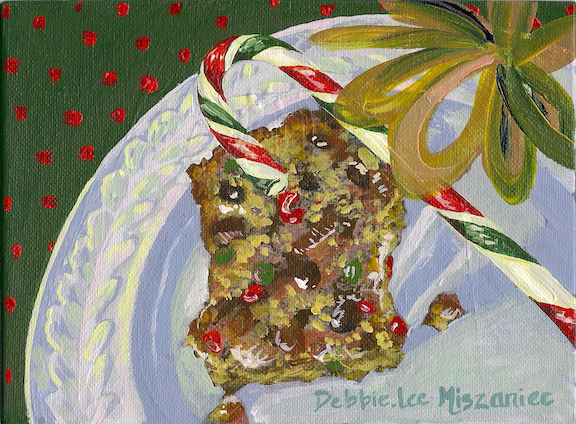
Butter Tart

Finding your style, your subject, as an artist is something artists are encouraged to do, but most are resistant to, though many hope to arrive at something naturally. Why is that? Branding mainly I suppose. It is easier to be known for something, and to build a market for something, if that something has a consistent look to it. As creative types who are trained to push boundaries and break norms, settling in to one style or subject is like choosing to encase yourself in a plastic suit that looks like you but can’t move, or grow, or express all the interesting weird parts of yourself. I was once told that based on the range of my work (I had brought three paintings to a critique), I came across as three completely distinct personalities! However I think eventually, as an artist follows his/her own interests and learns more about what truly motivates him/her, certain fascinations will emerge and make themselves clear without the need to plasticize.

Right now I believe I see this happening with my food paintings. Certainly the subject matter is not going to win any awards for its revolutionary content, however the fascination is authentic to me and my lived experience as a member of my society. So perhaps this is how finding your authentic voice as an artist happens:

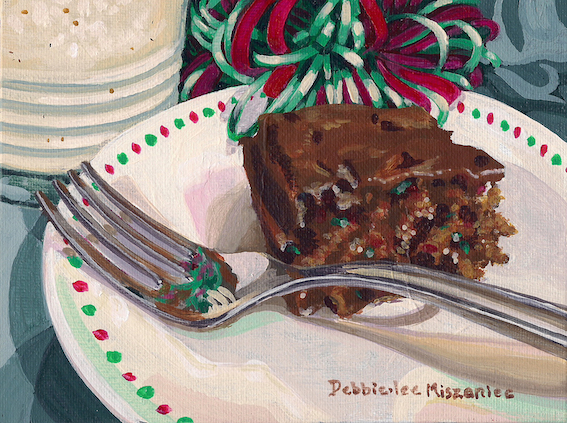
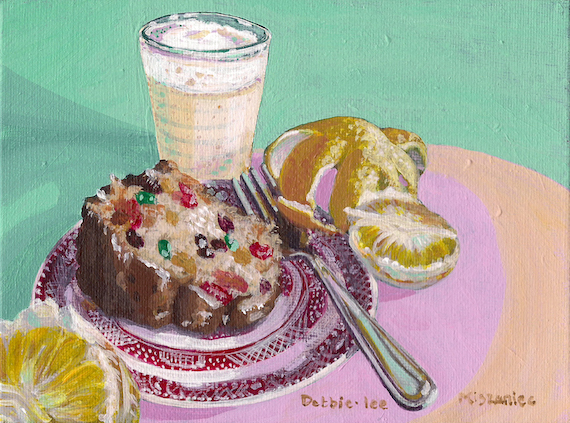
It all started with an innocent request from my husband Uncle. Actually, I think it all started with a 90 pound weight loss. It’s known that when you are depriving your body of sufficient calories, your body has a tendency to suggest solutions to you. Suddenly you can’t get that craving out of your mind. It develops into a fixation on high quality home made versions of your old favourites. I love Christmas fruitcake, and decided if I was going to indulge in the seasonal treat I would make my own brandy drenched home made cake. One cake was all it took and I was hooked. So back to my husband’s Uncles request. My husband suggested I make one for his father and uncle, since as his mother had passed away her custom of making them was gone. The following year I made one for Harry, and offered to make one for Bob. However as the fruitcakes are a weighty cake that cost twice as much to ship as to make, Bob asked if I would please paint him a fruitcake and send that instead. And so I did, for four straight Christmases. Bob now has a set of four fruitcake paintings.

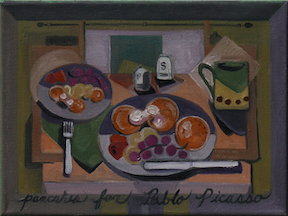
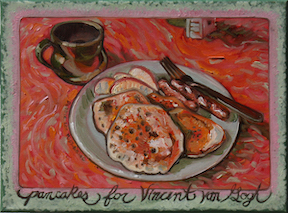
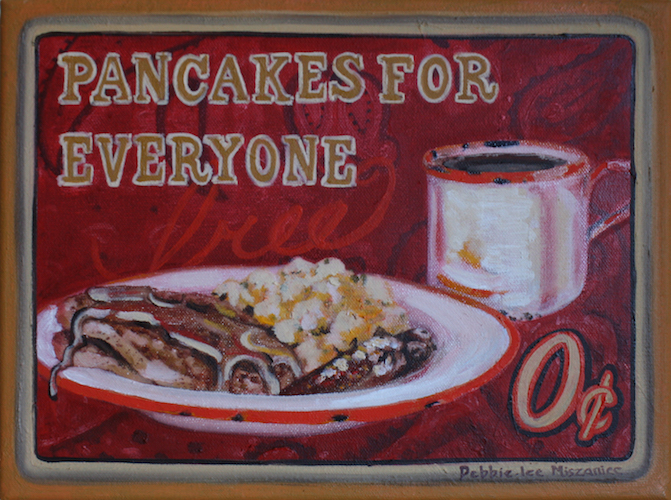
Then I was looking for a novel approach to participate in Calgary’s premier event of every summer since long before I was born, the Calgary Exhibition and Stampede. The Stampede hosts the Western Showcase Artist’s Studios and Art Gallery each year, a themed juried commercial art show which has distinctly shaped the arts in Calgary. I was thinking about what my favourite part of Stampede was growing up in Calgary, and for me it had to be the citywide free pancake breakfasts. Whatever your economic status, political, cultural or social affiliation, you are always welcome to enjoy a free pancake breakfast at any one of the many events hosted across the city during the 10 days of Stampede. So I decided to do a series of paintings combining my love of art history with my love of pancake breakfasts.

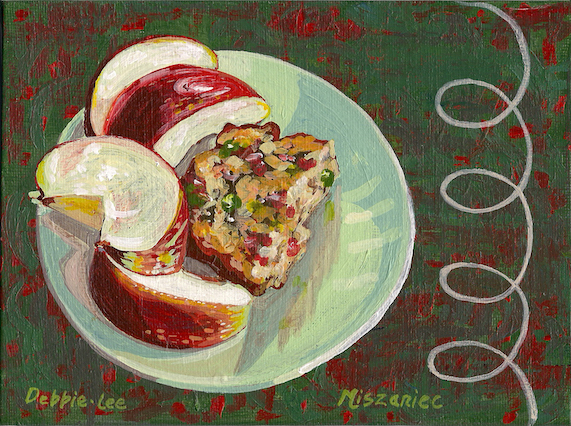
And now I am happily working away on a series of still life paintings depicting Canadian heritage treats such as Butter tarts, Saskatoon Jam and Nanaimo Bars.

Here is where the innocent request meets my own natural interest. Significant weight loss is one of those events that permanently changes ones metabolism. There are as yet no numbers on when one returns to ‘normal,’ as though one had never had the extra weight in the first place. I may never lose this interest in good food, as my subconscious seeks to assist me to return to my former size. So as strange as it may seem these coincidentally arrived at paintings of food may be a long term authentic subject matter, one I didn’t realize I had been developing. In fact, the further back I look, the more I find I was engaging with food in my work without realizing it as part of my own personal visual language.

  • Cowboy Coffee by Debbie.lee Miszaniec
Security oil on canvas 20″ x 40″ Debbie.lee Miszaniec

My advice to you if you are struggling against the advice to narrow down your style, your subject and your interests, as I do, is to let it happen naturally. What gives you the most joy? It may not be what you think it should be, or what others think is a worthy subject matter, or a profitable one. However if you let it, your voice will emerge on its own anyhow, without your intention. Just keep making.

Back to 2018: New/Old Video

https://youtu.be/o5TfWAPOfOM
2020 Revisits 2018

I discovered that I still had some footage from a 30 day vlog project I was recording in 2018, testing if I wanted to do this video thing. It turned out that I had way too much going on at that time to juggle a regular vlog, and so I shelved the footage. In between then and now two thirds of the footage went missing, but what remained was still an interesting look back for me as I reflected on what happened to those projects and involvements, and how they affected 2019. Now that I have decided to work on my Youtube Channel for 2020, I thought it might be fun to do a rewind and update video based on that test project. One thing I realized watching the footage, I love that haircut! It might be time to book a visit with a hairdresser.

10 Places To Look For Arts Opportunities in Calgary.

This piece was commissioned for one Call I responded to, and was also used for another later unrelated Call I responded to!

I was talking to another artist at a gallery opening one day (ironically an artist who has gallery representation, something I have yet to find) about the 100 Rejections project, its inspiration, and how it has helped me to not take rejection so personally, make my rejections constructive, and look at my response rate analytically.

If you want to learn about the original project you can read about it on my blog by clicking here.

So this other artist, whom I presume relies on her dealer to direct opportunities her way (oh in a perfect world), asked me where I find the opportunities to apply for.

None of my sources are a secret, they just take a little regular web crawling a couple times a month, subscribing to a few email lists, and letting your network know that you are interested in new opportunities.

If you are interested in embarking on a rejections project of your own, and you happen to reside in my geographic context (Calgary), here are my top picks for sourcing opportunities to apply for:

Email Lists to Subscribe to:

Website Classified Listings:

Other Places to Watch:

  • Facebook & Twitter – like and follow organization pages, and ask your friends to forward you interesting opportunities.

And there you go!

If you are not located in my area, there are other networks and organizations local to you. Share who you consult in your area and I will make a specific post for those areas.

If you have any other suggestions for places to watch for opportunities, let me know and I will update the list.

And if you know of a gallery that would just love to represent the type of work I do, let me know!

100 Rejections 2017 Review

I aimed high early last year when I decided to work through my fear of rejection by taking inspiration from Jia Jiang. My goal was to accumulate 100 (art related) rejections over 2017.

So how did that work out?

First off, I would like to say that I only got 1/3 of the way to my goal this year, sending out 34 applications. Of those, 6 were accepted, which works out to a 16 or 17 % acceptance rate. So I actually accumulated 28 rejections in 2017.

Having got a slow start during the first half of the year I had to apply myself from the last half of the summer by applying to 5 opportunities a week for the rest of the year to meet my goal.

That proved challenging as opportunities are time consuming to source as well as to apply for. I found I was spending more time doing that than making work between August and October. Then in October, as the applications I sent out were accepted, I had no time to make art or to apply for things as I was busy with framing and making and traveling and meeting and such to fulfill the proposals. Finally in November and December I had to balance studio time with application time.

Overall I found that the shift in focus, from trying to get accepted to collecting rejections, to be beneficial. I was not nearly so attached to the proposals, both when writing them and when waiting for results. I was more willing to take risks, as I was not focusing on the potential negatives of an opportunity and talking myself out of applying, or conversely on being super conservative or over-thinking so as not to lose out on an opportunity.

I am definitely going to carry on this project for 2018, with the goal being to make it all the way to 100 this year. Starting now, I should only have to send out 8 or 9 a month. I’ve done my 1st earlier this month. 1 down, 99 to go!


2018: School’s out Party’s over.

Hi again. I know, I know, 2 posts in one week? Madness!

On New Years Day I like to look back over the past year and think about what has worked, what has not, where things seem to be going and what new things I would like to explore in the coming year. Sometimes sacrifices must be made to allow other things to grow.

So, in order to put more energy into the studio, including some interesting projects that showed great potential for growth in the last year, for 2018 I am discontinuing offering Art Parties,  Art Lessons and Artist’s on a Mission programs.

I guess I’ll have to get new business cards made soon then.

New Year, New Blog

Hi all. For my first post of 2018, and my first post in a while, I wanted to start with a recap of the past year, and then introduce a few changes for the next year, specifically involving this blog:

I started this blog November 4th of 2016, a little over a year ago. In the past year I have learned that regularly posting articles to a blog in a journalistic fashion is really not for me. When I have the time, I am stretching for things to talk about. When I have a lot going on to talk about, I don’t have much time for blogging, or for going through reams of spam searching for legit comments before I write anything.

I debated scrapping the blog altogether, however I still think it could serve a purpose. My paintings typically contain a lot of references and background material. If you know that context, it really adds to the viewers appreciation of the artwork. I am often told that I should be posting that information with the art when it is on display. So the main focus of this blog for the next year will be to write about the contextual information for each piece. I will link back and forth between the blog and the art on the website, for those that want the ‘full story’.

This is a rather big project, so I would not expect every piece to have documentation right away. I’ll continue to post articles throughout the year, generally on Fridays, though it will likely be irregular.

In addition to this, I will still include project updates and show or event announcements as they occur. Thanks for staying on the adventure with me!

Debbie.lee

100 Rejections Update: Just Say No, or Not Quite?

I am going to go into this topic because I think it may be something a few others out there may have issues with too:

Recently with my quest to amass 100 rejections I have been faced with a quandry. Some of my rejections have been coming through as acceptances.

Best possible project outcome, right?

Well, yes, but…

some applications are not necessarily best fits. Some projects have red flags, but as the goal is rejections I have been less concerned with the potential con side of the pro/con list. So when they are accepted I feel the pressure to jump at the acceptance. After all, I applied for this, didn’t I? Obviously I want the position or project or opportunity. When the project has a number of draw backs, I feel a sense of guilt to then have to say no, it is not for me.

So what to do? If I stop applying for things out of a fear of success, not only do I jeopardize the project, but I also close myself off from potentially great opportunities.

The first thing to do is to recognize that the feeling of dis-ease is a psychological thing. Fundraisers and political campaigners have long known that if they can get an individual to express support of an idea early on, where it costs the person nothing, they are more likely to get the same individual to support the idea when it will cost the individual more  (donations, volunteerism, votes etc.).

So, a reluctance to turn down an opportunity that I am accepted or short listed for is in part a pressure resulting from my initial expression of interest in the opportunity. The fact that I applied for it will make me more likely to overlook aspects of the opportunity which don’t mesh with my needs, even if those aspects weren’t apparent in the initial call.

Recognizing that, I have changed my mind set on the application process:

I am not applying for the call as stated, I am expressing interest in an opportunity. I am interested in finding out more about the opportunity, and exploring how I can best solve the other’s need. In some cases, I will not be able to fill their need within their parameters, and that is fine too. It is also possible their expectations are unrealistic. They may not know enough about what they are asking for to have realistic expectations. If that is recognized we can start a negotiation anyhow, and come to a mutually beneficial arrangement. If not, I have not accepted the opportunity simply because it is offered to me, and I have saved myself a headache.

What if it then goes to someone else who takes the opportunity as is?

Great! Either they have the capability to comfortably fulfill it, or it will be a learning experience for both parties. Either way, I am saved the headache and someone else gets what they need in this moment in their career.

So, in conclusion, the 100 rejections project is teaching me, not only how to deal with rejection, but acceptance too!

Public Art

Why is public art such an easy target for outrage?

Everyone seems to feel they have the right to sound off on it without knowing anything about the art, the artist, the selection process, budgetary considerations, or even anything about art in general. Case in point, Bowfort Towers. So here I am sounding off on it too. Well, not on the art, or its cultural associations or significance, or its author, or the budget, or the selection process. No, I am going to sound off on the uproar that went out, by those who know nothing about it as well as those who should know better (namely other artists who compete for public art contracts).

First of all, If you were not interested enough to participate when the call went out for public interest in participating in shaping public art policy (and there are indeed calls, as an artist who is interested in possibly one day getting a contract for a public art project, I am on the email list for notifications from the city, so I know these calls for input and participation in policy have gone out), then for goodness sake, blame yourself for not having input into what gets selected and produced, and quit whining about the need for more community consultation! What do you expect? Someone to go door to door, with a binder of the proposals for each project, to survey every household in the city?

Along the same lines, refrain from making a statement on the lack of consultation with community and cultural groups until you actually know who was consulted. Bowfort Towers came under fire for not having sufficient (or any, according to certain published commenters) consultations with first nations groups prior to approving the design. Later on it was revealed that the city’s process did indeed involve consultation with an indigenous knowledge keeper. The fact that this person might have missed a visual association with a burial platform? Well, I think that is one of those cases where a hundred people may see no visual association between X and Y until one day one person makes an association and says, “Hey, did you ever notice how X looks like Y?” Suddenly, no one can un-see it. Then the association is so obvious, people wonder how it went un-noticed. they start to assume that the association is intentional. Does this mean that a cultural gaffe has occurred, outrage is due, and changes to consultations should be made? I don’t think so, but I will leave that up to you to decide. Suffice to say there are a lot of accidental phallic symbols in yards and gardens in my neighbourhood (two small round shrubs either side of a tall narrow shrub, two small flower beds either side of a straight narrow path). I am not sure that I would get very far insisting that the owners change their gardens to accommodate my sensitivity to unintended and accidental associations.

Second, quit assuming that everyone must like a work of art for it to be worthy of being a public art work! It is not going to happen, ever! You will never achieve public consensus on the relative merit of a work of art, unless the public consists of just one person. To make a comparison, blue and red are equally ‘good’ colours. Yet some people love red and can’t stand blue, while others feel the reverse. Still others love both and others hate both. While I would not paint my house red, I cannot claim that red is not a valid colour simply because it is not my preferred colour. Yet when it comes to art, some people cannot understand that their vision of what is art is not universal, and that there is no one type of art that will be acceptable to all people. It follows then that there is no basis for an individual to claim that a work of art is not worthy of public funds because the style of the art is not agreeable or to the taste of each and every member of that particular public.

Third, quit assuming that artists do not provide economic benefits to the community where the art is being installed, but are merely pocketing obscene amounts of money for little work. There are so many elements here I can’t go into it in just one post, but here are a few points to consider: Bowfort Towers is part of a percent for art policy, common to many cities around the world, one which was reduced over the last uproar, and may be under threat of that again (which is why I suspect that this is a manufactured uproar on the part of city departments who would like to reroute that cash to their own areas). What that means is that a percent (in this case .7 of a percent) of any public works project, goes to art and aesthetics. So Bowfort Towers total budget was five hundred thousand dollars. What does that say about the budget for the rest of the project, a major interchange? Now, if paying for materials, contractors, labour, insurance, manufacturing, permits and engineering for the project itself is going to cost over 50 million dollars, why would anyone think five hundred thousand is out of line for what it is going to cost for an integrated sculpture and earthwork artwork embracing either side of that interchange? The artist may be the designer, but with any artwork of that scale, in the public domain, all the same considerations will apply as would to a public park, building or infrastructure project. Materials aren’t free, contractors expect to be paid, and the city expects the piece will be of a quality to endure and not to endanger the public.

One influential commenter felt it was insensitive when people were unemployed to spend money on public art. I would like to point out that the artist is not able to complete a project of that scale on their own in their free time, with materials scavenged out of dumpsters. Thus people had to be hired, and materials purchased, which again leads to people being paid. It can be argued that it is insensitive to the unemployed to downplay the economic benefit of these public art projects. In fact the artist and the city both made statements to the effect that 80 to 90% of that $500 000 stayed in (or stimulated) the local economy. In essence public art is a local economic subsidy that benefits many in ways besides the aesthetic appreciation. Complaining that too much is being spent on it during a time of unemployment may have the curious effect of causing cuts to funding which promote unemployment further, thus cutting the throat of the complainant’s basic argument, and maybe their income too as the competition for other jobs intensifies.

Next there is the critique that it would be great if the contract went to a local artist, rather than an international one. Yes, I agree in theory it would be great to keep all of that money in our local economy, but I will admit that I don’t know all the ins and outs of why it was not possible. So as a wise person would, I will refrain from being outraged about it. I have heard a number of explanations, such as that contracts under a certain size may be reserved for locals however over a certain size they must be open to international bidders under free trade laws, and to close them might somehow jeopardize local artists from making bids internationally. Maybe this is the case, maybe not, but either way I won’t get angry about it until I know more than conjecture. It may even come down to no quality local bids made it to the table before the deadline. Should the project be held back until a suitable proposal can be filed by a local? I don’t know. I can attest myself to the difficulties in trying to get a proposal together for a large multifaceted project call, as captain, cook, crew and cabin boy of my own ship (dinghy).

So what was the result of all this outrage? Since it is an election year, they have decided to freeze awarding any new contracts until they can review the process (again, it was just reviewed a couple years ago after Traveling Light) by which public art is selected. Meanwhile public infrastructure projects will continue to be needed, so that percent I suppose is in limbo in the budget. Will it be cut again? Will it be consolidated into a mega project? Or will artworks need to be retrofitted to completed projects after construction? What will be the impact on smaller projects, such as the Painted Utility Box Program. Generally well received, it provides small commissions to local artists while helping deter vandalism to the utility boxes. That too is public art.

In the end, politicians like to please people, and if public art controversy does nothing but give them headaches, they have little incentive to support it. Thus I find people who call themselves artists, yet insist on getting on the outrage train, to be the most short sighted of critics; they are only serving to undercut what support the arts have by our civic leaders.